
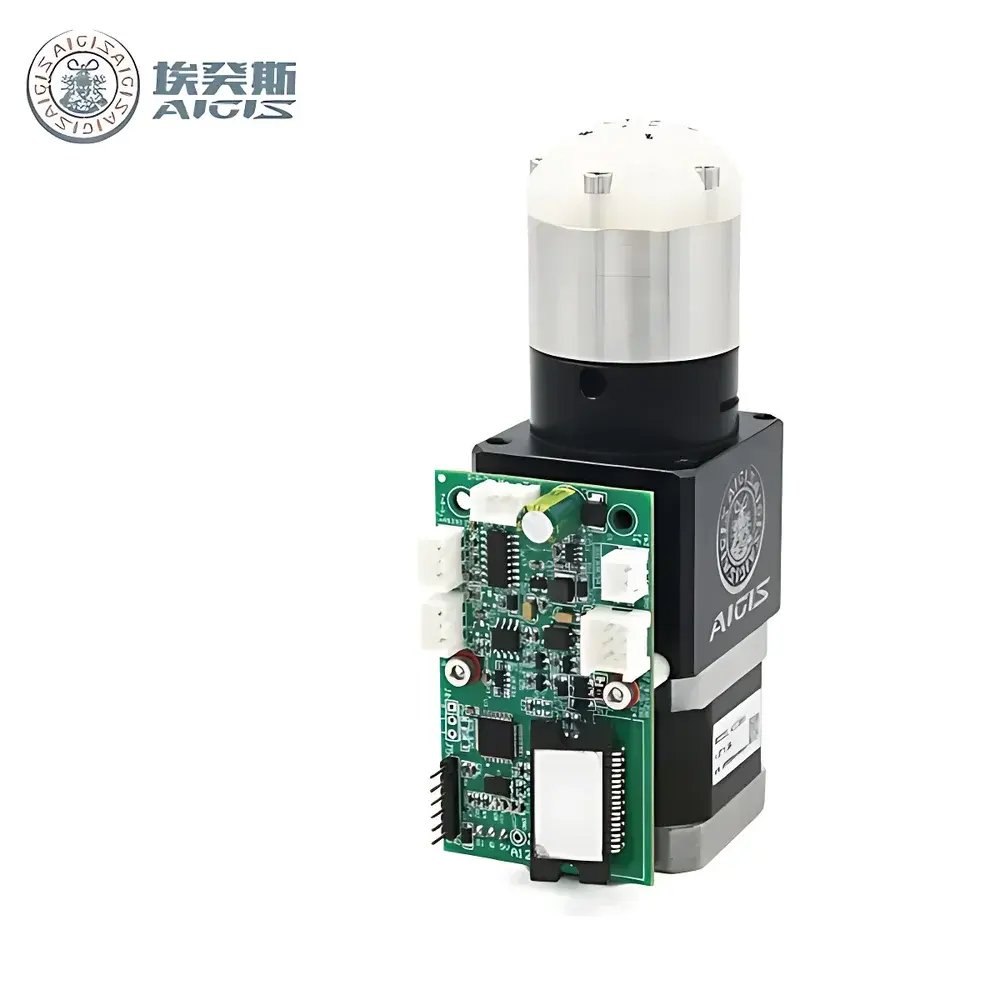
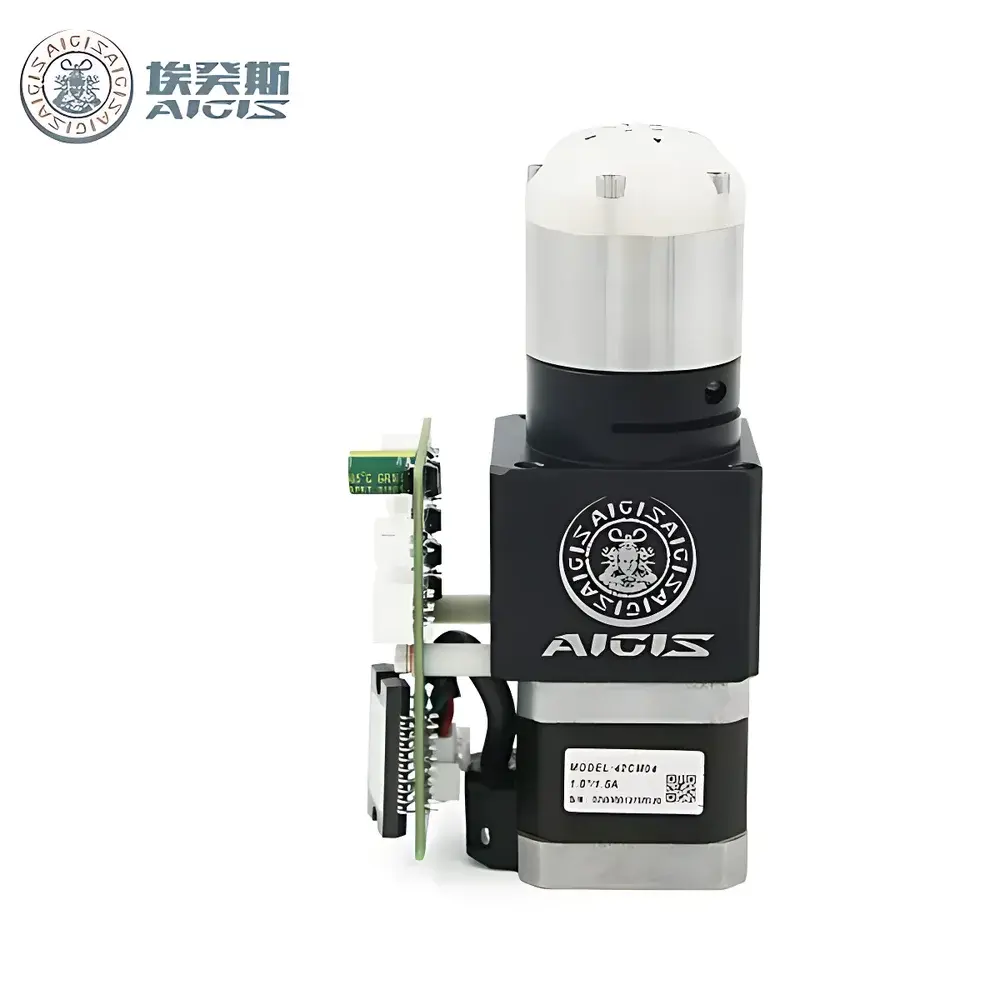
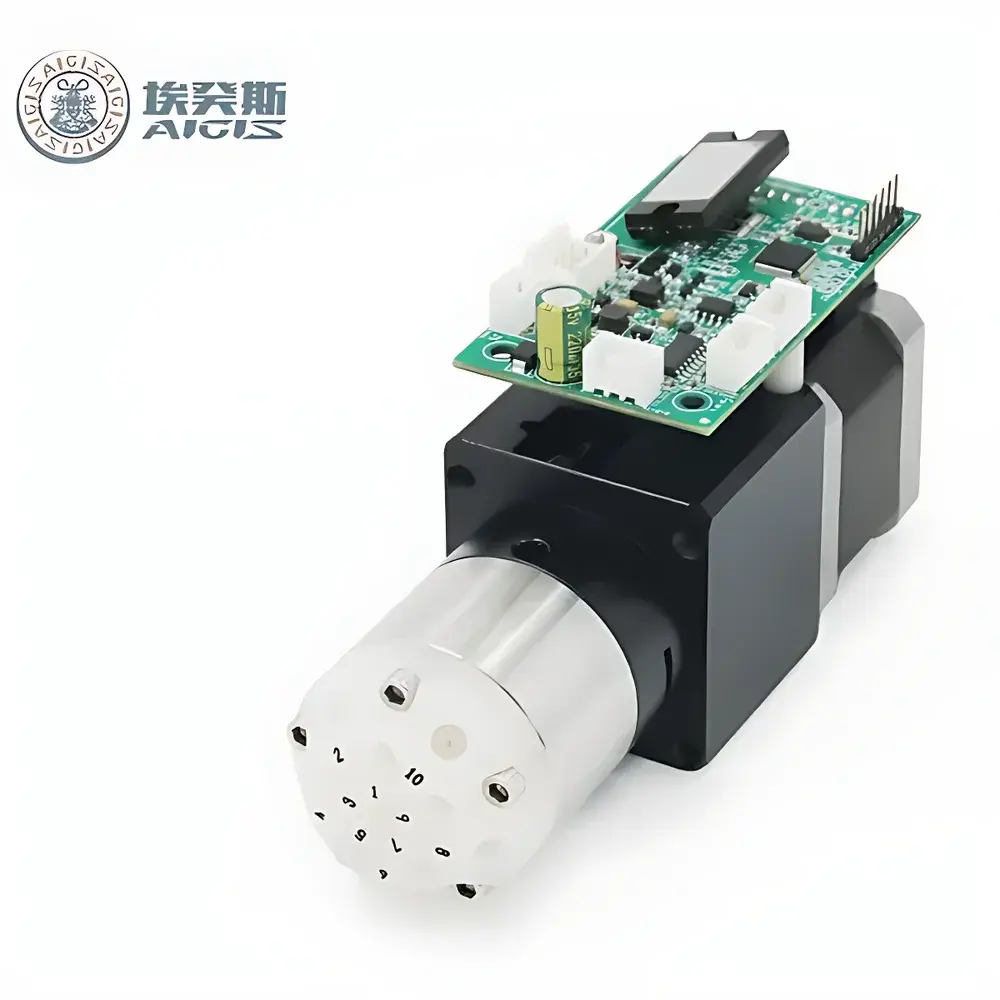
AIGIS Multi-Channel Rotary Selector Valve for Online Water Quality Monitoring
| Brand | AIGIS |
|---|---|
| Model | Multi-Channel Rotary Selector Valve for Online Water Quality Monitoring |
| Flow Path Options | 3/4/6/8/10, 12/16, 24/28/32 channels |
| Port Bore Diameter | 0.6 / 0.75 / 1.0 / 1.5 / 2.0 / 3.0 mm (standard) |
| Threaded Port Specifications | 1/4-28 UNF female, 10-32 UNF female, 6-40 UNF female |
| Rotor Groove Volume | 1.27–5.24 µL |
| Wetted Materials | Ceramic, PEEK, PPS, PCTFE, PVDF, PTFE, N60 (polyamide-imide), SUS316L |
| Max. Operating Pressure | 1.6 MPa (liquid), 0.5 MPa (gas) |
| Fluid Temperature Range | 0–85 °C |
| Rotor/Stator Cycle Life | ≥1,000,000 cycles |
| Actuation Time | ≤4 s per full rotation |
| Power Supply | 12–24 VDC |
| Peak Driving Torque | 2.5 N·m |
| Communication Interfaces | RS232, RS485 |
| Home Position Detection | Auto-initialization on power-up |
| Ambient Operating Temperature | 0–60 °C |
| Ambient Humidity | ≤95% RH, non-condensing |
Overview
The AIGIS Multi-Channel Rotary Selector Valve is an engineered fluidic switching solution designed specifically for integration into automated online water quality monitoring systems—particularly those performing sequential analysis of total phosphorus (TP), total nitrogen (TN), orthophosphate, nitrate, nitrite, ammonium, and other regulated parameters in municipal wastewater, surface water, drinking water distribution networks, and industrial effluent streams. Based on precision-machined rotary valve architecture, it operates via a motor-driven ceramic or high-performance polymer rotor rotating against a matched stator to selectively route liquid samples and reagents through discrete flow paths without cross-contamination. Its design adheres to fundamental principles of low-dead-volume fluid handling, minimal carryover (<0.05%), and repeatable port-to-port alignment—critical for maintaining analytical integrity in unattended, long-term deployments compliant with ISO 5667-3, EPA Method 365.4, and ASTM D515/D129.
Key Features
- Modular channel configuration supporting 3 to 32 independent flow paths—enabling flexible system scalability from compact benchtop analyzers to multi-parameter central monitoring stations.
- Multiple bore diameter options (0.5–3.0 mm) optimized for varying flow rate requirements: micro-bore (0.5 mm) for low-volume colorimetric assays; standard bores (0.6–1.5 mm) for mainstream TP/TN digestion and detection modules; large-bore (2.0–3.0 mm) for high-flow calibration standards delivery or bypass loops.
- Chemically inert wetted materials including alumina ceramic, PEEK, PVDF, and electropolished SUS316L—ensuring compatibility with aggressive reagents such as potassium persulfate, sodium hydroxide, sulfuric acid, and acidic molybdate solutions used in TN/TP digestion protocols.
- Robust mechanical lifetime rating of ≥1 million actuation cycles under nominal load—validated per IEC 60068-2 environmental stress testing protocols—supporting >2 years of continuous operation in 24/7 monitoring applications.
- Integrated position-sensing logic with auto-home initialization on power-up, eliminating the need for external homing sensors and reducing system wiring complexity and failure points.
- Low-torque, high-reliability stepper motor drive delivering precise angular positioning (±0.1° repeatability) and consistent 4-second full-rotation performance across ambient temperatures from 0–60 °C.
Sample Compatibility & Compliance
This selector valve is validated for use with aqueous matrices containing suspended solids <100 mg/L (TSS), turbidity <500 NTU, and chloride concentrations up to 5,000 mg/L. It meets material compatibility requirements specified in USP <661.1> for polymeric components and conforms to RoHS Directive 2011/65/EU and REACH Annex XVII restrictions. When integrated into complete analyzers, the valve supports compliance with regulatory data integrity expectations outlined in FDA 21 CFR Part 11 (via audit-trail-capable host software), ISO/IEC 17025:2017 (for accredited laboratories), and EU Water Framework Directive (2000/60/EC) monitoring program specifications. Its sealed construction achieves IP65-rated ingress protection when mounted per manufacturer installation guidelines.
Software & Data Management
The valve communicates via industry-standard RS232 and RS485 serial interfaces using ASCII-based command protocol (e.g., “SEL 05” to select Channel 5; “POS?” to query current position). It supports Modbus RTU over RS485 for seamless integration with PLC-controlled monitoring platforms and SCADA systems. Host software must implement timeout handling, checksum verification, and retry logic to ensure deterministic state transitions. Firmware versioning and diagnostic registers (e.g., cycle count, error flags, temperature status) are accessible via serial query—enabling predictive maintenance scheduling and remote health monitoring. No embedded web server or cloud connectivity is provided; all control and logging reside within the host analyzer’s validated software environment.
Applications
- Automated sequential injection analysis (SIA) for TP/TN determination in real-time wastewater influent/effluent monitoring.
- Multi-stream sampling from distributed sensor nodes feeding centralized analyzers in reservoir or river basin management systems.
- Reagent selection and calibration standard routing in UV-Vis spectrophotometric analyzers complying with ISO 15681-2.
- Flow path multiplexing in hybrid systems combining ion chromatography (IC) and colorimetry for comprehensive nutrient speciation.
- Onboard valving in autonomous buoy-based platforms requiring low-power, high-reliability fluidic switching under variable thermal and vibration conditions.
FAQ
What is the maximum allowable backpressure during reagent aspiration?
The valve is rated for continuous operation at ≤1.6 MPa (232 psi) for liquids; however, for aspiration scenarios involving vacuum-assisted draw, maintain differential pressure across the valve <0.3 MPa to prevent seal extrusion or rotor deformation.
Can this valve be cleaned in place (CIP) using hot caustic solution?
Yes—PEEK, PVDF, and ceramic components withstand 0.5 M NaOH at 60 °C for ≤30 min per cleaning cycle. Avoid prolonged exposure to >70 °C alkaline solutions or oxidizing agents like sodium hypochlorite above 500 ppm.
Is positional feedback available beyond the home signal?
No—this is an open-loop stepper-driven valve. Absolute position is inferred from step count; no encoder or Hall-effect feedback is integrated. System-level validation of port alignment must be performed during analyzer commissioning.
Does the valve support fail-safe positioning on power loss?
No—rotor position is not retained during power interruption. Upon restart, the auto-home routine executes, establishing a known reference point before resuming scheduled operations.







