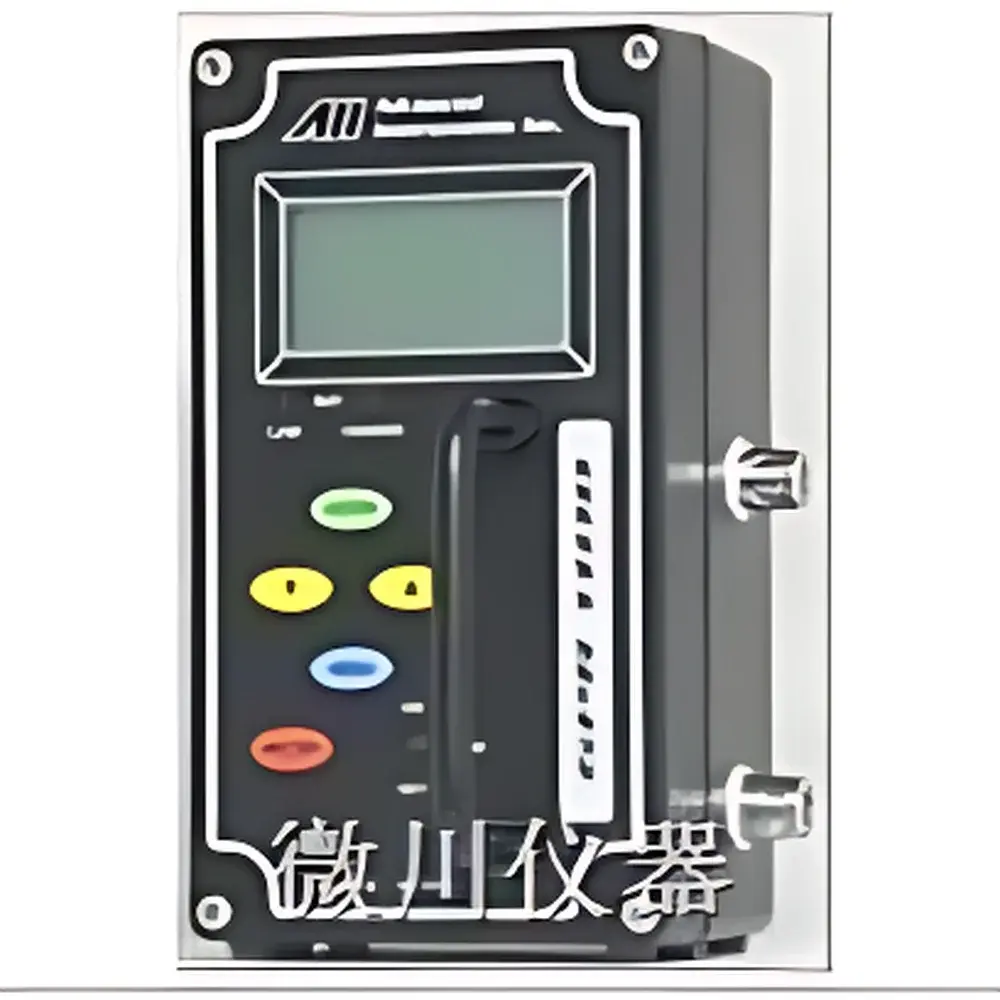
AII GPR-1100 Portable Oxygen Analyzer
| Brand | AII |
|---|---|
| Origin | USA |
| Model | GPR-1100 |
| Measurement Principle | Electrochemical Fuel Cell |
| Range Options | 0–10 / 0–100 / 0–1000 ppm, 0–1% / 0–25% FS |
| Accuracy | <1% FS |
| Linearity | >0.995 |
| Response Time (t₉₀) | 10 s |
| Recovery Time to 10 ppm | ≤60 s |
| Sensitivity Drift | <0.5% FS |
| Temperature Compensation | Built-in |
| Operating Temp | 5–45 °C |
| Sample Flow Rate | 0.25–2.5 L/min (recommended: 1 L/min) |
| Inlet Pressure | 5–30 psig |
| Outlet Pressure | Ambient |
| Display Resolution | 0.01 ppm |
| Output Signal | 0–1 VDC |
| Enclosure Rating | NEMA 4X (aluminum-clad) |
| Dimensions | 102 × 229 × 76 mm |
| Weight | 3.5 kg |
| Certifications | CE, ISO 9001, Class I, Division 1, Groups A–D (intrinsically safe) |
Overview
The AII GPR-1100 Portable Oxygen Analyzer is a field-deployable, electrochemical fuel cell–based instrument engineered for high-precision trace and percent-level oxygen measurement in demanding industrial gas streams. Unlike paramagnetic or zirconia-based analyzers, the GPR-1100 employs a solid polymer electrolyte (SPE) fuel cell sensor—specifically the GPR-12-333—that delivers stable, zero-drift performance without consumable reagents or periodic electrolyte replacement. Its measurement principle relies on the electrochemical oxidation of oxygen at the cathode, generating a current linearly proportional to O₂ partial pressure. This architecture ensures inherent selectivity against CO₂, H₂O vapor, and most hydrocarbons—critical when analyzing inert purge gases (e.g., Ar, N₂), hydrogen reformate, helium carrier streams, or mixed process gases containing up to 25% CO₂ (when equipped with the optional XLT-12-333 sensor). The analyzer operates across five factory-configurable ranges spanning 0–10 ppm to 0–25% FS, enabling consistent calibration traceability under varying background compositions.
Key Features
- Intrinsically safe design certified for Class I, Division 1, Groups A–D hazardous locations—enabling direct use in petrochemical, semiconductor, and pharmaceutical manufacturing environments.
- GPR-12-333 fuel cell sensor with true zero-maintenance operation: no liquid electrolyte, no membrane drying, no warm-up delay—functional immediately upon power-on.
- Five programmable measurement ranges (0–10 / 0–100 / 0–1000 ppm; 0–1% / 0–25% FS) selectable via intuitive menu-driven interface with waterproof tactile keys.
- Integrated temperature compensation and real-time ambient temperature/pressure display—ensuring accurate partial pressure normalization without external transmitters.
- NEMA 4X aluminum-clad enclosure rated for dust-tight, water-jet resistant operation—validated for continuous use in outdoor skids, mobile labs, and confined-space entry applications.
- Onboard rechargeable battery supporting up to 60 days standby or 24 hours of continuous sampling (with internal pump active), eliminating dependency on field power sources.
Sample Compatibility & Compliance
The GPR-1100 is validated for analysis of non-corrosive and mildly acidic gas matrices including nitrogen, argon, helium, hydrogen, natural gas blends, and CO₂-rich streams (≤25% CO₂). For applications exceeding 0.5% CO₂, the XLT-12-333 sensor variant is required to maintain long-term stability and avoid carbonate-induced electrode passivation. All wetted parts—including sample inlet, bypass manifold, and sensor housing—are constructed from electropolished 316 stainless steel, compliant with ASTM F86 surface finish standards for ultra-high-purity gas systems. The analyzer meets CE marking requirements per Directive 2014/34/EU (ATEX) and 2014/30/EU (EMC), and its quality management system is certified to ISO 9001:2015. It supports GLP-compliant operation through timestamped calibration logs and user-accessible firmware revision tracking.
Software & Data Management
While the GPR-1100 operates as a standalone instrument with no PC dependency, its 0–1 VDC analog output is compatible with distributed control systems (DCS), SCADA platforms, and data loggers adhering to ISA-50.00.01 signal standards. Internal memory stores up to 1,000 timestamped readings (date/time, O₂ concentration, temperature, pressure) accessible via USB-C port using AII’s proprietary configuration utility. The utility enables firmware updates, sensor diagnostics (including impedance sweep verification), and export of CSV-formatted reports suitable for FDA 21 CFR Part 11–aligned audit trails when paired with validated third-party logging software. No cloud connectivity or remote telemetry is embedded—preserving data sovereignty in regulated facilities.
Applications
- Verification of inert gas purity during blanketing operations in chemical reactors and storage tanks.
- Monitoring residual O₂ in hydrogen fuel cell feed streams to prevent catalyst poisoning.
- Leak detection in vacuum furnace atmospheres (Ar/N₂/H₂ mixtures) prior to heat treatment cycles.
- Quality assurance of modified atmosphere packaging (MAP) gas blends in food processing lines.
- Field validation of oxygen scrubber efficiency in semiconductor fab nitrogen delivery networks.
- Emergency response screening for O₂ deficiency/enrichment in confined spaces per OSHA 1910.146 protocols.
FAQ
What sensor technology does the GPR-1100 use, and how does it differ from paramagnetic analyzers?
It uses a solid polymer electrolyte (SPE) electrochemical fuel cell—offering superior specificity for O₂ in complex gas matrices, lower power consumption, and no moving parts, unlike paramagnetic instruments requiring magnetic field stabilization and frequent zero calibration.
Can the GPR-1100 measure oxygen in 100% CO₂ streams?
No—the standard GPR-12-333 sensor is limited to ≤0.5% CO₂. For higher CO₂ concentrations, the XLT-12-333 sensor must be installed, which incorporates a CO₂-tolerant catalyst layer and acid-resistant membrane formulation.
Is the 0–1 VDC output isolated and calibrated to NIST-traceable standards?
Yes—the analog output is galvanically isolated and factory-calibrated against NIST-traceable gas standards (±0.1% O₂ in N₂) with documented uncertainty budgets available upon request.
Does the instrument support automatic span calibration with external gas cylinders?
No—it requires manual span adjustment using certified calibration gas; however, the firmware retains last-calibration date, gas concentration, and operator ID for audit readiness.
What is the recommended maintenance interval for the GPR-12-333 sensor?
None—AII specifies “zero scheduled maintenance” for the sensor under normal operating conditions (5–45 °C, non-condensing humidity, ≤30 psig inlet pressure); lifetime exceeds 24 months in typical industrial service.