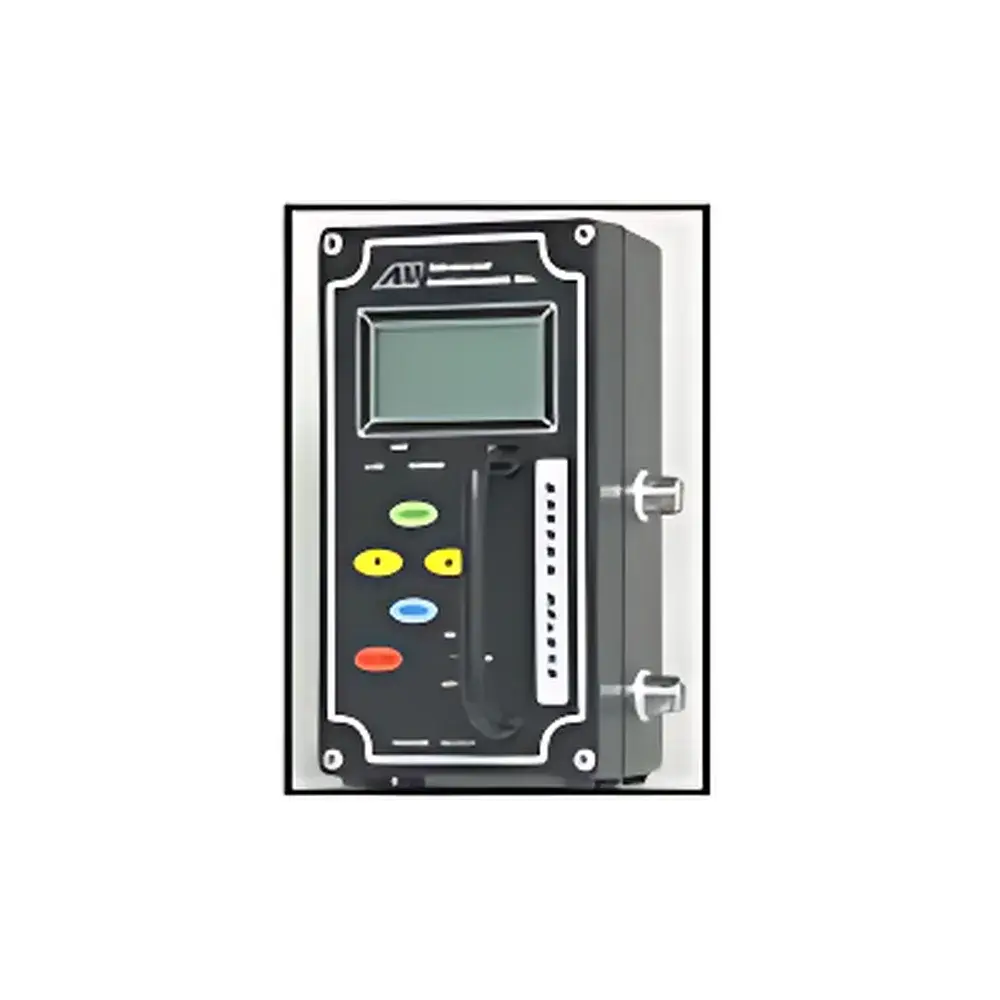
AII GPR-1100 Portable Trace Oxygen Analyzer
| Brand | AII |
|---|---|
| Origin | USA |
| Model | GPR-1100 |
| Measurement Principle | Electrochemical Fuel Cell |
| Range | 0–10 / 100 / 1000 ppm, 0–1% / 25% FS |
| Accuracy | <1% FS |
| Linearity | >0.995 |
| Sensitivity | <0.5% FS |
| Response Time (T90) | 10 s |
| Recovery Time to 10 ppm | 60 s |
| Operating Temperature | GPR Sensor: 5–45°C |
| XLT Sensor | –20–+45°C |
| Sample Pressure | Inlet 5–30 psig, Outlet atmospheric |
| Flow Rate | 0.5–5 SCFH (recommended: 2 SCFH) |
| Temperature Compensation | Built-in |
| Display Resolution | 0.01 ppm |
| Output Signal | 0–1 VDC |
| Enclosure Rating | NEMA 4X aluminum housing |
| Hazardous Area Rating | Class I, Division 1, Groups A–D |
| Calibration Gas Recommendation | 80% FS O₂ standard |
| Power | Rechargeable battery (60-day standby |
| Interface | Waterproof membrane keypad, menu-driven configuration |
| Connectivity | 1/8" quick-connect gas fitting |
| Compliance | CE-marked, ISO 9001 certified |
| Optional Sensor | XLT-12-333 (for CO₂ >0.5% applications) |
| Accessories | Carrying case, sampling conditioning kits |
Overview
The AII GPR-1100 Portable Trace Oxygen Analyzer is an intrinsically safe, field-deployable electrochemical instrument engineered for high-reliability quantification of trace oxygen concentrations in inert, reducing, and acidic process gas streams. Utilizing a solid-polymer electrolyte fuel cell sensor, the GPR-1100 delivers stable, drift-free measurements without consumable reagents or periodic electrolyte refills—enabling true maintenance-free operation over its specified 24-month sensor lifetime. Its measurement architecture is optimized for applications where oxygen contamination must be monitored at sub-ppm levels in ultra-high-purity gases such as nitrogen, argon, helium, hydrogen, and CO₂-rich mixtures. The analyzer operates on the principle of galvanic oxygen reduction at the cathode, generating a current linearly proportional to partial pressure of O₂—ensuring inherent accuracy and repeatability across five factory-configured ranges. Designed for compliance with industrial safety and quality management frameworks, the GPR-1100 meets Class I, Division 1, Groups A–D hazardous location requirements and carries CE marking for use in EU markets under applicable directives.
Key Features
- Intrinsically safe design certified for Class I, Division 1, Groups A–D environments—suitable for deployment in petrochemical, semiconductor, and pharmaceutical manufacturing zones.
- Fuel cell sensor (GPR-12-333) with 24-month service life and zero routine maintenance—eliminates calibration drift associated with zirconia or paramagnetic technologies.
- Five user-selectable measurement ranges (0–10 ppm, 0–100 ppm, 0–1000 ppm, 0–1% FS, 0–25% FS) via intuitive waterproof keypad interface.
- Integrated temperature and pressure compensation ensures measurement integrity across variable ambient and process conditions.
- NEMA 4X aluminum enclosure with IP66-rated ingress protection—resistant to dust, water jets, and corrosive atmospheres.
- Real-time display of O₂ concentration (0.01 ppm resolution), ambient temperature, and barometric pressure—supporting manual correction if required.
- Internal sample pump (optional activation) enables active draw sampling at 2 SCFH nominal flow, with full-scale response achieved in ≤10 seconds (T90).
- Battery-powered operation with 60-day shelf life in standby mode; operational runtime extends to 24 hours when configured without pump.
Sample Compatibility & Compliance
The GPR-1100 is validated for continuous analysis of oxygen in inert carrier gases (N₂, Ar), reducing atmospheres (H₂), noble gases (He), and CO₂-containing streams—including applications where CO₂ exceeds 0.5% (via optional XLT-12-333 sensor). It exhibits minimal cross-sensitivity to CO, CH₄, SO₂, and NOₓ under typical industrial concentrations. The analyzer complies with ISO 9001:2015 quality system requirements and bears CE marking per Directive 2014/34/EU (ATEX) and 2014/30/EU (EMC). While not explicitly 21 CFR Part 11–compliant due to lack of audit-trail software, its hardware-based calibration protocol—requiring documented use of NIST-traceable 80% FS O₂ standard gas—supports GLP and GMP-aligned validation protocols when integrated into controlled laboratory or QC workflows.
Software & Data Management
The GPR-1100 operates as a standalone field instrument with no embedded firmware-based data logging or PC connectivity. All configuration—including range selection, zero/span calibration, and unit preference—is executed locally via the membrane keypad and LCD interface. Calibration events are not timestamped or stored internally; users are expected to maintain external logbooks per ISO/IEC 17025 or internal QA procedures. For integration into centralized monitoring systems, the 0–1 VDC analog output provides a linear, isolated signal compatible with PLCs, DCS inputs, or third-party data acquisition hardware. No proprietary drivers or software installation is required for analog interfacing.
Applications
- Monitoring residual O₂ in high-purity nitrogen blanketing systems for reactor purging and storage tank inerting.
- Verifying oxygen exclusion in semiconductor fabrication gloveboxes and annealing furnaces.
- Leak detection and integrity verification of vacuum chambers and sealed packaging lines.
- Quality assurance testing of medical-grade helium and respiratory gas mixtures per ISO 8573-1 purity classes.
- Process control in hydrogen production and purification units where O₂ ingress poses explosion risk.
- Validation of CO₂ laser gas mixtures and specialty welding shielding gases.
FAQ
What is the recommended calibration frequency?
AII recommends quarterly calibration using a NIST-traceable 80% FS O₂ standard gas, or more frequently if exposed to extreme thermal cycling or aggressive sample matrices.
Can the GPR-1100 measure oxygen in 100% CO₂?
Yes—but only when equipped with the optional XLT-12-333 sensor, which mitigates CO₂-induced signal suppression observed with the standard GPR-12-333 element.
Is the internal pump always active?
No—the pump operates only when enabled via menu setting and draws sample at ~2 SCFH; passive diffusion sampling is supported at lower flow rates (0.5–1 SCFH) when pump is disabled.
Does the instrument require warm-up time before measurement?
The fuel cell sensor achieves operational stability within 60 seconds of power-on; no extended stabilization period is necessary.
How is zero calibration performed?
Zero calibration requires exposure to certified oxygen-free gas (e.g., 99.999% N₂); the analyzer does not support electronic zero offset adjustment without physical zero-gas introduction.
Related Products