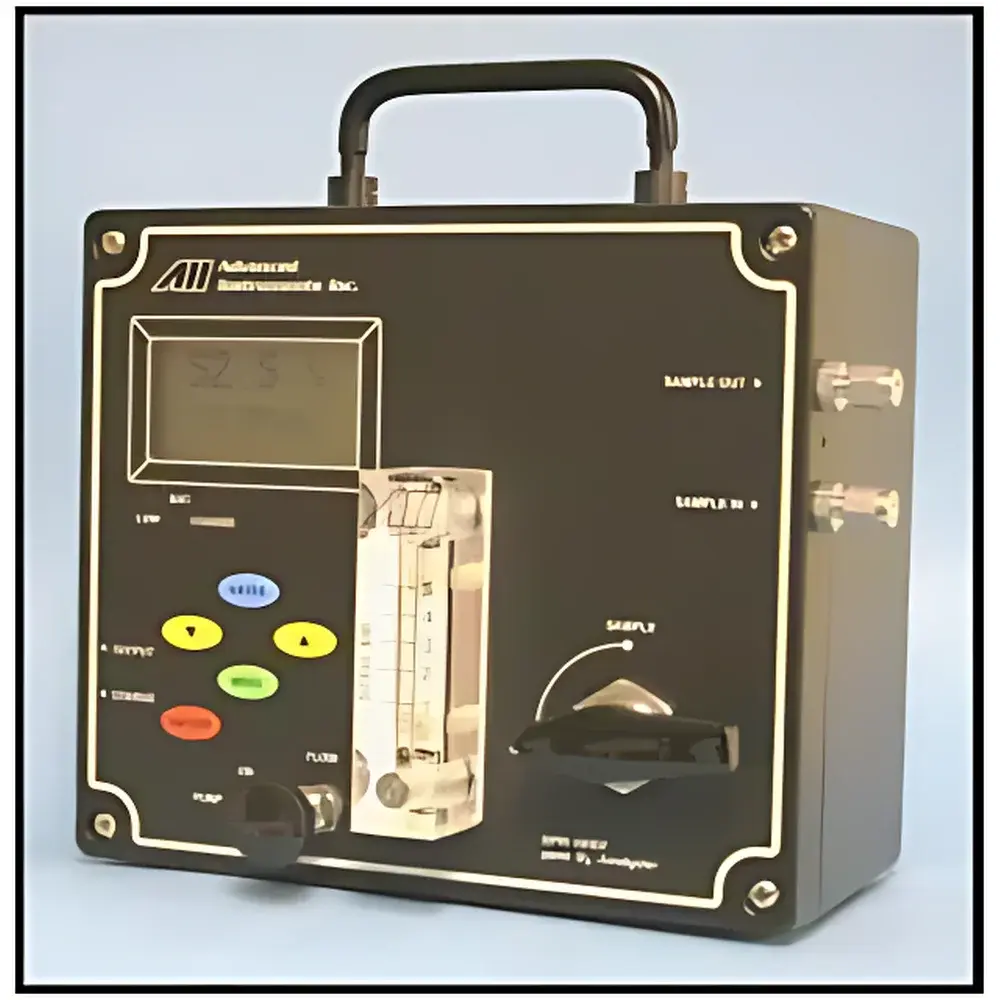
AII GPR-1200 Portable Trace Oxygen Analyzer
| Brand | AII |
|---|---|
| Origin | USA |
| Model | GPR-1200 |
| Measurement Principle | Electrochemical Fuel Cell |
| Range | 0–10 / 100 / 1000 ppm, 0–1% / 25% FS |
| Accuracy | <1% FS |
| Linearity | >0.995 |
| Sensitivity | <0.5% FS |
| Response Time (T90) | 10 s |
| Recovery Time to 10 ppm | 60 s |
| Operating Temperature | GPR Sensor: 5–45°C |
| XLT Sensor | –20–+45°C |
| Sample Gas Compatibility | Inert gases, He, H₂, mixed gases, CO₂-containing acidic gases |
| Pressure Range | Inlet 5–30 psig, Outlet atmospheric |
| Flow Rate | 1–5 SCFH (recommended 2 SCFH) |
| Temperature Compensation | Built-in |
| Display Resolution | 0.01 ppm |
| Output Signal | 0–1 VDC |
| Enclosure Rating | NEMA 4X aluminum-coated |
| Hazardous Area Classification | Class I, Division 1, Groups A–D |
| Calibration Gas | 80% FS O₂ standard gas recommended |
| Power | Rechargeable battery (60-day standby |
| Interface | Waterproof membrane keypad, menu-driven configuration |
| Indicators | Low-battery LED, charging-mode LED |
| Optional Sensors | XLT-12-333 (for CO₂ >0.5% applications) |
| Optional Accessories | Integral sampling pump (intrinsically safe design), carry case, flow control valve, sample/bypass selector valve, rotameter |
Overview
The AII GPR-1200 Portable Trace Oxygen Analyzer is an intrinsically safe, field-deployable electrochemical analyzer engineered for high-precision measurement of trace oxygen concentrations in demanding industrial process and laboratory environments. Utilizing a proprietary long-life fuel cell sensor (GPR-12-333), the instrument delivers stable, drift-free performance without routine maintenance or electrolyte replenishment—validated for continuous operation up to 24 months under typical conditions. Its core measurement principle relies on the electrochemical reduction of molecular oxygen at a catalytic cathode, generating a current linearly proportional to O₂ partial pressure across five user-selectable full-scale ranges (0–10 ppm to 0–25% FS). Designed for rigorous compliance with hazardous location requirements, the GPR-1200 meets Class I, Division 1, Groups A–D certification per UL 913 and CSA C22.2 No. 157, enabling safe deployment in petrochemical refineries, semiconductor purge lines, hydrogen production facilities, and inerted storage vessels where explosive atmospheres may be present.
Key Features
- Intrinsically safe architecture certified for Class I, Div. 1, Groups A–D environments—no external barriers required
- Fuel cell sensor technology with zero-maintenance design and 24-month operational lifespan under normal use
- Five factory-calibrated measurement ranges: 0–10 ppm, 0–100 ppm, 0–1000 ppm, 0–1% FS, and 0–25% FS—switchable via intuitive waterproof keypad
- Integrated temperature compensation and real-time ambient temperature/pressure display for accurate partial pressure correction
- NEMA 4X aluminum-coated enclosure providing dust-tight, corrosion-resistant, and hose-directed water protection
- Onboard flow control valve, sample/bypass selector, and calibrated rotameter for consistent 2 SCFH sample delivery
- Rechargeable lithium-ion battery supporting 60 days of standby monitoring or 24 hours of continuous operation with optional integral pump
- High-resolution LCD display with 0.01 ppm readability and dual-channel analog output (0–1 VDC)
Sample Compatibility & Compliance
The GPR-1200 is validated for quantitative oxygen analysis in non-corrosive and mildly acidic gas matrices—including nitrogen, argon, helium, hydrogen, synthetic air mixtures, and CO₂-rich streams (with optional XLT-12-333 sensor). It operates reliably within inlet pressure ranges of 5–30 psig and tolerates transient overpressures without sensor degradation. The analyzer conforms to ISO 9001:2015 quality management standards and bears CE marking for EMC Directive 2014/30/EU and Low Voltage Directive 2014/35/EU. Its intrinsic safety design satisfies IEC 60079-11 and ANSI/ISA-12.12.01 requirements, making it suitable for installation in Zone 0/1 classified areas when used with approved accessories. While not FDA 21 CFR Part 11–compliant by default (as a standalone field instrument), audit-ready calibration logs and timestamped zero/span records can be manually documented per GLP/GMP-aligned procedures.
Software & Data Management
The GPR-1200 operates as a self-contained, embedded-system analyzer with no host PC dependency. All configuration—including range selection, calibration initiation, and system diagnostics—is executed via its menu-driven interface. Though it lacks Bluetooth or USB connectivity, the 0–1 VDC analog output supports integration into distributed control systems (DCS), programmable logic controllers (PLCs), or third-party data loggers compliant with 4–20 mA or voltage-input protocols. Calibration events are logged internally with date/time stamps and reference gas concentration values; users maintain traceability through printed calibration certificates aligned with ISO/IEC 17025 practices. Firmware updates are performed via proprietary service tools accessible only to authorized AII technical support personnel.
Applications
- Monitoring residual oxygen in high-purity nitrogen or argon blanketing systems for pharmaceutical reactors and API synthesis vessels
- Leak detection and integrity verification of inerted cargo tanks and railcars transporting flammable liquids
- Quality assurance of ultra-high-purity hydrogen feedstock in PEM electrolyzer and fuel cell manufacturing lines
- Process validation of glovebox atmospheres in lithium-ion battery dry rooms (ISO 14644 Class 5–7 environments)
- Verification of deoxygenation efficacy in food packaging headspace (N₂/CO₂ mixtures) prior to sealing
- Field verification of oxygen scavenger performance in closed-loop transformer oil regeneration systems
FAQ
What is the recommended calibration frequency?
AII recommends quarterly calibration using a certified 80% FS oxygen standard gas (e.g., 20% O₂ in N₂), or more frequently if exposed to high-oxygen excursions or condensing moisture.
Can the GPR-1200 measure oxygen in 100% CO₂ streams?
Standard GPR-12-333 sensors exhibit cross-sensitivity above 0.5% CO₂; for such applications, the XLT-12-333 sensor variant must be specified at time of order.
Is the integral sampling pump certified for Class I, Div. 1 use?
Yes—the optional pump module is fully integrated into the intrinsic safety loop and carries identical UL/CSA hazardous location certifications as the base unit.
Does the instrument require warm-up time before measurement?
No stabilization period is needed; the fuel cell responds within 10 seconds (T90) and achieves ±10 ppm recovery in ≤60 seconds after exposure to ambient air.
How is sensor lifetime verified?
Sensor health is assessed via built-in diagnostic routines that monitor baseline current, slope linearity (>0.995), and response consistency—results accessible via service mode and logged during each calibration event.