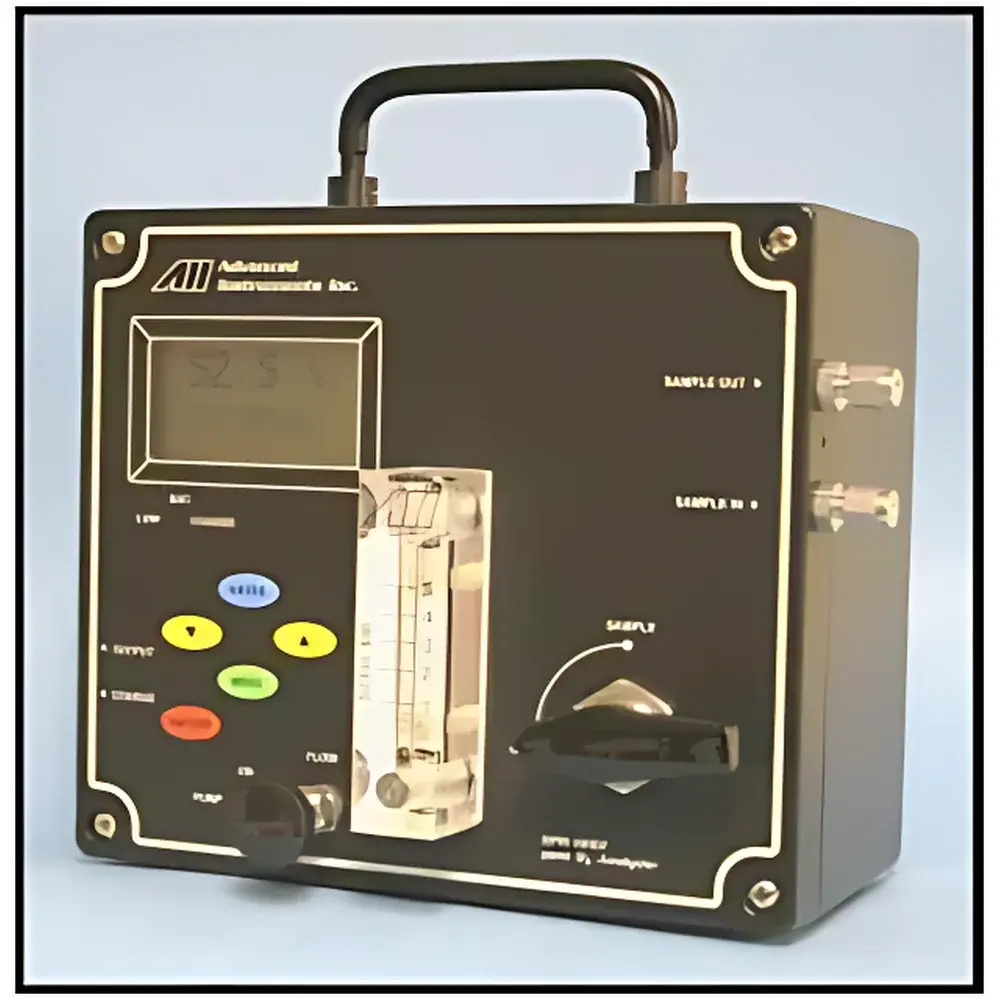
AII GPR-1200 Trace Oxygen Analyzer
| Brand | AII |
|---|---|
| Origin | USA |
| Model | GPR-1200 |
| Measurement Range | 0–10 ppm / 0–100 ppm / 0–1,000 ppm / 0–1% / 0–25% O₂ (user-selectable) |
| Accuracy | < ±1% of full scale |
| Detection Limit | 100 ppb |
| Sensor Type | Electrochemical (GPR-12-333 or optional XLT-12-333) |
| Sensor Lifetime | 24 months at 25°C with average O₂ < 1000 ppm |
| Response Time (t₉₀) | 10 seconds |
| Recovery Time to 10 ppm after air exposure | 60 min |
| Operating Temperature | 5–45°C (GPR sensor), –20–45°C (XLT sensor) |
| Sample Flow Rate | 0.25–2.5 L/min (recommended: 1 L/min) |
| Inlet Pressure | 5–30 psig |
| Exhaust | ambient |
| Display | 2.75″ × 1.375″ LCD, 0.01 ppm resolution |
| Enclosure | NEMA 4X, 8.6″ × 9″ × 3″, 12 lbs |
| Power | Rechargeable battery (60 days standby, 1 day with pump active) |
| Output Signal | 0–1 V analog |
| Certifications | CE, ATEX/IECEx certified for intrinsic safety (Class I, Div. 1, Groups A, B, C, D) |
| Sample Wetted Materials | 316 stainless steel |
| Linear Correlation Coefficient | >0.995 across all ranges |
| Temperature & Pressure Compensation | Yes |
| Interface | 1/8″ compression fitting |
| Controls | Range selector switch, waterproof keypad, calibration/system function keys |
| Status Indicators | LED for low battery and charging mode |
| Optional Accessories | XLT-12-333 low-temp sensor, integrated sample pump (general-purpose or intrinsically safe), carrying case, inlet particulate filter |
Overview
The AII GPR-1200 Trace Oxygen Analyzer is a field-deployable, intrinsically safe electrochemical analyzer engineered for continuous, high-stability measurement of oxygen concentrations in inert, reducing, and non-corrosive process gas streams. It operates on the principle of galvanic electrochemical sensing—where molecular oxygen diffuses through a selective membrane and undergoes a stoichiometric reduction reaction at a noble metal cathode, generating a current linearly proportional to partial pressure. This architecture eliminates the need for external power to drive the sensing reaction, ensuring inherent safety and long-term baseline stability. Designed specifically for applications demanding sub-ppm detection in environments where explosion hazards exist—such as semiconductor purge lines, hydrogen reforming off-gas, helium blanketing systems, and CO₂ beverage carbonation—the GPR-1200 delivers trace-level accuracy without catalytic interference or thermal drift. Its dual-sensor compatibility (standard GPR-12-333 and extended-range XLT-12-333) enables reliable operation from cryogenic to ambient temperature conditions while maintaining compliance with Class I, Div. 1 hazardous area requirements per NEC and IEC 60079 standards.
Key Features
- Intrinsically safe design certified to ATEX/IECEx Directive 2014/34/EU and UL 913 for Class I, Division 1, Groups A, B, C, D—enabling direct installation in Zone 0/1 hazardous locations without additional barriers.
- User-selectable measurement ranges spanning five decades: 0–10 ppm, 0–100 ppm, 0–1,000 ppm, 0–1%, and 0–25% O₂—each optimized for signal-to-noise ratio and linearity (>0.995 R²).
- True 0.01 ppm resolution display with simultaneous real-time readout of measured O₂ concentration, internal sensor temperature, and sample pressure—supporting manual compensation verification.
- NEMA 4X-rated aluminum enclosure (8.6″ × 9″ × 3″, 12 lbs) with IP66 ingress protection, suitable for outdoor, washdown, and high-humidity industrial settings.
- Integrated flow control and bypass valve with visual flow indicator—ensuring consistent diffusion-limited sampling and minimizing residence time effects.
- Rechargeable lithium-ion battery providing up to 60 days of maintenance-free standby operation or 24 hours of continuous sampling with built-in pump activation.
- Electrochemical sensor with 24-month nominal service life under typical operating conditions (≤1000 ppm average O₂, 25°C), requiring no periodic electrolyte replenishment or membrane replacement.
Sample Compatibility & Compliance
The GPR-1200 is validated for quantitative oxygen analysis in nitrogen, argon, helium, hydrogen, carbon dioxide, methane, ethane, and other non-acidic, non-oxidizing carrier gases. It is not intended for use with halogenated compounds, sulfur-containing species, or high-humidity samples (>90% RH) without optional desiccant filtration. All wetted surfaces—including sample inlet, sensor housing, and exhaust path—are constructed from electropolished 316 stainless steel to prevent catalytic surface reactions and ensure trace-level integrity. The analyzer conforms to CE marking requirements under the Electromagnetic Compatibility (EMC) Directive 2014/30/EU and Low Voltage Directive 2014/35/EU. Its intrinsic safety certification satisfies ANSI/ISA-12.12.01 and IEC 60079-11 for use in petrochemical, pharmaceutical, and food-grade manufacturing environments subject to FDA 21 CFR Part 11 and EU GMP Annex 1 audit expectations.
Software & Data Management
While the GPR-1200 operates as a standalone, microprocessor-controlled instrument with no embedded PC or network interface, its 0–1 V analog output is fully compatible with industry-standard SCADA, DCS, and PLC systems for centralized data logging and alarm integration. The front-panel keypad supports password-protected calibration routines using certified span gases (≥80% of selected range), with automatic zero stabilization during nitrogen purging. Audit trails—including date/time stamps for each calibration event, range change, and system reset—are retained in non-volatile memory and accessible via serial diagnostics (RS-232 port, optional). For laboratories operating under GLP or GMP frameworks, the device supports documented calibration intervals, operator ID entry, and electronic signature capture when interfaced with compliant LIMS platforms.
Applications
- Monitoring residual O₂ in high-purity inert gas supply lines for semiconductor wafer fabrication and thin-film deposition tools.
- Verification of deoxygenation efficiency in hydrogen production units (PSA, PEM electrolysis) and fuel cell feed gas conditioning.
- Quality assurance of modified atmosphere packaging (MAP) gases used in pharmaceutical blister packaging and sterile medical device sterilization.
- Leak detection and integrity validation of vacuum furnace atmospheres during titanium and superalloy heat treatment.
- Process control of oxygen scavenging in beverage carbonation systems using food-grade CO₂.
- Environmental monitoring of inerted storage tanks containing flammable hydrocarbons or reactive metal powders.
FAQ
What is the minimum detectable oxygen concentration?
The instrument achieves a practical lower limit of detection of 100 ppb across all calibrated ranges, verified per ISO 17025-compliant procedures using NIST-traceable standard gases.
Can the GPR-1200 be used in high-humidity sample streams?
Direct exposure to saturated or condensing moisture will impair sensor response and longevity; an inline sintered stainless-steel particulate filter and optional coalescing dryer are recommended for dew points above –20°C.
Is field calibration possible without external gas cylinders?
Yes—zero calibration is performed using high-purity nitrogen (≥99.999%), and span calibration requires only a single certified reference gas matching the selected range; no multi-point gas standards are necessary.
How does temperature affect measurement accuracy?
The built-in temperature sensor enables automatic compensation within the specified operating envelope; however, rapid ambient shifts (>5°C/min) may induce transient offset until thermal equilibrium is reestablished.
Does the analyzer support Modbus or HART communication protocols?
No—the GPR-1200 provides only isolated 0–1 V analog output; digital protocol integration requires an external signal converter or third-party gateway compatible with 4–20 mA or RS-485 interfaces.
Related Products