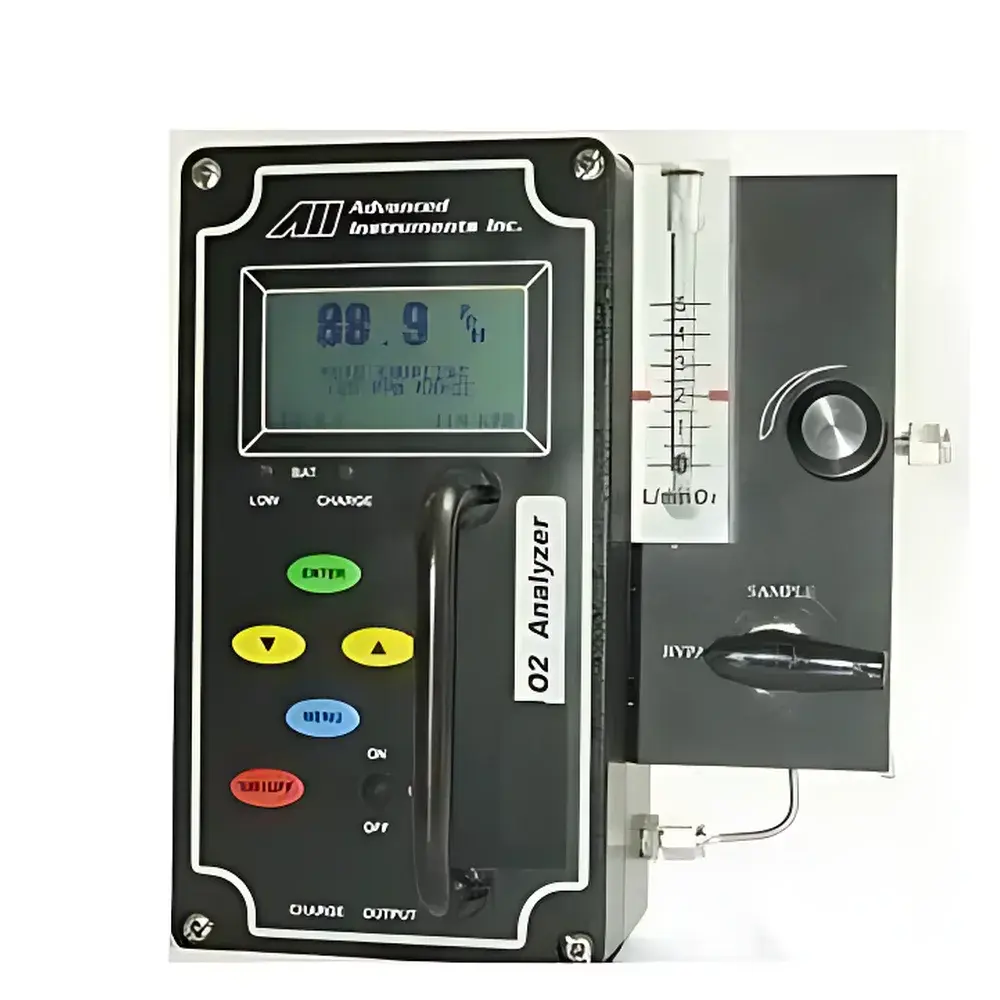
AII GPR-1300 Trace Oxygen Analyzer
| Brand | AII |
|---|---|
| Origin | USA |
| Model | GPR-1300 |
| Measurement Range | 0–10 ppm / 0–100 ppm / 0–1,000 ppm / 0–1% / 0–25% O₂ (user-selectable) |
| Accuracy | < ±1% of full scale |
| Resolution | 0.01 ppm |
| Sensor Type | Electrochemical (GPR-12-333 or optional XLT-12-333) |
| Sensor Lifetime | 24 months @ 25°C, avg. [O₂] < 1000 ppm |
| Response Time (t₉₀) | 10 s |
| Recovery Time to 10 ppm after air exposure | 1 h |
| Sample Flow Rate | 0.25–2.5 L/min (recommended: 1 L/min) |
| Inlet Pressure | 5–30 psig |
| Exhaust | atmospheric vent |
| Operating Temperature | 5–45°C (GPR sensor), –20–45°C (XLT sensor) |
| Enclosure Rating | NEMA 4X |
| Dimensions | 8.6″ × 9″ × 3″ |
| Weight | 12 lbs |
| Power | Rechargeable battery (60 days standby, 1 day with pump active) |
| Output Signal | 0–1 V analog |
| Certifications | CE, ATEX/IECEx-certified intrinsic safety for Class I, Div. 1, Groups A, B, C, D |
| Sample Wetted Materials | 316 stainless steel |
| Calibration | Single-point using certified gas ≥80% of selected range |
| Linearity | >0.995 across all ranges |
| Temperature & Pressure Compensation | Built-in |
| Display | 2.75″ × 1.375″ backlit LCD with real-time temperature/pressure readout |
| User Interface | Waterproof membrane keypad with range selection, calibration, and system function controls |
| Optional Accessories | Integrated sampling pump (general-purpose or intrinsically safe), portable carry case, inlet particulate filter, XLT low-temperature sensor module |
Overview
The AII GPR-1300 Trace Oxygen Analyzer is a field-deployable, intrinsically safe electrochemical analyzer engineered for continuous, high-stability measurement of oxygen concentrations in inert, reducing, and non-corrosive process gases—including nitrogen, argon, helium, hydrogen, carbon dioxide, and hydrocarbon streams. Utilizing AII’s proprietary long-life galvanic fuel cell sensor technology (GPR-12-333 or optional XLT-12-333), the instrument delivers trace-level detection from 100 ppb up to 25% O₂ across five user-selectable ranges. Its measurement principle relies on diffusion-limited electrochemical reduction of molecular oxygen at a noble metal cathode, generating a current linearly proportional to partial pressure—converted internally to concentration via temperature- and pressure-compensated algorithms. Designed for integration into laboratory verification protocols, purge validation systems, semiconductor gas delivery networks, and pharmaceutical inerting processes, the GPR-1300 meets the metrological rigor required for GLP-compliant documentation and ISO 8573-1 purity class verification.
Key Features
- Intrinsically safe construction certified to ATEX/IECEx standards for Class I, Div. 1, Groups A, B, C, D—enabling deployment in hazardous areas without explosion-proof enclosures.
- Five programmable measurement ranges (0–10 ppm, 0–100 ppm, 0–1,000 ppm, 0–1%, 0–25%) selectable via front-panel switch, supporting both ultra-trace and percent-level applications.
- True 0.01 ppm resolution with >0.995 linearity across all spans—validated per ASTM D6348 and ISO 7504 guidelines for trace gas analyzers.
- Integrated temperature and absolute pressure sensing enables real-time compensation, eliminating manual correction factors during ambient or process-condition fluctuations.
- NEMA 4X-rated aluminum enclosure (8.6″ × 9″ × 3″, 12 lbs) with IP66 ingress protection—suitable for outdoor mounting, cleanroom peripheries, or mobile cart integration.
- Rechargeable lithium-ion battery supports 60 days of low-duty-cycle monitoring (pump off) or 24 hours of continuous operation with integrated sample pump enabled.
- Front-panel waterproof keypad and intuitive menu navigation simplify calibration, zero/span verification, and diagnostic access without external software.
Sample Compatibility & Compliance
The GPR-1300 is validated for use with non-condensing, non-acidic, non-solvent-laden gases. Sample contact materials consist exclusively of electropolished 316 stainless steel—compatible with high-purity nitrogen, argon, helium, H₂, CO₂, and saturated hydrocarbon streams (e.g., methane, ethane). It is not intended for use with halogenated compounds, chlorine, ozone, NOₓ, or acidic gases (e.g., SO₂, HCl), which degrade sensor electrolyte integrity. The analyzer complies with CE marking requirements under the EMC and RoHS directives. Its intrinsic safety certification satisfies UL 913 (7th ed.) and IEC 60079-0/11 for Group A (acetylene) through D (propane) atmospheres. For regulated environments, audit-ready calibration logs (including date, operator ID, standard gas lot number, and deviation values) can be manually recorded to support FDA 21 CFR Part 11 alignment when paired with controlled documentation procedures.
Software & Data Management
While the GPR-1300 operates as a stand-alone instrument with no mandatory PC interface, its 0–1 V analog output is compatible with PLCs, DCS systems, and data loggers compliant with IEEE 11073 or Modbus RTU protocols (via optional signal conditioner). The built-in LCD displays real-time O₂ concentration, measured temperature, absolute pressure, battery status, and sensor health indicators—including low-voltage warning and charging mode confirmation. Calibration events are timestamped and retained in non-volatile memory for up to 100 cycles. Though no embedded firmware-based audit trail is present, the device supports GLP-aligned workflows when used with externally validated logbooks or LIMS-integrated calibration management platforms. No cloud connectivity or proprietary drivers are required—ensuring long-term operational continuity without vendor lock-in.
Applications
- Verification of inert gas purity in semiconductor fab tool purges (meeting SEMI F57-0218 specifications for <1 ppm O₂ in N₂/Ar).
- Monitoring residual oxygen in pharmaceutical nitrogen blanketing systems prior to lyophilization or API handling (per USP and EU Annex 1).
- Leak detection in vacuum furnace backfill lines by trending sub-ppm O₂ excursions during thermal cycling.
- Quality assurance of high-purity helium used in GC carrier gas systems—ensuring baseline stability and column longevity.
- Hydrogen stream certification for fuel cell feedstock (ISO 8573-8 Class 2 compliance for O₂ ≤500 ppb).
- On-site validation of cryogenic liquid dewar headspace O₂ during LNG or liquid H₂ transfer operations.
FAQ
What sensor technologies are supported—and how do they differ?
The standard GPR-12-333 sensor operates optimally between 5–45°C and offers 24-month service life under typical trace-O₂ conditions (<1000 ppm). The optional XLT-12-333 extends operational range to –20°C, enabling use in chilled CO₂ or refrigerated H₂ lines.
Is field calibration possible without certified gas standards?
No. Per ISO/IEC 17025 and ASTM D6348, calibration must be performed using NIST-traceable, certified reference gases at ≥80% of the selected measurement span. Zero calibration is not required due to sensor design.
Can the GPR-1300 be installed in-line or only as a sidestream analyzer?
It is configured for sidestream (extractive) analysis only. An external sample conditioning system—including particulate filtration, pressure regulation, and flow control—is required for in-line integration.
Does the unit meet FDA requirements for pharmaceutical manufacturing?
While the GPR-1300 itself carries no FDA listing, its intrinsic safety rating, stainless-steel wetted path, and stable electrochemical response support IQ/OQ execution under 21 CFR Part 211. Full validation requires site-specific protocol development and documented calibration traceability.
What maintenance intervals are recommended?
Sensor replacement every 24 months (or sooner if response time degrades beyond 15 s t₉₀ or linearity falls below 0.990). Mechanical inspection of 1/8″ compression fittings and inlet filter cleaning should occur quarterly in high-particulate environments.
Related Products