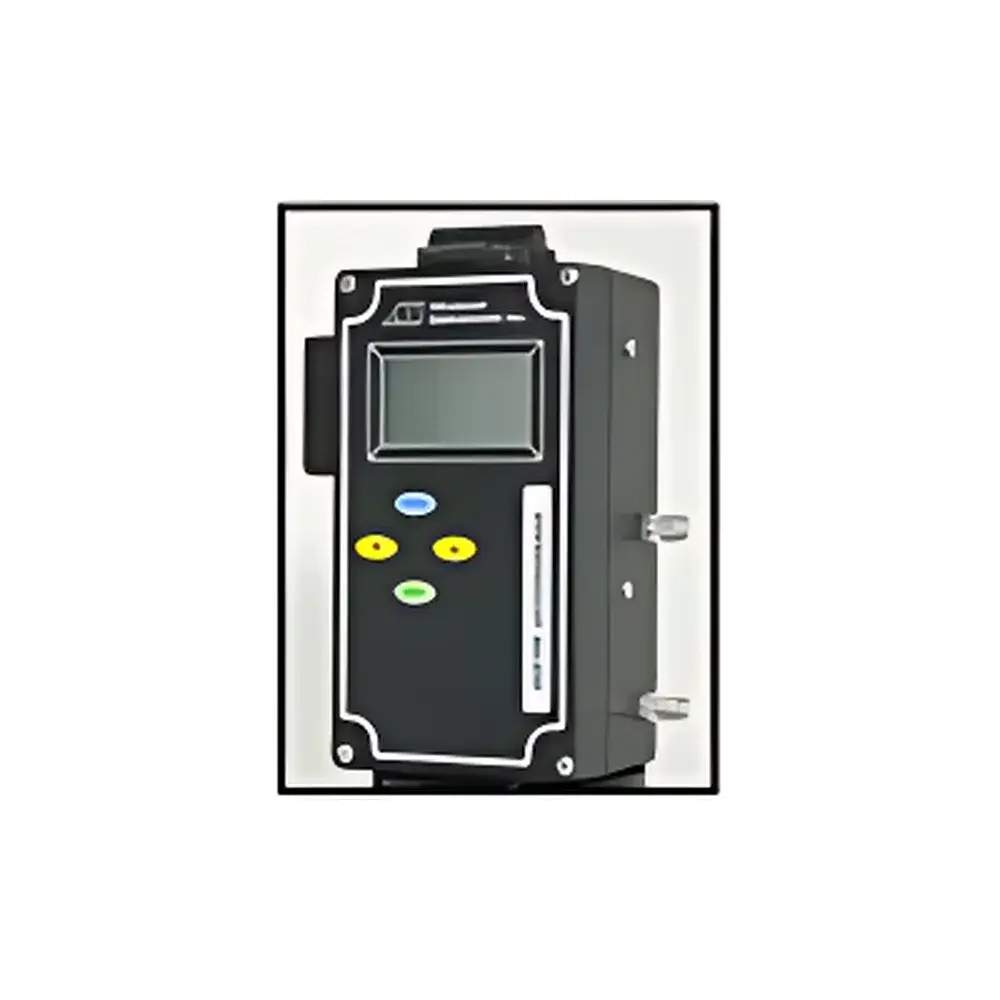
AII GPR-1500 Online Trace Oxygen Analyzer
| Brand | AII |
|---|---|
| Origin | USA |
| Model | GPR-1500 |
| Measurement Principle | Electrochemical Fuel Cell (Galvanic) |
| Detection Range | 0–10 ppm, 0–100 ppm, 0–1%, 0–25% O₂ (selectable) |
| Accuracy | < ±1% of full scale |
| Linearity | >0.995 across all ranges |
| Response Time (t₉₀) | ≤15 s |
| Recovery Time (to 10 ppm after air exposure) | <1 h |
| Operating Temperature | 5–45°C (GPR sensor), –20–45°C (XLT sensor) |
| Sample Flow Rate | 0.25–2.5 L/min (recommended: 1.0 L/min) |
| Inlet Pressure | 5–30 psig |
| Exhaust | Ambient pressure |
| Output Signal | 4–20 mA (2-wire loop-powered, 9–28 VDC) |
| Alarm Outputs | 2 configurable relay outputs |
| Display | 3½-digit LCD (2.75″ × 1.375″), resolution 0.01 ppm, real-time temperature & pressure readout |
| Enclosure Rating | NEMA 4X (IP66), cast aluminum housing |
| Dimensions | 21″ × 5″ × 7″ (533 × 127 × 178 mm), 15 lbs (6.8 kg) |
| with sample system board | 21″ × 15″ × 8″ (533 × 381 × 203 mm), 25 lbs (11.3 kg) |
| Sensor Life | 24 months at 25°C |
| Calibration | Span adjustment via software or front-panel numeric input |
| Compensation | Automatic temperature and pressure compensation |
| Sample Compatibility | Inert gases (N₂, Ar), hydrocarbons (CH₄, C₂H₆), H₂, He, CO₂ (with XLT-12-333 sensor) |
| Certifications | CE, ATEX/IECEx Class I, Div. 1, Groups B, C, D (intrinsically safe — certification pending) |
| Warranty | 12 months (instrument and sensor) |
Overview
The AII GPR-1500 Online Trace Oxygen Analyzer is an industrial-grade electrochemical analyzer engineered for continuous, high-stability measurement of trace to percent-level oxygen concentrations in process gas streams. It employs a galvanic fuel cell sensing principle—specifically the proprietary XLT-12-333 sensor—which operates without external bias voltage, electrolyte replenishment, or periodic maintenance. This self-powered electrochemical transduction mechanism delivers inherently stable zero and span characteristics, enabling long-term reproducibility in demanding environments such as inert gas blanketing systems, semiconductor purge lines, hydrogen reforming units, and CO₂ beverage carbonation processes. Unlike paramagnetic or zirconia-based analyzers, the GPR-1500 offers superior selectivity against common interferents (e.g., CO₂, H₂O vapor, hydrocarbons) when configured with the XLT sensor variant, and exhibits negligible cross-sensitivity in helium, nitrogen, argon, and hydrogen matrices. Its modular electronics architecture supports field-upgradable firmware and calibrated range switching—critical for multi-point process validation under evolving operational conditions.
Key Features
- Galvanic fuel cell sensor (XLT-12-333) with 24-month rated service life at 25°C—zero-maintenance operation in CO₂-rich streams (>0.5% CO₂)
- Five factory-configurable measurement ranges: 0–10 ppm, 0–100 ppm, 0–1%, 0–25% O₂—switched manually or automatically via internal logic
- True 2-wire, loop-powered 4–20 mA analog output (9–28 VDC), compliant with HART-compatible control systems and PLC analog input modules
- Two independently programmable relay alarm outputs with latching/non-latching modes, configurable for high/low O₂ thresholds
- NEMA 4X-rated cast aluminum enclosure (IP66), rated for outdoor wall-mount installation in corrosive or washdown environments
- Onboard 3½-digit LCD display with real-time O₂ concentration, temperature, and pressure readouts—resolution down to 0.01 ppm in trace ranges
- Digital zero and span calibration via front-panel keypad or remote software interface—no potentiometer adjustments required
- Integrated temperature and pressure compensation algorithms per ISO 8573-1 Annex B and ASTM D6299 guidelines
Sample Compatibility & Compliance
The GPR-1500 is validated for continuous analysis of oxygen in non-corrosive, dry-to-moderately humid gas matrices including nitrogen, argon, helium, hydrogen, methane, ethane, carbon dioxide, and synthetic air. When equipped with the XLT-12-333 sensor, it maintains metrological integrity in CO₂ concentrations up to 100%—a key differentiator for food & beverage, pharmaceutical, and biogas applications. The analyzer complies with CE marking requirements for electromagnetic compatibility (EN 61326-1) and low-voltage safety (EN 61010-1). Intrinsically safe configuration (pending ATEX/IECEx certification) meets Class I, Division 1, Groups B, C, D hazardous area classification per NFPA 70 and UL 913 standards. Optional cold-temperature LCD module extends operational capability to –30°C ambient—suitable for cryogenic storage monitoring and LNG processing facilities.
Software & Data Management
Calibration and diagnostic functions are accessible via the front-panel membrane keypad or optional RS-232/RS-485 serial interface (Modbus RTU protocol). Firmware updates and historical calibration logs are stored in non-volatile memory with timestamped audit trails—supporting GLP/GMP documentation requirements. While the GPR-1500 does not include embedded data logging, its 4–20 mA output is fully compatible with distributed control systems (DCS), SCADA platforms, and historian databases (e.g., OSIsoft PI, Emerson DeltaV) that enforce FDA 21 CFR Part 11 electronic record and signature compliance. All calibration events—including span gas concentration, date/time stamp, operator ID, and post-calibration verification values—are retained for ≥12 months and exportable via serial dump.
Applications
- Inert gas purity monitoring in semiconductor fabrication tools (N₂/Ar purge lines, wafer annealing chambers)
- Oxygen ingress detection in vacuum furnace backfilling and heat-treatment atmospheres
- Residual O₂ quantification in pharmaceutical lyophilization cycles and nitrogen-blanketed API storage vessels
- Trace oxygen control in hydrogen production and purification skids (PEM electrolyzer outlet, PSA tail gas)
- CO₂ quality assurance in carbonated beverage bottling lines and food packaging MAP systems
- Leak detection in sealed gloveboxes and battery dry rooms (Li-ion manufacturing)
FAQ
What is the recommended calibration frequency for the GPR-1500 in continuous operation?
For critical applications requiring regulatory compliance (e.g., pharmaceutical or semiconductor), daily zero checks and weekly span verification using certified calibration gas (≥80% of selected range) are advised. Under stable process conditions, monthly full calibration suffices.
Can the GPR-1500 measure oxygen in wet gas streams?
Yes—provided condensate is removed upstream via coalescing filter and refrigerated dryer. The XLT sensor tolerates up to 90% RH at 25°C; prolonged exposure to liquid water or aerosols will degrade performance and void warranty.
Is pressure compensation mandatory for accurate readings?
Yes. The GPR-1500 incorporates absolute pressure sensing and applies real-time compensation per the ideal gas law. Uncorrected inlet pressure variation beyond ±5% of setpoint introduces measurable error—especially below 100 ppm O₂.
How does the GPR-1500 handle sensor drift over time?
The instrument implements digital zero-drift compensation via software offset correction, eliminating manual potentiometer adjustment. Drift exceeding ±2% of full scale triggers a service alert and requires recalibration—not sensor replacement.
Does the analyzer support HART communication?
No—the GPR-1500 provides only analog 4–20 mA output and discrete relay alarms. HART or Foundation Fieldbus integration requires an external signal converter or gateway device.
Related Products