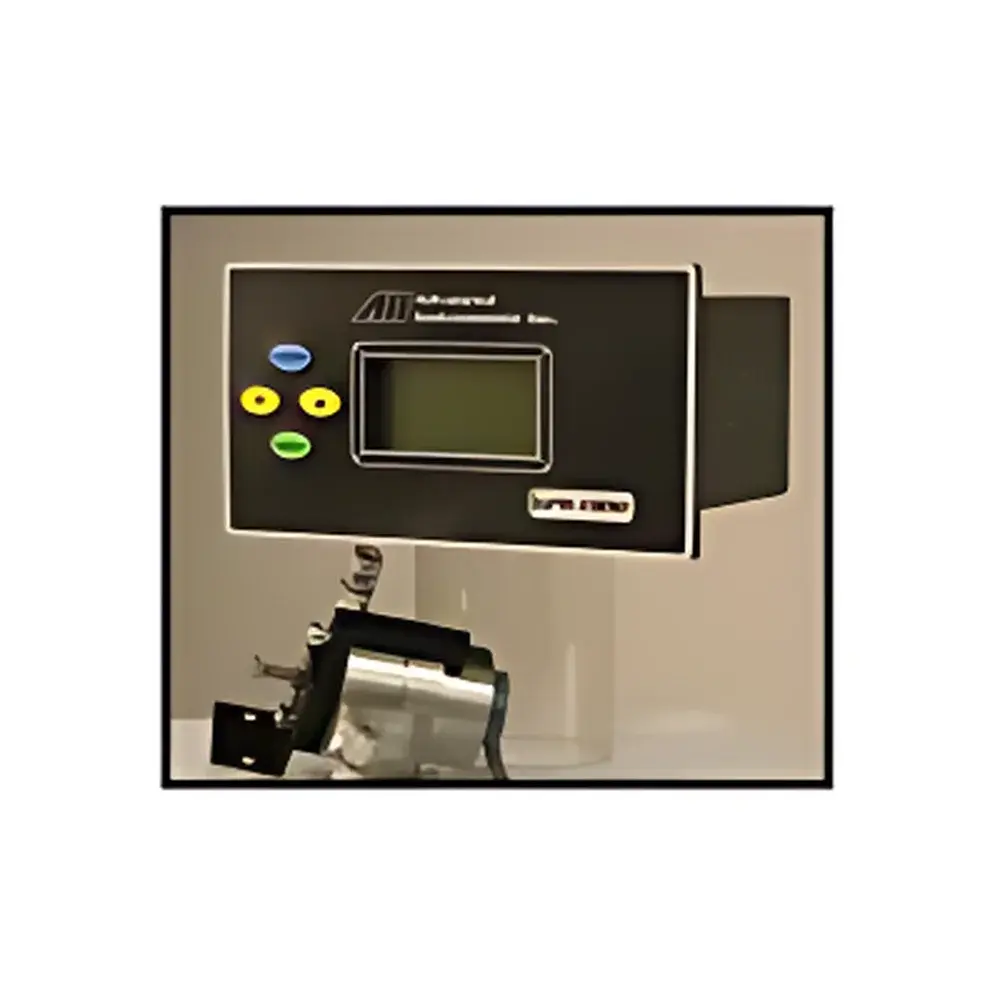
AII GPR-1900 Online Trace Oxygen Analyzer
| Brand | AII |
|---|---|
| Origin | USA |
| Model | GPR-1900 |
| Measurement Principle | Electrochemical Fuel Cell |
| Range | 0–10 / 100 / 1000 ppm, 0–1% / 25% FS |
| Accuracy | <1% FS |
| Sensitivity | <0.5% FS |
| Linearity | >0.995 |
| Response Time (T90) | 10 s |
| Recovery Time to 10 ppm | 60 s |
| Operating Temperature | 5–45 °C |
| Operating Pressure (Inlet) | 5–30 psig (max 100 psig) |
| Outlet Pressure | Ambient |
| Flow Rate | 1–3 SCFH (recommended 2 SCFH) |
| Compensation | Automatic temperature and barometric pressure compensation |
| Output Signals | 0–1 V analog, isolated 4–20 mA |
| Alarm Outputs | Two user-adjustable capacitive relay alarms |
| Calibration | Recommended with 80% FS span gas |
| Display | Large LCD with 0.001 ppm resolution |
| Enclosure | Anodized aluminum panel-mount housing |
| Power Supply | 220 VAC, 50/60 Hz |
| Certifications | CE, ISO 9001 |
| Sensor Option | XLT-12-333 (for CO₂ >0.5% applications) |
| Communication Interface | RS-232 serial port |
| Wetted Materials | Stainless steel |
| Ingress Protection | IP65-rated front panel (per enclosure design) |
Overview
The AII GPR-1900 Online Trace Oxygen Analyzer is an industrial-grade electrochemical analyzer engineered for continuous, high-stability measurement of trace oxygen concentrations in inert, reducing, and mildly acidic process gas streams. Utilizing a solid polymer electrolyte (SPE) fuel cell sensor, the instrument delivers stable, drift-free performance without consumable reagents or frequent recalibration—making it suitable for unattended operation in critical process environments such as semiconductor purge lines, high-purity nitrogen generation systems, hydrogen reforming loops, and controlled-atmosphere packaging lines. Unlike paramagnetic or zirconia-based analyzers, the GPR-1900’s fuel cell principle provides inherent selectivity for O₂ in complex matrices—including He, H₂, Ar, N₂, and CO₂-containing mixtures—without cross-sensitivity to moisture, hydrocarbons, or common background gases. Its architecture supports long-term deployment under variable pressure and ambient temperature conditions, with integrated compensation algorithms ensuring measurement integrity across dynamic operating ranges.
Key Features
- Electrochemical fuel cell sensor with 24-month typical service life and zero routine maintenance requirements
- Five factory-configured measurement ranges (0–10 ppm, 0–100 ppm, 0–1000 ppm, 0–1% FS, 0–25% FS), selectable via menu-driven interface
- Automatic or manual range switching with seamless signal continuity and no dead-band transitions
- Dual adjustable capacitive relay outputs for high/low alarm thresholds, plus dedicated diagnostics for sensor signal degradation, power loss, and internal system faults
- Real-time ambient temperature and barometric pressure monitoring with automatic compensation applied to raw sensor output
- Front-panel membrane keypad with intuitive navigation for calibration, alarm setup, and system configuration
- Isolated 4–20 mA and 0–1 V analog outputs compliant with standard DCS/PLC input modules
- RS-232 serial interface supporting remote parameter access, data logging initiation, and firmware-level diagnostics
- Anodized aluminum panel-mount enclosure rated to IP65 on the front face for industrial control room or skid-mounted integration
- Stainless steel wetted components compatible with ultra-high-purity (UHP) gas handling standards
Sample Compatibility & Compliance
The GPR-1900 is validated for use with inert gases (N₂, Ar), noble gases (He), reducing gases (H₂), and mixed streams containing up to 25% CO₂—provided the optional XLT-12-333 sensor variant is installed. It meets CE marking requirements for electromagnetic compatibility (EMC Directive 2014/30/EU) and low-voltage safety (LVD Directive 2014/35/EU). The device conforms to ISO 9001:2015 quality management system standards during manufacturing and final test. While not intrinsically safe, its general-purpose classification aligns with IEC 60079-0 for non-hazardous area installation. For regulated industries, the instrument supports audit-ready operation when paired with external data acquisition systems that implement 21 CFR Part 11-compliant electronic records and signature controls.
Software & Data Management
Although the GPR-1900 operates autonomously without embedded software, its RS-232 interface enables integration into supervisory control systems using ASCII command protocols. Users may initiate zero/span calibration remotely, query real-time O₂ concentration, retrieve sensor health status, and log timestamped readings at configurable intervals. When interfaced with SCADA or historian platforms (e.g., Ignition, Siemens Desigo, or OSIsoft PI), the analyzer contributes to trend analysis, batch record generation, and deviation detection workflows. Optional data point logging modules—when deployed externally—support GLP/GMP-aligned metadata tagging (operator ID, calibration gas lot number, environmental conditions) and encrypted archival per internal QA policies.
Applications
- Monitoring residual O₂ in nitrogen blanketing systems for chemical reactors and storage tanks
- Quality assurance of high-purity hydrogen used in fuel cell manufacturing and metallurgical annealing
- In-line verification of oxygen scavenging efficiency in modified atmosphere packaging (MAP) lines
- Leak detection and integrity validation in vacuum chamber purging cycles
- Process gas purity verification upstream of cryogenic air separation units
- Control feedback for catalytic deoxo beds in semiconductor fabrication tool gas delivery networks
FAQ
What calibration gases are recommended for routine span verification?
A certified gas mixture containing 80% of the selected full-scale value (e.g., 8 ppm for the 0–10 ppm range) is recommended. Zero calibration may be performed using high-purity inert gas (e.g., 99.999% N₂) or certified zero air.
Can the GPR-1900 operate continuously at elevated inlet pressures beyond 30 psig?
Yes—the sensor and flow path are rated for transient exposure up to 100 psig; however, sustained operation above 30 psig requires external pressure regulation to maintain optimal flow dynamics and sensor longevity.
Is temperature compensation applied automatically during measurement?
Yes—internal thermistor and barometric sensor inputs feed real-time correction coefficients to the microprocessor, ensuring consistent accuracy across the specified 5–45 °C ambient operating range.
Does the instrument support dual power supply options?
The standard unit accepts 220 VAC, 50/60 Hz; a DC-powered variant (24 VDC) is available upon request and subject to OEM configuration.
How is sensor replacement handled in the field?
The fuel cell module is a plug-in component requiring no alignment or firmware reconfiguration; replacement restores full factory calibration within one thermal stabilization cycle (≤30 minutes).