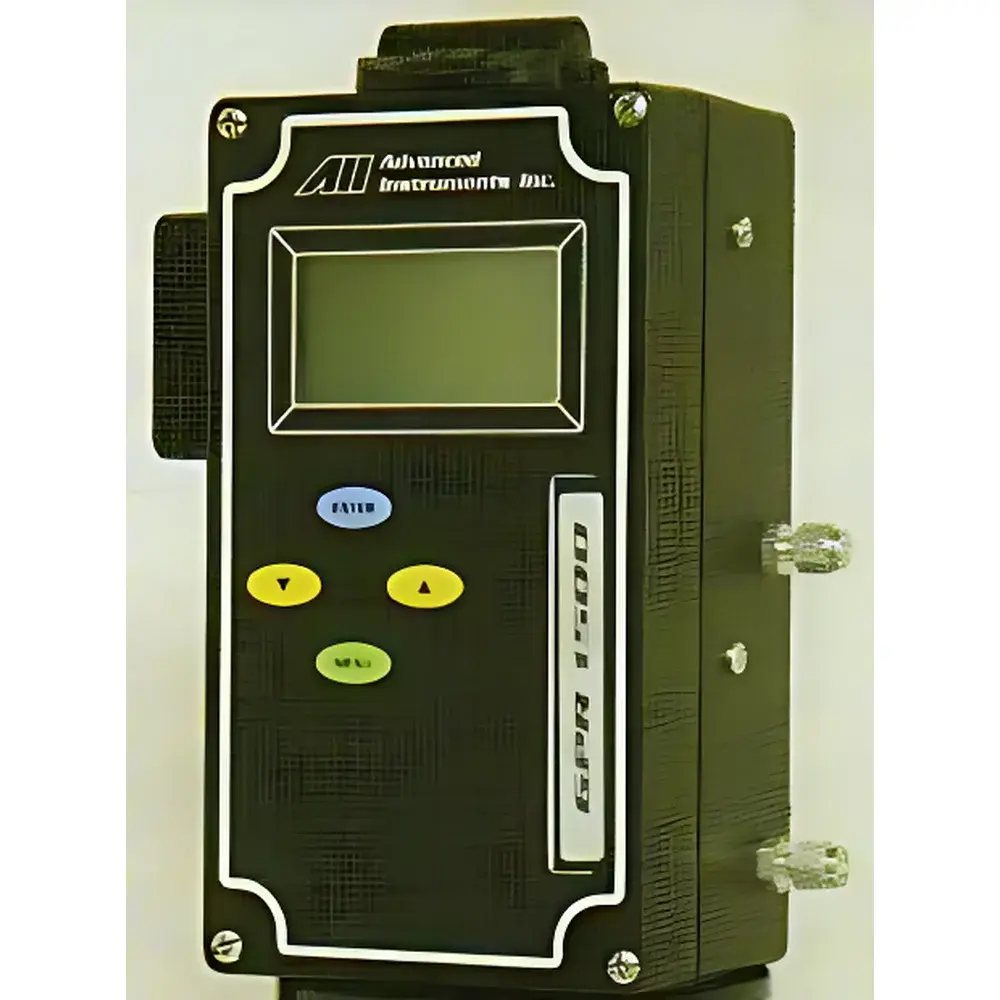
AII GPR-2500MO Oxygen Analyzer
| Brand | AII |
|---|---|
| Origin | USA |
| Model | GPR-2500MO |
| Measurement Principle | Electrochemical Fuel Cell |
| Range | 0–100% FS |
| Accuracy | <1% FS |
| Linearity | >0.995 |
| Response Time | 10 s |
| Sensitivity | 0.1% RD |
| Display Resolution | 0.1% O₂ |
| Operating Temperature | 5–45 °C |
| Power Supply | 12–28 VDC (≥24 VDC with intrinsic safety barrier) |
| Inlet Pressure | 5–30 psig |
| Outlet Pressure | Ambient |
| Flow Rate | 0.5–5 SCFH (recommended: 2 SCFH) |
| Gas Compatibility | Inert gases, helium, hydrogen, and mixed process gases |
| Compensation | Automatic temperature and barometric pressure compensation |
| Output Signal | 4–20 mA |
| Enclosure Rating | NEMA 4X aluminum-coated |
| Input/Output Fittings | 1/8" and 1/4" Swagelok® compression fittings |
| Calibration Gas Recommendation | 80% FS O₂ in inert balance |
| Certifications | CE, ISO 9001 |
| Hazardous Area Option | Intrinsically safe configuration available for Class I, Division 1, Groups A–D (with optional barrier) |
Overview
The AII GPR-2500MO Oxygen Analyzer is a robust, field-deployable electrochemical analyzer engineered for continuous, high-reliability oxygen concentration measurement in industrial process streams and inert gas supply systems. Utilizing a proprietary fuel cell sensor (GPR-11-120-4), the instrument operates on the principle of galvanic oxygen reduction, generating a current proportional to partial pressure of O₂—eliminating the need for external power to the sensing element and ensuring inherent stability and drift-free operation. Designed for fixed-installation applications in bulk gas production, blanketing systems, heat-treating furnaces, and semiconductor purge lines, the GPR-2500MO delivers full-scale measurement across 0–100% O₂ with sub-1% FS accuracy, supported by real-time temperature and barometric pressure compensation to maintain metrological integrity under variable ambient conditions.
Key Features
- Long-life electrochemical fuel cell sensor with 24-month typical service life and zero routine maintenance requirements
- NEMA 4X aluminum-coated enclosure rated for outdoor and washdown environments
- Integrated menu-driven interface with waterproof membrane keypad for local configuration of range, calibration, and system diagnostics
- Large backlit LCD display showing real-time O₂ concentration (0.1% resolution), ambient temperature, and local barometric pressure
- Intrinsically safe configuration option compliant with Class I, Division 1, Groups A–D per NEC/CEC standards when paired with an approved safety barrier
- Wide DC power input range (12–28 VDC), supporting integration into standard 24 VDC plant control infrastructure
- Linear analog output (4–20 mA) with HART® compatibility (optional firmware) for seamless integration into DCS, PLC, or SCADA systems
- Gas inlet/outlet via industry-standard 1/8″ and 1/4″ Swagelok® compression fittings; flow-optimized design supports stable operation at 0.5–5 SCFH
Sample Compatibility & Compliance
The GPR-2500MO is validated for use with non-corrosive, non-condensing process gases including nitrogen, argon, helium, hydrogen, and custom binary or ternary mixtures—provided no reactive species (e.g., chlorine, fluorine, NOₓ, or high-concentration CO₂) are present above trace levels. It is not suitable for oxidizing or acidic gas matrices that degrade fuel cell electrolytes. The analyzer conforms to EN 61326-1 (EMC for industrial environments) and carries CE marking for EMC and Low Voltage Directive compliance. Its quality management system is certified to ISO 9001:2015. For installations in classified hazardous locations, the unit may be deployed with an externally mounted, third-party-certified intrinsic safety barrier (e.g., Pepperl+Fuchs KFD2-STC4-Ex1) to meet IEC 60079-11 and UL 913 requirements.
Software & Data Management
While the GPR-2500MO operates as a stand-alone analog transmitter without embedded data logging, its 4–20 mA output is fully compatible with upstream historian systems (e.g., OSIsoft PI, Emerson DeltaV DCS, or Rockwell FactoryTalk) for time-series trending, alarm generation, and batch record retention. Optional HART-enabled firmware (available via field upgrade) enables digital configuration of damping, zero/span offsets, and diagnostic status interrogation using standard handheld communicators or asset management software. All calibration events—including date, operator ID (if entered manually), and reference gas concentration—are logged locally in non-volatile memory and retrievable via serial interface (RS-232, optional module). Audit trails comply with basic GLP/GMP documentation expectations for routine QC verification.
Applications
- Monitoring residual oxygen in nitrogen-purged reactors, storage tanks, and packaging lines to ensure inerting efficacy
- Verification of O₂ content in medical-grade or electronics-grade bulk gas deliveries prior to distribution
- Process control feedback in controlled-atmosphere heat treatment furnaces (e.g., annealing, brazing, sintering)
- Leak detection in vacuum chambers and gloveboxes via positive-pressure O₂ ingress testing
- Quality assurance in hydrogen production and purification skids where O₂ contamination poses explosion risk
- Environmental monitoring of inert blanket integrity in flammable liquid storage terminals
FAQ
What calibration gas is recommended for routine span verification?
A certified 80% FS O₂ standard in nitrogen or argon is recommended to verify linearity and sensitivity across the upper measurement range.
Can the GPR-2500MO measure oxygen in hydrogen-rich streams?
Yes—the fuel cell sensor is specifically designed for operation in H₂ background gases; however, total system design must ensure no catalytic recombination or thermal runaway occurs upstream of the sensor.
Is temperature compensation automatic or user-configurable?
Compensation is fully automatic and continuous, utilizing integrated thermistor and barometric pressure transducers calibrated at point-of-manufacture.
Does the analyzer support Modbus RTU or other digital protocols natively?
No—digital communication requires optional HART firmware and a HART-compatible master device; native Modbus is not supported.
What is the expected service life of the fuel cell sensor under continuous operation?
The GPR-11-120-4 sensor has a rated operational lifetime of 24 months when exposed to ≤100 ppm average O₂ concentration; exposure to sustained >21% O₂ accelerates consumption and reduces service life proportionally.
Related Products