
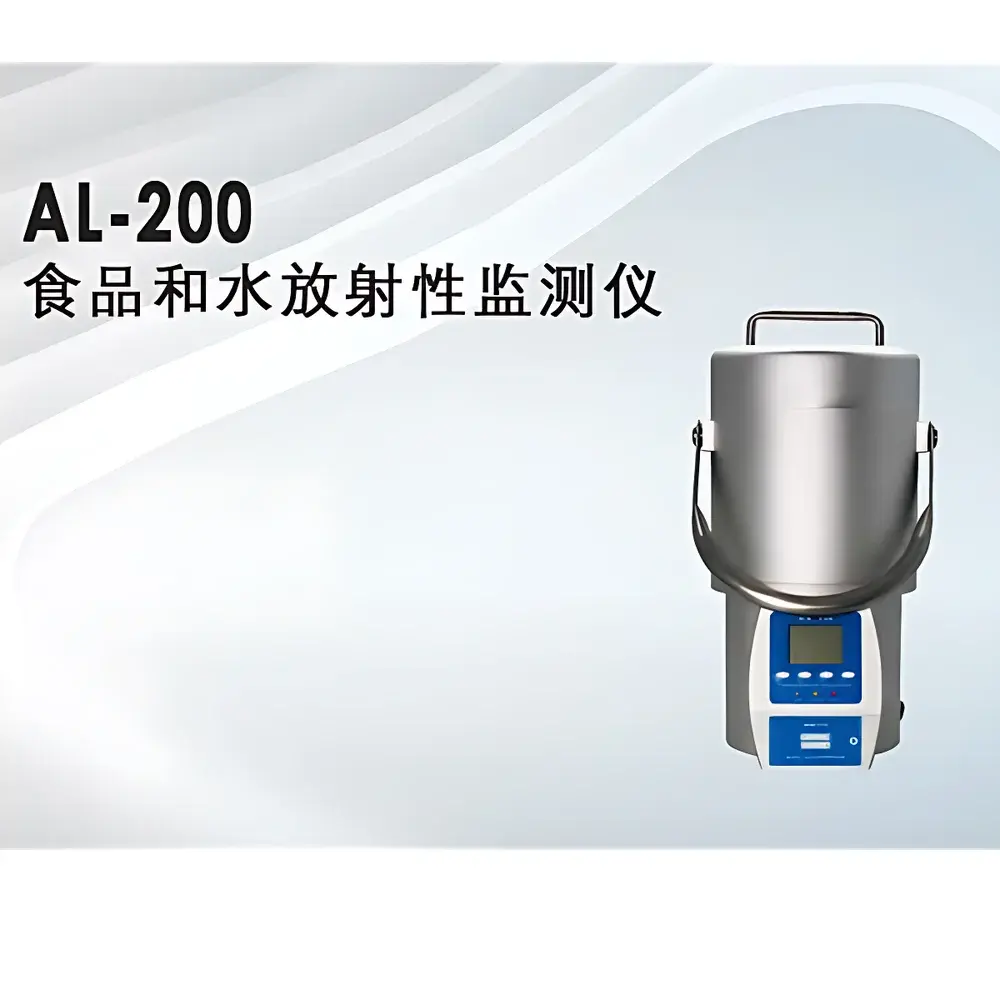
Ailun AL-200 Portable Radioactivity Monitor for Food and Water
| Brand | Ailun |
|---|---|
| Model | AL-200 |
| Type | Portable Activity Meter (Radionuclide Concentration Analyzer) |
| Detector | Scintillation Crystal (NaI:Tl) |
| Power Supply | AC 100–240 V (with adapter) or 2×AA batteries |
| Display | Backlit LCD with real-time activity readout (Bq/kg or Bq/L) |
| Data Storage | Up to 200 measurement records |
| Radiation Indication | Tri-color LED status indicator (green/yellow/red) |
| Sample Forms | Liquids (water, beverages) and solids (food, soil, filters) |
| Shielding | Integrated lead-lined metal housing |
| Connectivity | Optional USB interface for PC-based control and data export |
| Compliance | Designed per IEC 60846-1:2014 (radiation protection instrumentation – ambient and/or directional dose equivalent rate meters) |
| Weight | <1.8 kg |
| Dimensions | 220 × 110 × 75 mm |
Overview
The Ailun AL-200 is a field-deployable radioactivity monitor engineered for quantitative assessment of gamma-emitting radionuclides—primarily cesium-137 (⁶⁷Cs), cesium-134 (¹³⁴Cs), and iodine-131 (¹³¹I)—in foodstuffs, drinking water, and environmental solid matrices. It operates on the principle of gamma-ray spectroscopy using a thallium-doped sodium iodide (NaI:Tl) scintillation detector, coupled with pulse-height analysis to discriminate characteristic photopeaks in the 300–800 keV energy range. Unlike gross-counting survey meters, the AL-200 delivers specific activity concentrations (Bq/kg or Bq/L) by applying energy-specific calibration factors traceable to national standards. Its design prioritizes metrological robustness in non-laboratory settings: the integrated lead shielding (≥2 mm Pb equivalent) minimizes background interference, while temperature-compensated electronics ensure stable gain over operating ranges from 0 °C to 40 °C. The instrument meets the functional requirements of rapid screening protocols mandated under EU Council Regulation (Euratom) No. 2016/52 and China’s GB/T 16145–2022 for post-incident food monitoring.
Key Features
- High-sensitivity NaI:Tl scintillation detector with optimized light collection efficiency for detection limits ≤15 Bq/kg (for ¹³⁷Cs in 500 g food samples, 60-min count)
- Real-time spectral processing via embedded 32-bit microcontroller; no external PC required for basic operation
- Tri-color LED hazard indicator calibrated to IAEA Safety Guide RS-G-1.7 thresholds: green (≤1× limit), yellow (1–3× limit), red (>3× limit)
- Full-metal enclosure with internal lead lining and EMI-shielded circuitry, certified for electromagnetic compatibility per IEC 61326-1:2020
- Dual-power architecture: mains-powered (100–240 V AC) for stationary use; AA-battery backup (≥12 h continuous operation at 25 °C) for field deployment
- On-device data management: time-stamped storage of up to 200 measurements with sample ID, geometry, and operator notes
- Integrated clock with battery-backed SRAM retains configuration, calibration constants, and time/date during power loss
Sample Compatibility & Compliance
The AL-200 accommodates standardized geometries: liquid samples (up to 500 mL in supplied polyethylene measurement cup) and homogenized solids (up to 1 kg placed in optional stainless-steel container). Sample mass/volume input is manually entered prior to counting to enable automatic activity concentration calculation. The system supports routine verification against certified reference materials (e.g., IAEA-375, NIST SRM 4357) and complies with QA/QC requirements outlined in ISO/IEC 17025:2017 for testing laboratories. While not a primary standard instrument, its performance is validated against reference methods per ASTM D3648-19 (Standard Test Methods for Radioactivity in Water) and GB 14883.1–2016 (Determination of radionuclides in food). Regulatory documentation includes conformity to RoHS 2011/65/EU and CE marking under the EU Electromagnetic Compatibility Directive 2014/30/EU.
Software & Data Management
Optional Windows-compatible software (AL-DataLink v2.1) enables remote instrument control, spectral review, and customizable reporting. Data export supports CSV, XML, and PDF formats compatible with LIMS integration. Audit trail functionality logs all parameter changes, measurement initiations, and firmware updates—meeting minimum requirements for GLP-compliant environments. Software-generated reports include uncertainty budgets calculated per GUM (JCGM 100:2008) incorporating counting statistics, calibration factor uncertainty, and geometry correction terms. USB communication adheres to CDC ACM class protocol, requiring no proprietary drivers on Windows 10/11 or Linux kernel ≥5.4.
Applications
- Rapid post-accident screening of agricultural products, dairy, and seafood following nuclear incidents
- Regulatory compliance testing at border inspection posts (customs, quarantine) per IAEA TECDOC-1162 guidelines
- Environmental surveillance programs for groundwater and surface water near nuclear facilities
- Quality assurance in food processing plants handling imported raw materials from regions with elevated background radiation
- Public health response—field deployment by CDC or municipal health departments during radiological emergencies
- Educational use in university nuclear engineering labs for hands-on gamma spectrometry fundamentals
FAQ
What radionuclides can the AL-200 quantify with certified accuracy?
It is factory-calibrated for ¹³⁷Cs, ¹³⁴Cs, and ¹³¹I using matrix-matched standards; other gamma emitters (e.g., ⁶⁰Co, ⁴⁰K) may be identified qualitatively but require user-defined calibration.
Is the instrument suitable for regulatory reporting?
Yes—when operated within defined procedures (including daily background check, weekly CRM verification, and documented geometry control), data meet evidentiary thresholds for preliminary regulatory submissions under national food safety authorities.
How is detector energy resolution specified?
Typical FWHM resolution at 662 keV (¹³⁷Cs) is ≤7.5%—verified during final acceptance testing and recorded in the certificate of conformance shipped with each unit.
Can the AL-200 operate in high-humidity environments?
Rated IP54 per IEC 60529; condensation-resistant housing allows use in field conditions up to 90% RH (non-condensing), though prolonged exposure above 85% RH is not recommended.
Does the USB interface support real-time spectral streaming?
No—USB mode enables batch transfer of stored spectra and measurement metadata; live spectrum acquisition requires direct instrument display only.
Related Products







