
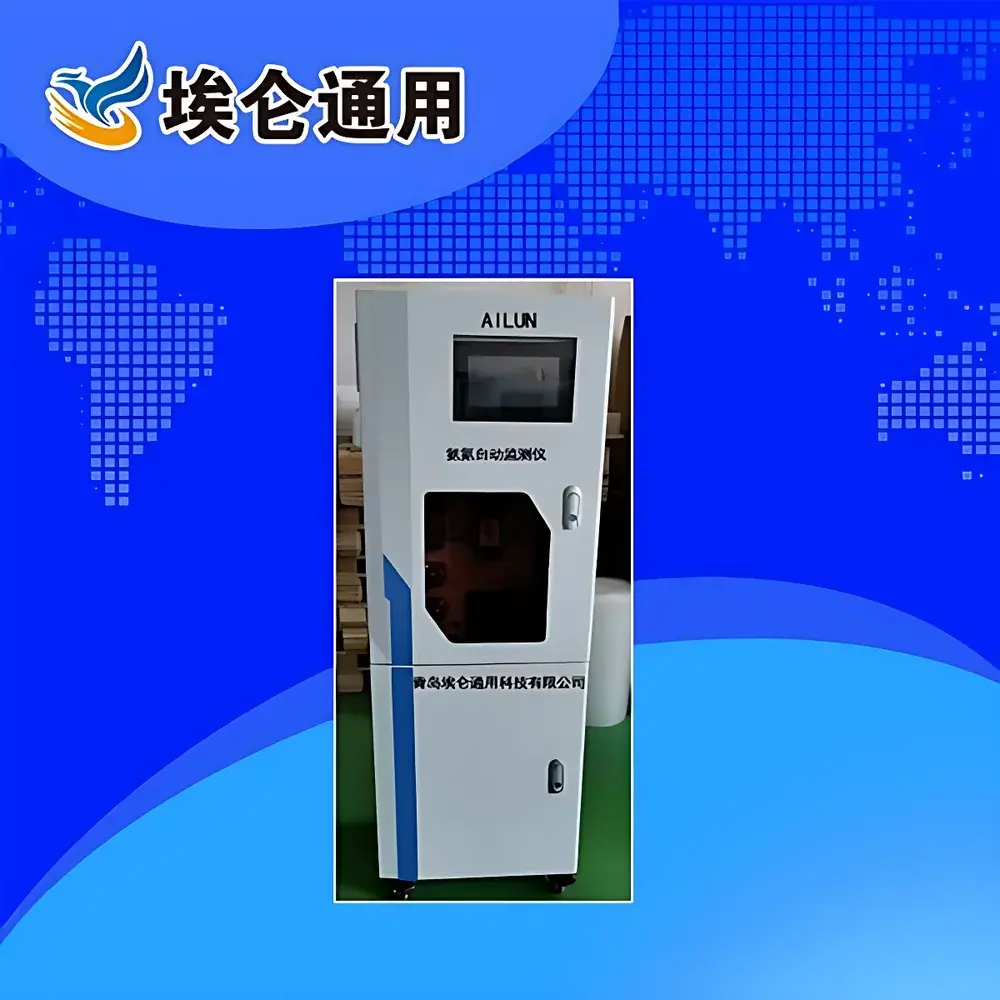
Ailun AL-AC130 Automated Ammonia Nitrogen Analyzer
| Brand | Ailun (Qingdao Ailun) |
|---|---|
| Origin | Shandong, China |
| Model | AL-AC130 |
| Measurement Principle | Colorimetric Method (Nesslerization or Salicylate-based) |
| Measurement Range | 0–500 mg/L NH₃–N (expandable) |
| Detection Limit | ≤0.15 mg/L (±30% error at LOD) |
| Accuracy | ±8.0% at 2.0 mg/L |
| Repeatability | ≤2% RSD |
| Low-concentration Drift | ≤0.02 mg/L/24h |
| High-concentration Drift | ≤1.0 mg/L/24h |
| Minimum Cycle Time | 20 min (color development time adjustable from 5–120 min) |
| Sample Throughput | 10 samples per batch |
| Sampling Interval | 10–9999 min programmable + on-the-hour mode |
| Calibration Interval | 1–99 days, user-defined start time |
| Maintenance Interval | >720 hours |
| Output Interfaces | RS-232, RS-485, 4–20 mA (optional) |
| Operating Environment | +5 to +28 °C, ≤90% RH (non-condensing) |
| Power Supply | AC 220 V ±10%, 50 Hz ±10%, 5 A |
| Memory Effect | ≤0.3 mg/L at 2.0 mg/L standard |
| Field Validation | ≤0.2 mg/L bias for samples <2.0 mg/L |
Overview
The Ailun AL-AC130 Automated Ammonia Nitrogen Analyzer is a laboratory-grade, discrete-segmented flow analyzer engineered for precise, unattended quantification of ammonia nitrogen (NH3–N) in wastewater and industrial effluent streams. It operates on the colorimetric principle—specifically optimized for either Nesslerization or salicylate-based reaction chemistry—where ammonia reacts with reagents under controlled pH and temperature conditions to form a stable colored complex. Absorbance is measured photometrically at a defined wavelength (typically 420 nm for Nessler or 655 nm for salicylate), and concentration is calculated via a calibrated calibration curve. Designed for regulatory-compliant monitoring at municipal and industrial wastewater treatment plants, the AL-AC130 delivers trace-level sensitivity, high inter-run reproducibility, and robust resistance to matrix interference when operated within its specified environmental and sample quality constraints.
Key Features
- Programmable color development time (5–120 minutes), enabling optimization for challenging matrices including high-turbidity or chlorine-containing samples
- Discrete batch processing capability for up to 10 water samples per analytical cycle, minimizing cross-contamination risk
- Automated multi-point calibration with user-definable intervals (1–99 days) and flexible scheduling—including off-peak initiation—to support GLP-aligned operational routines
- Integrated drift compensation algorithms that monitor baseline stability and correct for low- and high-concentration signal drift (≤0.02 mg/L and ≤1.0 mg/L per 24 h, respectively)
- Low memory effect design validated against reference standards: ≤0.3 mg/L carryover at 2.0 mg/L NH3–N and ≤0.2 mg/L at 8.0 mg/L NH3–N
- Dual communication architecture supporting RS-232/RS-485 serial protocols and optional 4–20 mA analog output for integration into SCADA or DCS environments
- Self-diagnostic system with event logging, error code reporting, and maintenance countdown timer (>720 h nominal service interval)
Sample Compatibility & Compliance
The AL-AC130 is validated for use with raw and treated wastewater, landfill leachate, and industrial process effluents where NH3–N concentrations fall within 0–500 mg/L. Interference mitigation protocols are embedded in method configuration: pre-filtration is recommended for samples with turbidity >50 NTU; dechlorination steps (e.g., sodium thiosulfate addition) are required for residual chlorine >0.5 mg/L; and chelating agents may be introduced to suppress calcium/magnesium-induced precipitation in hard water matrices. The instrument meets functional requirements aligned with ISO 14911 (water quality — determination of ammonium — spectrophotometric methods) and supports data integrity practices consistent with FDA 21 CFR Part 11 when paired with compliant LIMS or data acquisition software. Its performance specifications satisfy typical QA/QC criteria outlined in US EPA Method 350.1 and ASTM D1426 for ammonia nitrogen analysis.
Software & Data Management
Control and data handling are managed via embedded firmware with a web-accessible interface (HTTP/HTTPS) and local touchscreen navigation. All measurement events—including calibration runs, blank corrections, spike recoveries, and maintenance logs—are timestamped and stored with full audit trail capability. Raw absorbance values, calculated concentrations, QC flags, and instrument status parameters are exportable in CSV or XML format. Optional PC-based software provides advanced trending (e.g., Shewhart control charts), automated report generation (PDF/Excel), and configurable alarm thresholds for out-of-specification results. Data encryption, user role management (admin/operator/auditor), and electronic signature support ensure alignment with GLP and GMP documentation standards.
Applications
- Continuous compliance monitoring at discharge points of municipal wastewater treatment plants (WWTPs)
- Process control feedback in nitrification/denitrification basins and membrane bioreactors (MBRs)
- Effluent characterization for industrial pretreatment programs (e.g., food processing, chemical manufacturing, pharmaceutical production)
- Research-grade ammonia profiling in pilot-scale bioreactor studies and environmental fate modeling
- Calibration verification and method validation in certified environmental testing laboratories (ISO/IEC 17025-accredited)
FAQ
What sample preparation is required prior to analysis?
Pre-filtration through a 0.45 µm membrane filter is mandatory for turbid samples. Samples containing residual chlorine must be quenched with sodium thiosulfate; high-hardness samples may require EDTA addition to prevent precipitate formation during color development.
Can the AL-AC130 be integrated into an existing plant SCADA system?
Yes—via RS-485 Modbus RTU or optional 4–20 mA analog output. Configuration files and protocol documentation are provided for seamless DCS/PLC integration.
How frequently must the optical path be cleaned?
The flow cell and photometer optics are self-cleaning via scheduled flush cycles; manual inspection and cleaning are recommended every 6 months or after 720 hours of continuous operation.
Is method validation documentation available for regulatory submission?
A comprehensive Instrument Qualification Package (IQ/OQ/PQ templates), method validation report (per ISO/IEC 17025 Annex B), and raw data audit trail export tools are supplied with each unit.
Does the analyzer support remote diagnostics and firmware updates?
Yes—secure HTTPS-based remote access enables real-time status monitoring, diagnostic log retrieval, and over-the-air firmware upgrades without on-site technician intervention.
Related Products







