
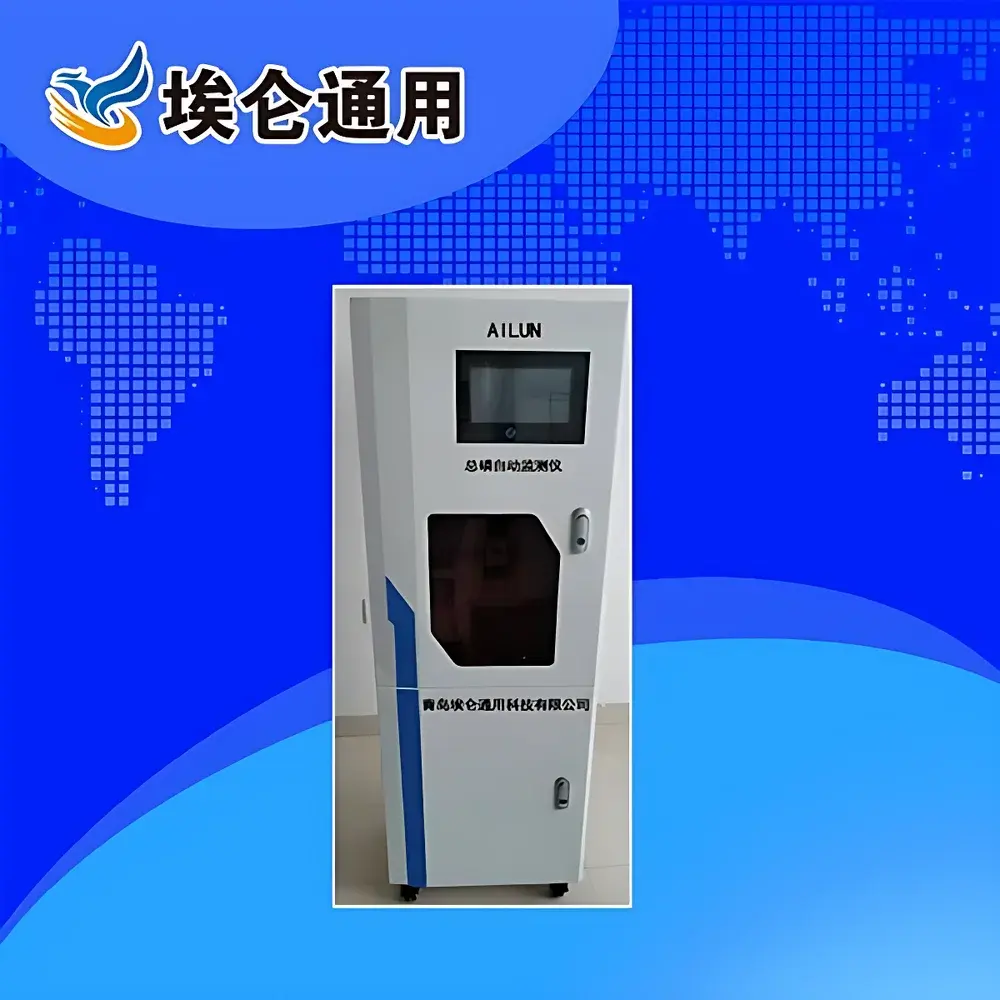
Ailun AL-AC140 Total Phosphorus Automatic Analyzer
| Brand | Ailun General / Qingdao Ailun |
|---|---|
| Origin | Shandong, China |
| Manufacturer Type | Authorized Distributor |
| Country of Origin | China |
| Model | AL-AC140 |
| Measurement Parameter | Total Phosphorus |
| Instrument Type | Laboratory-Based Analyzer |
| Measurement Principle | Acid Digestion + Molybdenum Blue Colorimetry |
| Measurement Range | 0–10 mg/L (expandable and adjustable) |
| Detection Limit | 0.01 mg/L |
| Repeatability | ≤5% RSD |
| Zero Drift | ≤0.01 mg/L |
| Span Drift | ≤1.0% over 24 h |
| Measurement Cycle | 20–120 min (adjustable in 1-min increments) |
| Digestion Time | Configurable |
| Sampling Interval | 10–9999 min or on-the-hour mode |
| Calibration Interval | 1–99 days, user-definable start time |
| Maintenance Interval | Monthly (~30 min per session) |
| Output Interfaces | RS-232, RS-485, 4–20 mA (optional) |
| Environmental Requirements | Indoor controlled temperature (+5 to +28 °C), humidity ≤90% non-condensing |
| Power Supply | AC 230 ±10 V, 50 ±10 Hz, 5 A |
| Accuracy (Standard Solution) | ±8.0% at 2.0 mg/L, ±5.0% at 5.0 mg/L, ±3.0% at 8.0 mg/L |
| Memory Effect | ≤0.3 mg/L at 2.0 mg/L standard, ≤0.2 mg/L at 8.0 mg/L standard |
| Field Sample Comparison | ≤0.2 mg/L for samples <2.0 mg/L |
Overview
The Ailun AL-AC140 Total Phosphorus Automatic Analyzer is a laboratory-grade, fully automated spectrophotometric system engineered for precise, reproducible quantification of total phosphorus (TP) in aqueous environmental matrices. It implements the standardized acid digestion–molybdenum blue colorimetric method (aligned with ISO 6878:2004 and EPA Method 365.4), wherein all phosphorus species—including orthophosphate, condensed phosphates, and organically bound phosphorus—are oxidized to orthophosphate under high-temperature acidic conditions (typically using potassium persulfate or sulfuric–nitric acid mixtures), followed by reaction with ammonium molybdate and antimony potassium tartrate under reducing conditions to form a stable heteropolyblue complex. Absorbance is measured at 700 nm using a high-stability optical path and temperature-compensated photometric detector. Designed for regulatory-compliant monitoring in wastewater treatment plants, chemical manufacturing facilities, aquaculture operations, and municipal water quality laboratories, the AL-AC140 delivers trace-level sensitivity with a detection limit of 0.01 mg/L and maintains measurement integrity across variable sample matrices.
Key Features
- Fully automated operation including sampling, reagent dosing, digestion, color development, photometric measurement, and waste discharge—minimizing manual intervention and operator variability.
- Configurable digestion protocol supporting both closed-vessel high-pressure and open-heating modes to accommodate diverse sample organic load and turbidity profiles.
- Optimized optical system featuring dual-beam compensation and LED-based 700 nm light source for long-term photometric stability and reduced lamp drift.
- Integrated temperature-controlled reaction chamber ensuring consistent digestion kinetics and color development across ambient fluctuations (operational range: +5 to +28 °C).
- Modular fluidic architecture with chemically resistant PTFE and quartz components, enabling reliable handling of aggressive digestants and minimizing carryover via programmable rinse cycles and memory-effect mitigation algorithms.
- Comprehensive self-diagnostic suite monitoring pump performance, valve actuation, photometer baseline, and reagent depletion—generating event logs and maintenance alerts.
Sample Compatibility & Compliance
The AL-AC140 is validated for use with raw and treated wastewater, surface water, groundwater, effluent from industrial processes (e.g., fertilizer production, food processing, electroplating), and recirculating aquaculture system (RAS) water. While common anions (Cl⁻, SO₄²⁻, NO₃⁻) and cations (Ca²⁺, Mg²⁺, Na⁺) exhibit negligible interference within typical environmental concentrations, highly colored or organically enriched samples (e.g., tannin-rich leachates or anaerobic digester supernatants) may require dilution or pre-filtration to ensure complete oxidation and avoid underestimation. The analyzer meets functional requirements specified in ISO/IEC 17025 for testing laboratories and supports audit-ready documentation for GLP and GMP environments. Its measurement traceability aligns with NIST-traceable phosphate standards, and data integrity conforms to principles outlined in FDA 21 CFR Part 11 when paired with compliant LIMS integration.
Software & Data Management
Controlled via embedded Linux-based firmware with intuitive web interface accessible via Ethernet (HTTP/HTTPS). Real-time status visualization includes live absorbance curves, digestion temperature profiles, and reagent consumption tracking. All measurements are timestamped and stored locally with optional automatic export to FTP, Modbus TCP, or OPC UA servers. Raw data files include full metadata (sample ID, calibration ID, digestion parameters, QC flags) and support CSV, XML, and ASTM E1381-compliant formats. Audit trail functionality records all user actions—including method edits, calibration events, and manual overrides—with immutable timestamps and operator IDs. Remote diagnostics and firmware updates are supported via secure SSH tunneling.
Applications
- Continuous compliance monitoring of TP discharge limits per national effluent standards (e.g., China’s GB 18918-2002, EU Urban Wastewater Treatment Directive).
- Process control in biological nutrient removal (BNR) systems, enabling dynamic adjustment of coagulant dosing and sludge retention time.
- Research-grade phosphorus mass balance studies in constructed wetlands, riverine systems, and sediment-water interface investigations.
- Quality assurance for drinking water source protection programs and watershed-scale eutrophication risk assessment.
- Validation of field-deployable sensors through laboratory reference analysis under controlled matrix-matched conditions.
FAQ
What digestion method does the AL-AC140 employ?
It utilizes high-temperature acid digestion with potassium persulfate under catalytic acidic conditions, fully oxidizing particulate and organic phosphorus to orthophosphate prior to colorimetric detection.
Can the instrument measure total nitrogen simultaneously?
No—the AL-AC140 is dedicated to total phosphorus analysis. For combined TP/TN analysis, Ailun offers parallel or integrated platforms (e.g., AL-AC140 + AL-AN120 configuration) with independent digestion and detection modules.
How is calibration verified during extended unattended operation?
Multi-point calibration verification is scheduled automatically; bracketing checks using mid-range and endpoint standards confirm linearity and sensitivity drift before each batch, with results logged and flagged if deviation exceeds ±3%.
Is the system compatible with third-party SCADA or LIMS platforms?
Yes—via native Modbus TCP, RS-485 RTU, or configurable 4–20 mA analog output; digital outputs support MQTT and RESTful API extensions for enterprise integration.
What maintenance tasks require technician involvement?
Monthly procedures include optical path cleaning, digestion coil inspection, peristaltic pump tubing replacement, and verification of reagent shelf-life expiration—documented in the onboard maintenance log with completion timestamps.
Related Products







