
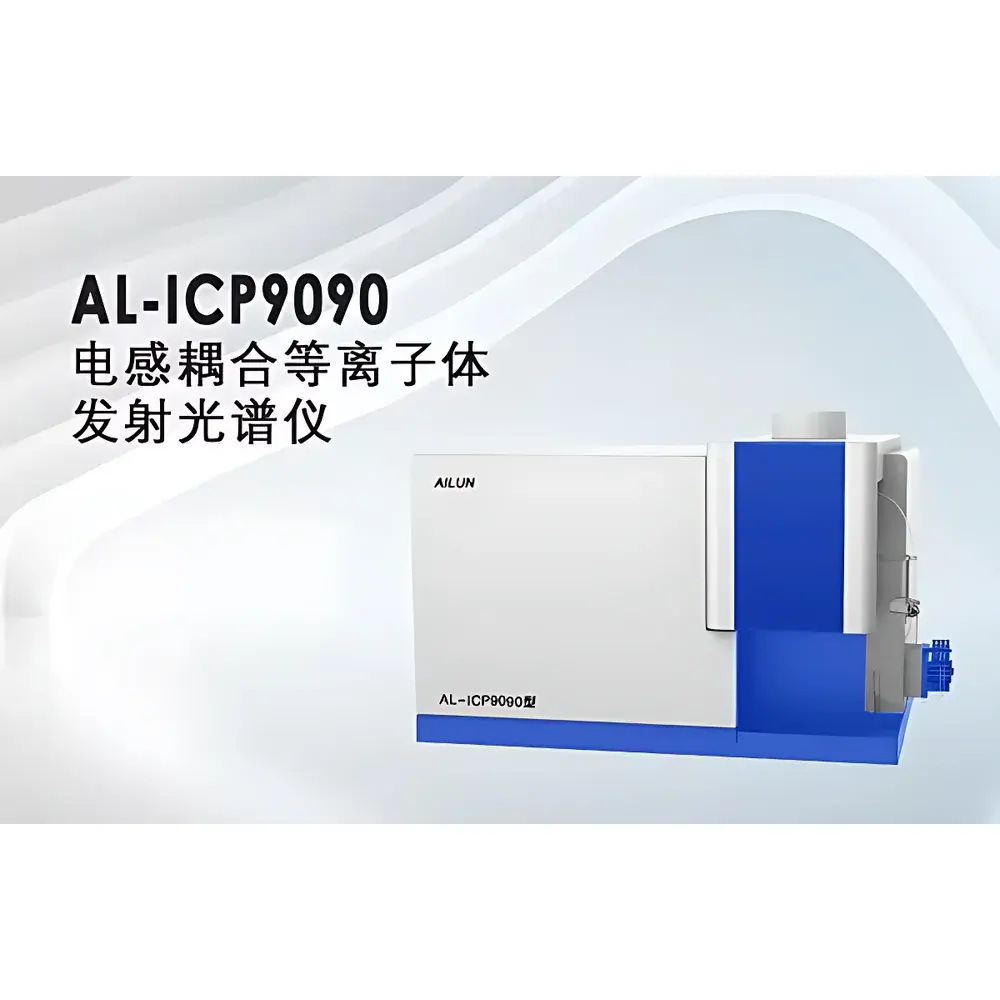
Ailun AL-ICP9090 Inductively Coupled Plasma Optical Emission Spectrometer
| Brand | Ailun General / Qingdao Ailun |
|---|---|
| Origin | Shandong, China |
| Manufacturer Type | Authorized Distributor |
| Origin Category | Domestic (China) |
| Model | AL-ICP9090 |
| Pricing | Upon Request |
Overview
The Ailun AL-ICP9090 is a high-performance inductively coupled plasma optical emission spectrometer (ICP-OES) engineered for precise, multi-element quantitative analysis in environmental, geological, metallurgical, pharmaceutical, and regulatory testing laboratories. Utilizing robust radiofrequency (RF) plasma generation at 27.12 MHz or 40.68 MHz (configurable), the instrument atomizes and excites sample aerosols in a high-temperature (~6,000–10,000 K) argon plasma, enabling detection of atomic and ionic emission lines across the UV-Vis spectral range (165–900 nm). Unlike mass-spectrometric detection, ICP-OES relies on wavelength-resolved photometric measurement—offering superior linear dynamic range (up to 6 orders of magnitude), high sample throughput, and excellent stability for routine trace-metal analysis at sub-pptr (ng/L) levels in liquid matrices.
Key Features
- High-efficiency solid-state RF generator with automatic impedance matching and plasma ignition monitoring
- Simultaneous dual-view plasma configuration (radial and axial observation) for optimized sensitivity and matrix tolerance
- Advanced echelle grating spectrometer with CCD detector (1024 × 1024 pixels), thermoelectric cooling (–15 °C), and low-noise readout architecture
- Integrated peristaltic pump with variable speed control and integrated argon gas flow regulation (plasma, auxiliary, nebulizer)
- Robust torch design with quartz injector and concentric glass nebulizer for stable aerosol generation and minimal memory effects
- Onboard internal standard correction, drift compensation, and real-time background subtraction algorithms
- Compliance-ready hardware architecture supporting audit trails, electronic signatures, and user-access-level management
Sample Compatibility & Compliance
The AL-ICP9090 accepts aqueous solutions, acid-digested environmental or biological samples (e.g., EPA Method 200.7, 200.8, ISO 11885), and diluted industrial process streams. It supports direct analysis of low-TDS samples (<2% total dissolved solids) and accommodates optional accessories for high-salt or organic solvent introduction (e.g., microconcentric nebulizers, chilled spray chambers). The system is designed to meet essential requirements for GLP and GMP environments: full 21 CFR Part 11 compliance is achievable via optional software modules that enforce role-based access control, electronic signature workflows, and immutable audit logs for all method changes, calibration events, and result exports. Instrument qualification documentation (IQ/OQ/PQ templates) is provided to support laboratory validation under ISO/IEC 17025 and ASTM E1655 frameworks.
Software & Data Management
The AL-ICP9090 operates with Ailun’s proprietary SpectraLink™ v4.x acquisition and analysis suite, featuring intuitive method setup wizards, spectral interference library mapping (including common polyatomic overlaps: ArO⁺, ArCl⁺, NO⁺), and customizable report templates compliant with LIMS export standards (ASTM E1382, HL7, CSV/Excel). All raw spectral data are stored in vendor-neutral HDF5 format with embedded metadata (wavelength calibration, integration time, RF power, gas flows). Software supports automated QC checks (e.g., continuing calibration verification per USP , control charting per ISO 8258), and integrates with enterprise LIMS via secure RESTful API or ODBC drivers. Data integrity safeguards include write-once storage mode, automatic backup scheduling, and encrypted database archiving.
Applications
- Environmental monitoring: quantification of regulated metals (As, Cd, Cr, Pb, Hg, Se) in drinking water, wastewater, soil leachates per EPA 200.7/200.8 and ISO 17294-2
- Geochemical exploration: rapid multi-element profiling (Li–U) in rock digests and stream sediments
- Pharmaceutical quality control: elemental impurity screening in active pharmaceutical ingredients (APIs) and excipients per ICH Q3D guidelines
- Metallurgical QA/QC: alloy composition verification (Al, Cu, Fe, Mg, Ni, Zn, Ti) and inclusion analysis in melt samples
- Fertilizer and agricultural product testing: P, K, Ca, Mg, S, B, Zn, Mn, Cu, Fe, Mo determination in plant tissue and soil extracts
- Food safety laboratories: monitoring of toxic elements (Pb, Cd, As, Sn) in infant formula, cereals, and seafood products
FAQ
What is the typical detection limit for common elements using the AL-ICP9090?
Typical 3σ detection limits range from 0.01–0.5 µg/L for most elements in aqueous standards, depending on integration time, viewing mode (axial vs. radial), and spectral line selection.
Does the system support automated calibration and QC protocols?
Yes—the software includes configurable calibration curve generation (linear, quadratic, or weighted), bracketing standards, and automated continuing calibration verification (CCV) with pass/fail thresholds per regulatory method requirements.
Is the AL-ICP9090 compatible with existing laboratory informatics infrastructure?
It supports standard data exchange formats (CSV, XML, PDF reports) and offers optional LIMS integration modules compliant with ASTM E1382 and ANSI/NIST ITL 2005-01 specifications.
What maintenance intervals are recommended for optimal performance?
Routine maintenance includes quarterly torch and injector cleaning, biannual nebulizer inspection, annual RF generator performance verification, and semi-annual spectrometer wavelength calibration using internal Hg/Ar lamp references.
Can the instrument be upgraded for future regulatory requirements?
Hardware architecture supports firmware updates and modular software licensing; optional upgrades include enhanced spectral deconvolution algorithms, expanded interference correction libraries, and extended 21 CFR Part 11 functionality.



