
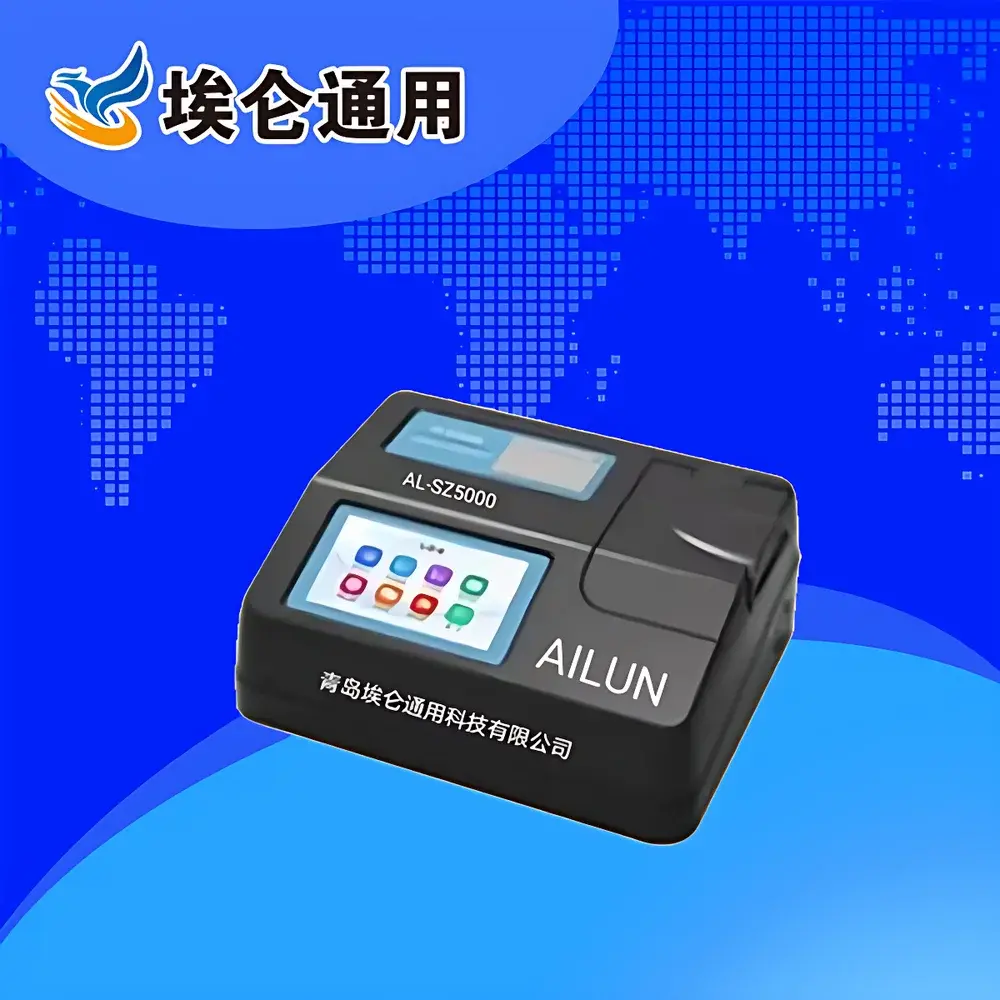
Ailun AL-SZ5000 Multi-Parameter Water Quality Analyzer
| Brand | Ailun General / Qingdao Ailun |
|---|---|
| Origin | Shandong, China |
| Manufacturer Type | Authorized Distributor |
| Country of Origin | China |
| Model | AL-SZ5000 |
| Instrument Type | Laboratory Water Quality Analyzer |
| Measured Parameters | COD, Ammonia Nitrogen (NH₃-N), Total Phosphorus (TP), Total Nitrogen (TN) |
| Measurement Range | COD 5–10,000 mg/L |
| Display | 7-inch color LCD touchscreen |
| Optical System | Imported fiber-optic detection system |
| Wavelength Range | 340–900 nm |
| Wavelength Accuracy | ±1 nm |
| Spectral Bandwidth | 4 nm |
| Light Source | Imported 12 V / 20 W halogen lamp (rated life >100,000 h) |
| Detection Method | Cuvette-based colorimetry with pre-filled reagent vials |
| Resolution | 0.001 mg/L (for applicable ranges) |
| Accuracy | ≤±5% FS |
| Repeatability | ≤±2% RSD |
| Pre-stored Calibration Curves | 100 factory-loaded standard curves + 10 user-definable fitting curves |
| Data Storage | Up to 1,000,000 measurement records with timestamped retrieval |
| Auto-calibration | Yes, with fixed reference channel |
| Digestion Unit | Integrated 16-position digestion block (standard configuration) |
| Printer | Built-in thermal printer for real-time and historical data output |
| Data Interface | USB port + RS-232 serial interface |
| Compliance Standards | HJ 535-2009, GB 11893-1989, HJ/T 399-2007 |
Overview
The Ailun AL-SZ5000 Multi-Parameter Water Quality Analyzer is a laboratory-grade spectrophotometric instrument engineered for precise, standardized quantification of four critical water quality parameters: Chemical Oxygen Demand (COD), Ammonia Nitrogen (NH₃-N), Total Phosphorus (TP), and Total Nitrogen (TN). It operates on the principle of colorimetric analysis using pre-formulated, sealed reagent vials—eliminating manual reagent preparation and minimizing operator-induced variability. The optical architecture integrates a high-stability imported halogen light source (12 V / 20 W, >100,000 h lifetime), a precision 4 nm spectral bandwidth filter system, and a fiber-optic detection path calibrated across 340–900 nm. This design ensures robust photometric performance in routine environmental testing labs where reproducibility, traceability, and regulatory alignment are essential. The instrument conforms to key Chinese environmental monitoring standards—including HJ 535-2009 (Nessler reagent method for NH₃-N), GB 11893-1989 (ammonium molybdate spectrophotometry for TP), and HJ/T 399-2007 (rapid digestion-spectrophotometry for COD)—enabling direct comparability with certified reference methods.
Key Features
- Integrated 16-position digestion module compliant with HJ/T 399-2007 heating profiles for COD and TN digestion.
- 7-inch capacitive touchscreen interface with intuitive navigation, multilingual UI support (English default), and context-sensitive operation prompts.
- Fiber-optic optical path with fixed reference channel for real-time baseline correction and drift compensation.
- 360° rotational cuvette holder ensuring consistent optical alignment and minimizing positional error during sequential measurements.
- Preloaded calibration library: 100 standardized curves aligned to national method protocols, plus 10 user-editable curve slots supporting custom matrix-matched calibrations.
- Automatic wavelength validation and zero-point calibration routines executed at power-on and before each measurement cycle.
- Thermal printer with timestamped output for current results and stored historical datasets—fully traceable for internal QA audits.
Sample Compatibility & Compliance
The AL-SZ5000 is validated for use with surface water, groundwater, domestic wastewater, and industrial effluents within defined turbidity (<50 NTU) and chloride interference limits (COD method: <2000 mg/L Cl⁻). All test procedures align with China’s Ministry of Ecology and Environment (MEE) method equivalency requirements. While not certified to ISO/IEC 17025 under third-party accreditation, its operational framework supports GLP-compliant documentation: audit-trail enabled data logging (user ID, time stamp, method ID, curve version), non-erasable storage, and exportable CSV via USB. The instrument meets electromagnetic compatibility (EMC) Class B requirements per GB/T 18268.1-2010 and safety standards per GB 4793.1-2007.
Software & Data Management
Firmware includes embedded data management tools supporting up to 1,000,000 timestamped records (sample ID, parameter, concentration, curve used, operator ID, digestion temperature/time). Data retrieval is hierarchical—filterable by date range, parameter, or sample batch—and exportable without proprietary software dependency. USB mass-storage mode allows direct file transfer to LIMS or Excel-compatible systems. Serial (RS-232) output enables integration with automated lab workflows or SCADA-linked reporting platforms. All calibration modifications are logged with version control and require dual-password authorization to prevent unauthorized curve edits—supporting 21 CFR Part 11–aligned access controls when deployed in regulated environments.
Applications
The AL-SZ5000 serves as a primary analytical platform in municipal water treatment plants for process control (e.g., nitrification/denitrification monitoring), environmental monitoring stations conducting routine surface water surveillance, and industrial compliance labs verifying discharge permit limits (e.g., TP in phosphate manufacturing effluent, COD in food processing wastewater). Its rapid turnaround (≤15 min per COD determination post-digestion) and minimal consumables footprint make it suitable for high-throughput screening. Academic laboratories utilize its open curve-editing capability for method development studies involving alternative chromogenic reagents or matrix-spiked recovery validation.
FAQ
Does the AL-SZ5000 support external calibration verification with NIST-traceable standards?
Yes—users may perform independent verification using certified reference materials (CRMs) traceable to NIST or CNAS-accredited providers; results are recorded alongside native calibration logs.
Can the digestion block temperature and ramp profile be customized?
The standard firmware implements fixed MEE-compliant heating protocols; advanced users may request OEM firmware variants with programmable temperature profiles under technical support agreement.
Is spectral scanning functionality available for method development?
No—the AL-SZ5000 operates in fixed-wavelength photometric mode only; it does not support full-spectrum acquisition or derivative absorbance analysis.
What maintenance intervals are recommended for optical components?
The halogen lamp requires replacement after ≥100,000 h of cumulative operation; fiber-optic path cleaning is advised quarterly using lint-free swabs and isopropyl alcohol per maintenance manual Section 4.2.
How is data integrity ensured during power interruption?
All measurements in progress are buffered in non-volatile memory; incomplete digestions trigger automatic pause/resume upon restart, preserving thermal history and result validity.







