
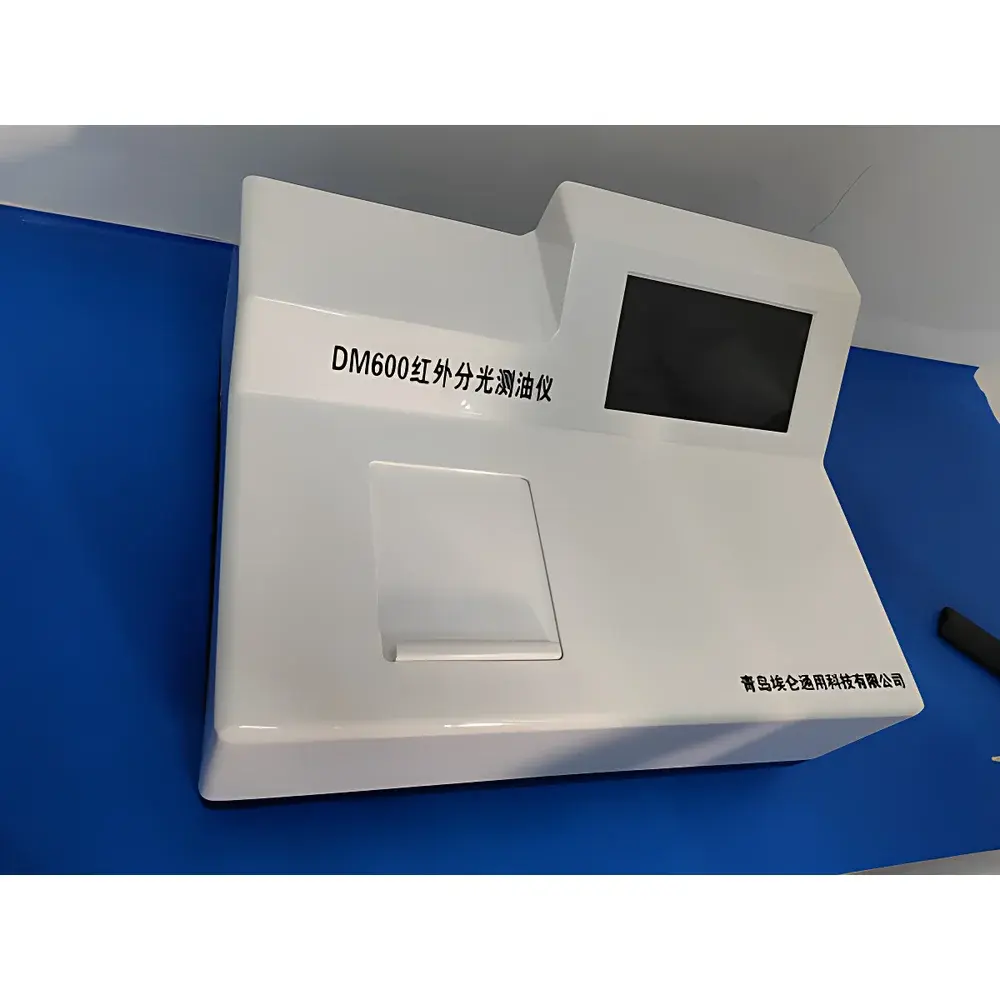
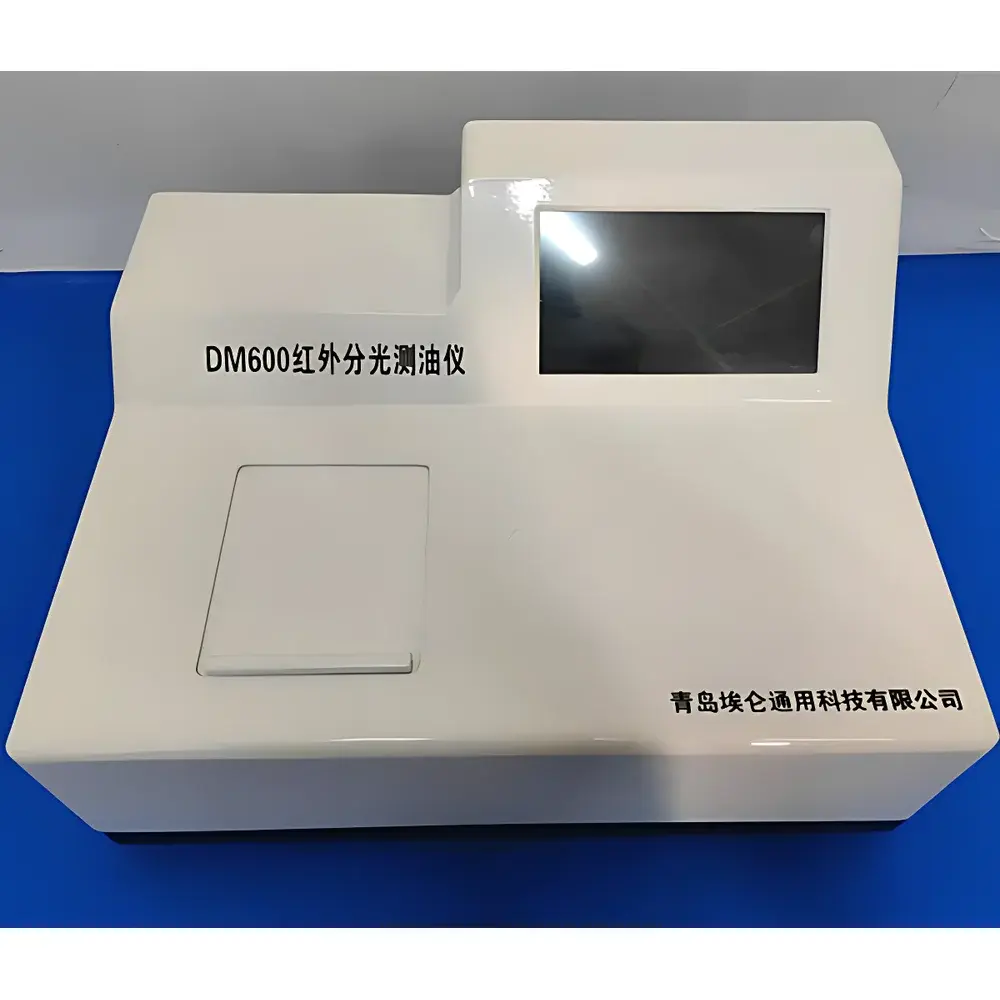
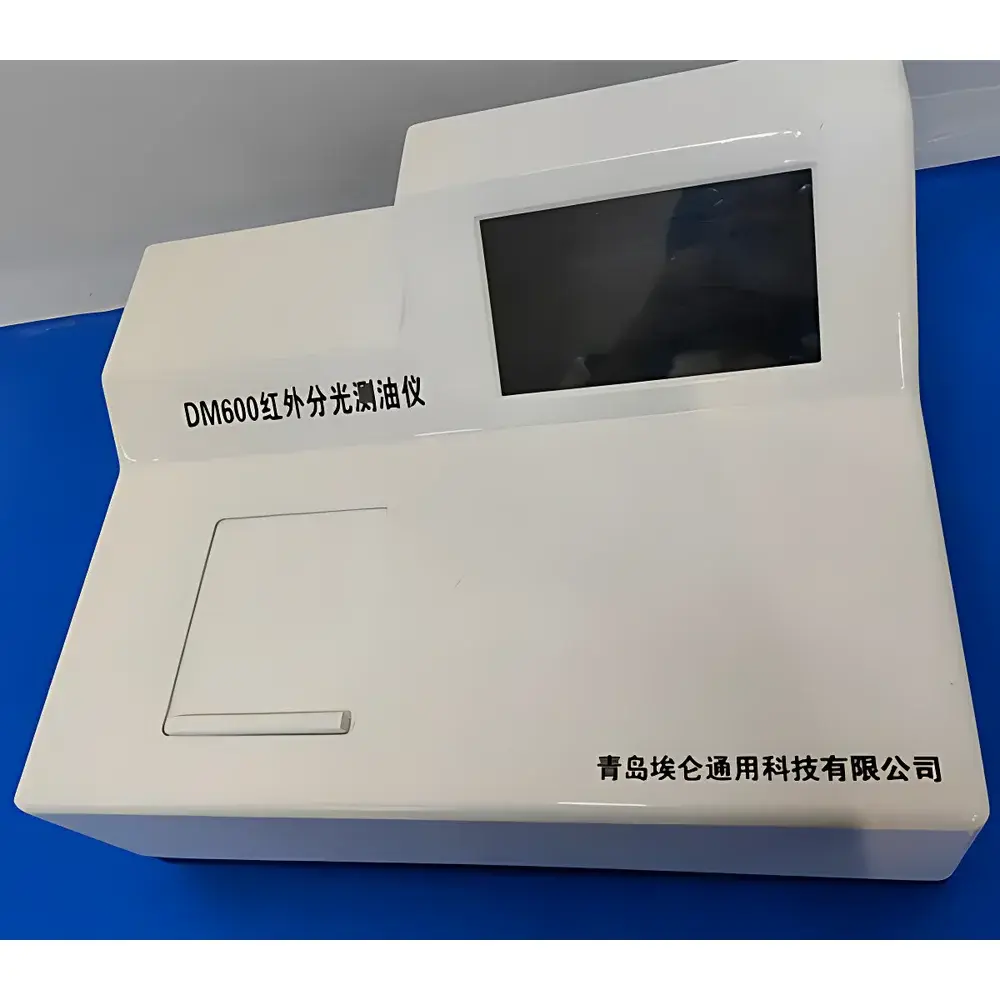
Ailun General AL-8 Infrared Oil Content Analyzer
| Brand | Ailun General / Qingdao Ailun |
|---|---|
| Origin | Shandong, China |
| Model | AL-8 |
| Instrument Type | Laboratory |
| Principle | Infrared Spectrophotometry |
| Measurement Range | 0.00–1000 mg/L |
| Detection Limit | <0.0012 mg/L (C₂Cl₄ extract, 4 cm quartz cuvette) |
| Accuracy | ±0.5 mg/L (C < 10 mg/L) |
| Resolution | 0.01 mg/L |
| Wavenumber Range | 3400–2400 cm⁻¹ |
| Absorbance Range | 0.0000–3.000 AU |
| Baseline Drift | <0.001 AU/60 min |
| Dimensions | 550 × 380 × 150 mm |
| Weight | 15 kg |
| Power Supply | 220 ± 22 V, 50–60 Hz, 35 VA |
Overview
The Ailun General AL-8 Infrared Oil Content Analyzer is a dedicated laboratory instrument engineered for the quantitative determination of total petroleum hydrocarbons (TPH) and animal/vegetable oils in aqueous matrices using standardized infrared spectrophotometry. It operates on the fundamental principle that hydrocarbon functional groups—particularly C–H stretching vibrations in methyl (–CH₃), methylene (–CH₂–), and aromatic structures—exhibit characteristic absorption bands within the mid-infrared region (3400–2400 cm⁻¹). The AL-8 specifically measures absorbance at three critical wavenumbers: 2930 cm⁻¹ (aliphatic C–H stretch), 2960 cm⁻¹ (methyl C–H asymmetrical stretch), and 3030 cm⁻¹ (aromatic C–H stretch), applying the HJ 637–2012 correction algorithm to compute oil concentration as C = X·A2930 + Y·A2960 + Z·(A3030 − A2930/F). This methodology ensures compliance with the Chinese national environmental standard for water quality analysis and delivers trace-level sensitivity required for regulatory monitoring of surface water, groundwater, municipal wastewater, and industrial effluents.
Key Features
- Optically integrated, detachable optical module designed for enhanced thermal stability and reduced mechanical drift—enabling high signal-to-noise ratio (SNR) performance without moving chopper components.
- Electrically modulated infrared source eliminates thermal stress and mechanical wear associated with traditional rotating choppers, improving long-term reliability and reducing maintenance intervals.
- Phase-sensitive lock-in amplifier circuitry applied to detector signal processing, extending detection capability to sub-μg/L levels in optimized extraction configurations.
- Full spectral scanning functionality (3400–2400 cm⁻¹) supports qualitative interference assessment, baseline verification, and method validation—allowing users to visually identify spectral anomalies from solvents, surfactants, or humic substances.
- Universal cuvette compartment accommodating path lengths from 1 cm to 5 cm, compatible with standard quartz cells; enables dynamic range extension via dilution or concentration strategies without hardware modification.
- Embedded microprocessor-controlled data acquisition and real-time calculation engine—capable of completing a full measurement cycle, including auto-zeroing, spectral acquisition, and concentration computation, in under 30 seconds.
- Integrated dual-role architecture: functions both as a dedicated oil analyzer per HJ 637–2012 and as a general-purpose infrared spectrophotometer for auxiliary research applications.
Sample Compatibility & Compliance
The AL-8 is validated for use with tetrachloroethylene (C₂Cl₄) as the primary extraction solvent—a requirement specified in HJ 637–2012 due to its low background absorbance and favorable phase separation characteristics. The system includes built-in solvent purity verification routines to confirm spectral cleanliness prior to sample analysis, preventing false positives from contaminated reagents. Method applicability covers all common aqueous environmental samples: raw and treated drinking water sources, leachate, cooling tower blowdown, oily bilge water, and bioremediation effluent streams. While not certified to ISO/IEC 17025 or EPA Method 1664, the AL-8’s optical design, calibration traceability, and documented linearity (R > 0.999 over 0.01–1000 mg/L) support internal QA/QC protocols aligned with GLP principles. Its fixed-wavelength algorithm implementation ensures reproducibility across laboratories when operated under controlled environmental conditions (5–35 °C, 20–80% RH).
Software & Data Management
The AL-8 is operated via a Windows-based graphical workstation software package supporting full audit trail functionality—including user login timestamps, parameter change logs, and raw spectral file metadata (date/time, cuvette path length, operator ID). All absorbance spectra and quantitative results are saved in proprietary binary format with optional export to CSV or PDF for integration into LIMS environments. Calibration curves are stored with coefficient sets (X, Y, Z, F), enabling multi-point standardization and batch recalibration without firmware updates. The software implements automatic zero-point compensation before each measurement, linear regression fitting for standard series, and outlier rejection based on residual analysis. Though not compliant with FDA 21 CFR Part 11 out-of-the-box, the system supports manual electronic signature logging and can be configured for 21 CFR Part 11 readiness through supplementary IT governance controls.
Applications
- Regulatory compliance testing for petroleum hydrocarbon discharge limits under local environmental protection ordinances.
- Wastewater treatment plant influent/effluent monitoring to assess oil-water separation efficiency and membrane fouling potential.
- Environmental site assessment (ESA) and Phase II investigations where rapid field-lab turnaround is critical for decision-making.
- Research on emulsified oil stability, biodegradation kinetics, and surfactant-assisted remediation processes.
- Quality control of industrial process water used in metalworking, food processing, and pharmaceutical manufacturing.
- Educational laboratories requiring a robust, standards-aligned platform for teaching infrared spectroscopy fundamentals and environmental analytical chemistry.
FAQ
What extraction solvent is required for AL-8 operation?
Tetrachloroethylene (C₂Cl₄) is mandatory per HJ 637–2012; alternative solvents such as n-hexane or Freon-113 are not supported due to spectral interference and non-compliance with the standard’s correction algorithm.
Can the AL-8 measure dissolved vs. dispersed oil fractions separately?
No—the AL-8 reports total extractable oil content as defined by the standard method; fractionation requires complementary techniques such as gas chromatography or gravimetric separation.
Is the instrument suitable for saline or high-TDS water samples?
Yes, provided extraction efficiency is verified; high ionic strength may affect phase separation but does not interfere with infrared absorbance measurement post-extraction.
How often must the system be calibrated?
Initial calibration is performed with certified reference standards; routine verification is recommended daily using a mid-range check standard (e.g., 40 mg/L), with full multi-point calibration every 7–14 days depending on usage frequency.
Does the AL-8 support automated sample introduction?
No—it is a manual-load benchtop instrument; autosamplers are not available as factory options, though third-party liquid handlers may be interfaced via RS-232 or USB virtual COM port.







