
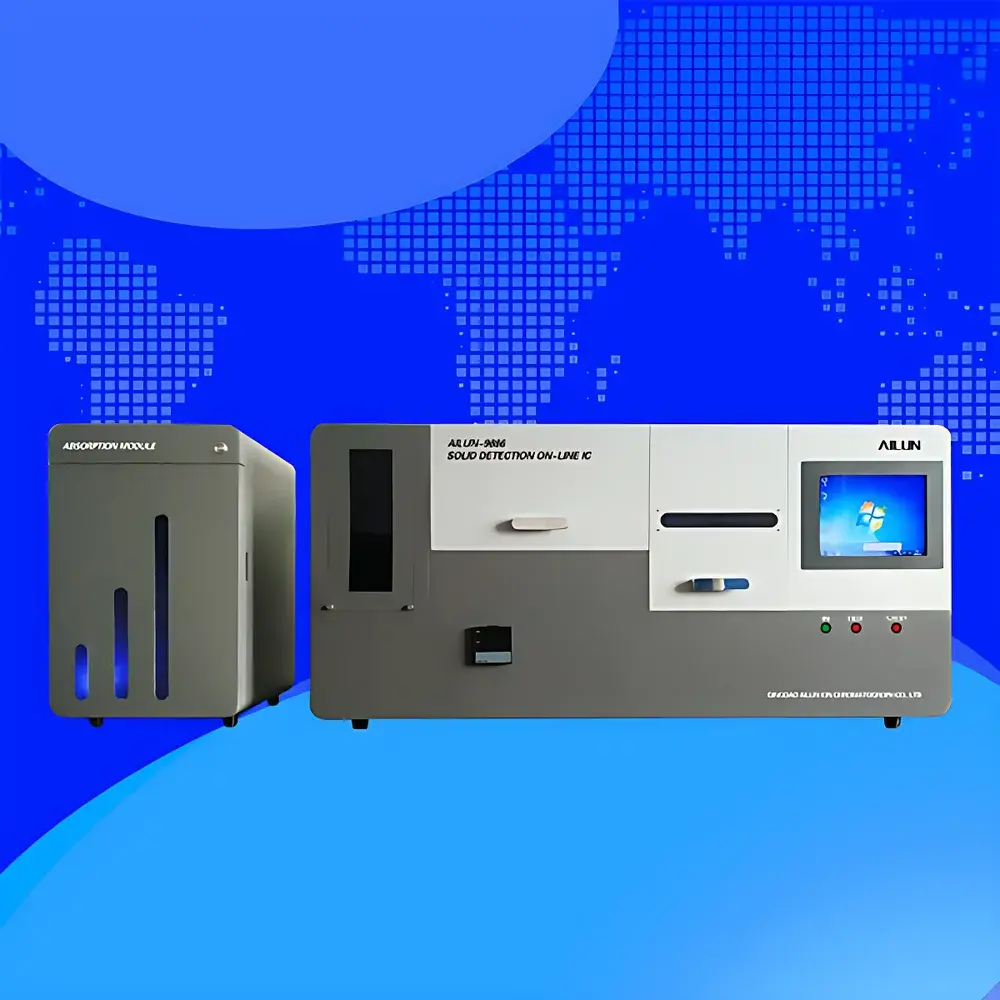
Ailun General AULUN-H9886 Solid-State Morphology Detection Online Ion Chromatograph
| Brand | Ailun General |
|---|---|
| Origin | Shandong, China |
| Manufacturer Type | Authorized Distributor |
| Regional Classification | Domestic (PRC) |
| Model | AULUN-H9886 |
| Instrument Type | Laboratory Benchtop |
| Application Scope | Universal |
| Pump Pressure Range | 0–42 MPa |
| Flow Rate Range | 0.001–9.999 mL/min |
| Eluent Flow Rate | 0.7–1.5 mL/min |
| Maximum Operating Pressure | 0–35 MPa |
| Operating Temperature Range | 5–65 °C |
| Temperature Reproducibility | ±0.1 °C |
| Eluent Concentration Range | 1.92–4.8 mM |
Overview
The Ailun General AULUN-H9886 Solid-State Morphology Detection Online Ion Chromatograph is a high-precision, laboratory-grade ion chromatography system engineered for the quantitative and qualitative analysis of ionic species in complex solid-phase matrices—without requiring full dissolution or aggressive sample pretreatment. Unlike conventional ion chromatographs designed exclusively for aqueous elution, the AULUN-H9886 integrates an optimized hyphenated workflow combining controlled thermal desorption, on-line matrix-assisted extraction, and suppressed conductivity detection to resolve ionic signatures directly linked to solid morphology (e.g., crystallinity, phase segregation, surface-bound counterions, or salt hydrate states). This architecture enables trace-level anion/cation profiling—including F⁻, Cl⁻, NO₂⁻, NO₃⁻, SO₄²⁻, PO₄³⁻, NH₄⁺, Na⁺, K⁺, Ca²⁺, Mg²⁺—in heterogeneous solids such as polymer granules, catalyst pellets, pharmaceutical excipients, electronic substrate residues, and thermally stable waste streams. Its design conforms to fundamental principles of ISO 17025-compliant analytical method validation and supports GLP-aligned documentation workflows.
Key Features
- Integrated solid-state interface module enabling direct injection of particulate, powdered, or pelletized samples via programmable thermal ramping and low-volume eluent flushing
- High-pressure dual-piston reciprocating pump with active pulse damping, delivering flow stability ≤0.05% RSD across the full 0.001–9.999 mL/min range
- Thermostatically controlled column compartment (5–65 °C, ±0.1 °C reproducibility) compatible with both high-capacity anion-exchange and cation-exchange columns (e.g., Dionex IonPac AS23, CS12A)
- On-board eluent generator supporting gradient-compatible carbonate/bicarbonate and methanesulfonic acid systems; concentration programmability from 1.92 to 4.8 mM with ≤0.5% CV precision
- Auto-sampler with 108-position vial capacity, integrated standard curve builder, and sequence-based calibration verification per ASTM D4327 and ISO 10304-1
- Real-time pressure monitoring at pump outlet, column inlet, and detector cell; automatic shutdown at 35 MPa threshold to protect separation integrity
Sample Compatibility & Compliance
The AULUN-H9886 accommodates non-aqueous and semi-solid samples including polymeric resins (PET, PE, PP), spent refinery catalysts, printed circuit board (PCB) leachates, incinerated medical waste ash, pharmaceutical tablet coatings, and edible oil processing residues. Sample introduction utilizes a proprietary low-dwell-volume extraction loop coupled with back-flush capability to minimize carryover (<0.01% for Cl⁻ at 10 ppm). System compliance includes alignment with USP for water conductivity testing, EPA Method 300.1 for anion analysis, and ICH Q2(R2) guidance for method robustness. Data audit trails meet FDA 21 CFR Part 11 requirements when deployed with optional secure user authentication and electronic signature modules.
Software & Data Management
Controlled via Ailun ChromoLink™ v4.2 software—a Windows-based platform supporting method parameter encryption, version-controlled method libraries, and automated report generation in PDF/A-1b and CSV formats. All acquisition parameters (flow, temperature, gradient, detector gain) are stored as XML metadata within raw data files (.ICD). Software supports remote instrument status polling via HTTPS API and integrates with LIMS through ASTM E1384-compliant messaging. Raw chromatograms retain native time-stamped detector voltage traces; peak integration follows ISO 14155-defined baseline algorithms with configurable noise thresholding and retention time locking.
Applications
- Petrochemicals: Quantification of chloride-induced stress corrosion precursors in crude oil fractions and catalyst support leachates
- Environmental Monitoring: Speciation of halide and sulfate salts in stabilized fly ash and municipal solid waste incineration residues
- Plastics Recycling: Detection of brominated flame retardant residuals (e.g., TBBPA-derived Br⁻) and residual catalyst ions (e.g., Sn²⁺, Ti⁴⁺) in post-consumer PET flakes
- Electronics Manufacturing: Ionic contamination screening (Na⁺, Cl⁻, SO₄²⁻) on PCB surfaces per IPC-J-STD-001 and IEC 61189-5-5
- Pharmaceuticals: Counterion profiling in lyophilized biologics and residual acetate/phosphate in mRNA lipid nanoparticle formulations
- Food Safety: Nitrite/nitrate migration from packaging films into edible oils under accelerated storage conditions (ISO 10565)
FAQ
Can the AULUN-H9886 analyze intact polymer pellets without digestion?
Yes—the system employs a thermally modulated micro-extraction interface that releases surface and lattice-bound ions under controlled inert gas purge, preserving bulk morphology for subsequent SEM/EDS correlation.
Is method transfer supported between AULUN-H9886 and legacy IC platforms?
Method parameter files (.ICM) export in vendor-neutral JSON schema; retention time alignment is achievable within ±0.2% using internal standard referencing per ISO 10304-3.
What maintenance intervals are recommended for the eluent generator?
Electrolytic membrane replacement every 12 months or 5,000 analysis cycles; suppressor cartridge life extends to 3,000 injections under 1.2 mM KOH eluent at 1.0 mL/min.
Does the system support EPA-approved methods for wastewater solids?
Fully compliant with EPA Method 300.0 (modified for solid-phase extraction) and ASTM D5907 for total dissolved solids-associated anions; validation packages include spike recovery data across 10–500 µg/g ranges.
How is data integrity ensured during networked operation?
All raw data files are SHA-256 hashed at acquisition; software enforces write-once-read-many (WORM) archive mode when connected to NAS with SMB 3.1.1 encryption and access control lists (ACLs).
Related Products





