
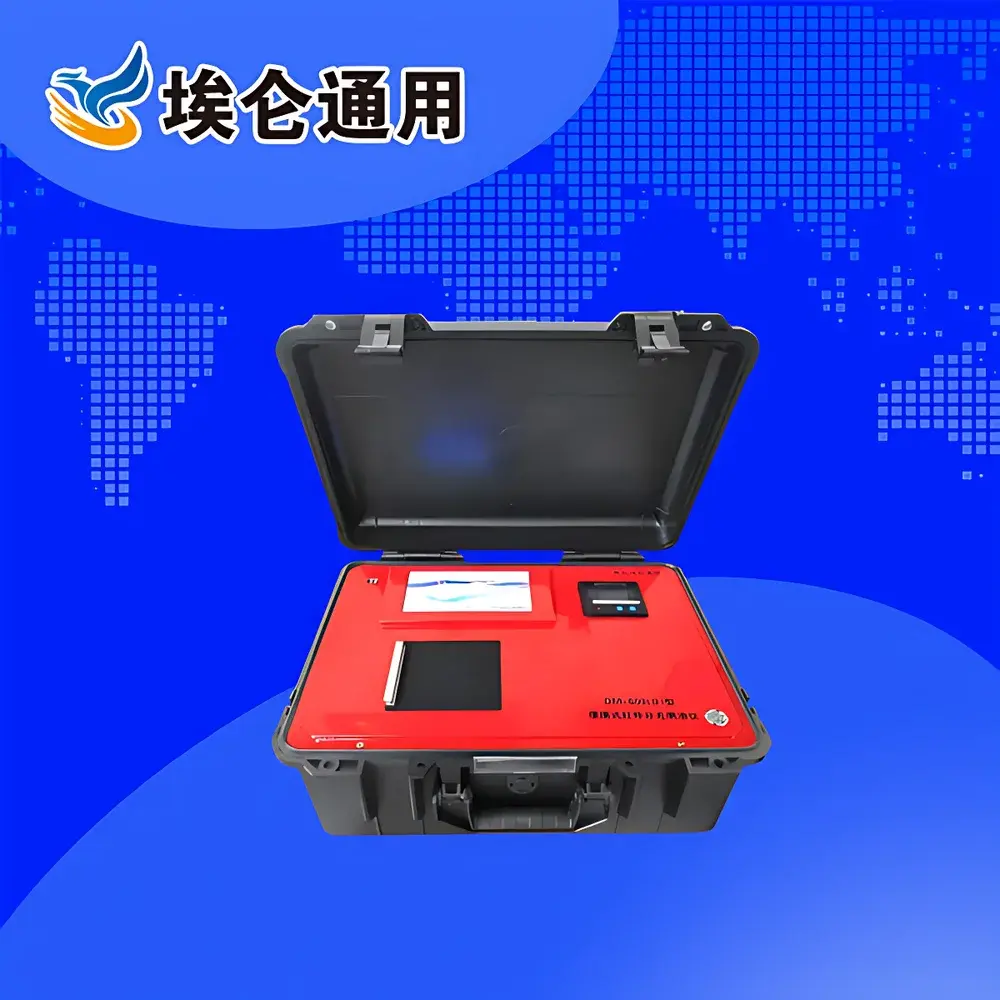
Ailun General DM-600(III) Portable Infrared Spectrophotometric Oil Analyzer
| Brand | Ailun General / Qingdao Ailun |
|---|---|
| Origin | Shandong, China |
| Manufacturer Type | Authorized Distributor |
| Country of Origin | China |
| Model | DM-600(III) |
| Instrument Type | Portable |
| Principle | Infrared Spectrophotometry (Fourier-transform-free dispersive IR) |
| Measurement Range | 0.00–64,000 mg/L |
| Detection Limit | 0.0012 mg/L (as oil in water) |
| Accuracy | ±2% of reading |
| Spectral Resolution | 1 cm⁻¹ |
| Analysis Time per Sample | ≤60 s |
| Wavenumber Accuracy | ±1 cm⁻¹ |
| Absorbance Range | 0.00000–2.00000 AU |
| Wavenumber Range | 2400–3400 cm⁻¹ |
| Operating Temperature | −5 to 50 °C |
| Relative Humidity | 20–95% RH (non-condensing) |
| Power Supply | Internal Li-ion battery (≥8 h continuous operation) or 12 V DC automotive input |
| Compatible Extraction Solvents | Tetrachloroethylene (PERC) and Carbon Tetrachloride (CCl₄) |
Overview
The Ailun General DM-600(III) Portable Infrared Spectrophotometric Oil Analyzer is an engineered field-deployable instrument designed for quantitative determination of total petroleum hydrocarbons (TPH), petroleum hydrocarbons (petroleum oils), and non-petroleum hydrocarbons (e.g., animal and vegetable oils) in aqueous matrices. It operates on the principle of infrared absorption spectroscopy—specifically targeting C–H bond stretching vibrations in aliphatic (2930 cm⁻¹ and 2960 cm⁻¹) and aromatic (3030 cm⁻¹) functional groups. The instrument implements a three-point calibration algorithm compliant with HJ 637–2018, the official Chinese Environmental Protection Standard for determination of petroleum and animal/vegetable oils in water by infrared spectrophotometry. Samples are first acidified to pH ≤2, then extracted using tetrachloroethylene (or carbon tetrachloride), followed by silica-magnesium adsorption to separate polar interferences prior to spectral acquisition. This dual-measurement protocol enables independent quantification of total oil content and petroleum-specific content, with animal/vegetable oil derived as their arithmetic difference.
Key Features
- Integrated optical architecture with rigid monolithic beam path—designed for high mechanical stability and vibration resistance during transport and field deployment.
- Dedicated shock-absorbing carrying case with ergonomic handles and modular accessory compartments for extraction vials, solvent bottles, and calibration standards.
- High-capacity rechargeable lithium-ion battery supporting ≥8 hours of continuous operation; optional 12 V DC automotive power interface extends operational window for extended site surveys.
- Multi-solvent compatibility: validated performance with both tetrachloroethylene (PERC) and carbon tetrachloride (CCl₄) as extraction media—enabling alignment with evolving regulatory solvent restrictions and lab safety protocols.
- Real-time spectral acquisition across 2400–3400 cm⁻¹ at 1 cm⁻¹ resolution, with absorbance linearity verified from 0.00000 to 2.00000 AU—supporting robust quantitation across four orders of magnitude (0.0012–64,000 mg/L).
- Onboard spectral validation: automatic wavenumber accuracy verification via built-in polystyrene reference peak (1601 cm⁻¹), traceable to NIST-traceable standards.
Sample Compatibility & Compliance
The DM-600(III) is validated for use with surface water, groundwater, municipal wastewater, industrial effluents, cooling tower water, boiler feedwater, and soil leachates following standard EPA Method 1664 (modified) and HJ 637–2018 sample preparation protocols. Its measurement uncertainty profile (±2% RSD) meets the repeatability requirements specified in ISO 9562:2021 (Petroleum products — Determination of oil content in water — Infrared spectrometric method). The instrument supports GLP-compliant data handling when paired with external audit-ready software; all spectral acquisitions include embedded timestamps, operator ID fields, and solvent lot tracking. While not inherently 21 CFR Part 11 compliant, its raw spectral output (.spc or .csv) is compatible with validated third-party LIMS platforms supporting electronic signature and audit trail functions.
Software & Data Management
The analyzer includes embedded firmware with intuitive touchscreen navigation and context-sensitive help prompts. All spectra and quantitative results are stored internally with metadata (date/time, operator ID, solvent batch, calibration ID, sample ID). Export options include USB mass storage (FAT32), Bluetooth 5.0 (to Windows/Linux laptops), and optional Wi-Fi module (IEEE 802.11n) for direct transfer to cloud-based environmental data management systems. Quantitative algorithms implement full HJ 637–2018 correction equations—including solvent blank subtraction, matrix interference compensation, and triple-wavenumber regression weighting. Raw spectral files retain full 1 cm⁻¹ resolution for retrospective reprocessing or inter-laboratory comparison.
Applications
- Field screening of oil contamination in rivers, lakes, and coastal zones during spill response or routine monitoring programs.
- Compliance testing for discharge permits under local environmental regulations (e.g., China’s GB 8978–1996, EU WFD Annex X).
- Process water quality control in petrochemical refineries, steel mills, thermal power plants, and food processing facilities.
- Source water assessment for municipal drinking water utilities detecting hydrocarbon intrusion from pipeline leaks or upstream industrial activity.
- Soil-water partition studies in agricultural, forestry, and aquaculture settings where hydrophobic organic contaminants may migrate into irrigation or groundwater supplies.
- Method validation and cross-platform verification in academic and governmental research laboratories conducting comparative oil speciation studies.
FAQ
Does the DM-600(III) support ASTM D7066–04 or ISO 9562:2021 compliance?
Yes—the instrument’s spectral range, resolution, and calibration methodology align with the core technical requirements of both standards; however, formal certification requires laboratory-specific validation per ISO/IEC 17025.
Can the unit be used with alternative solvents such as cyclohexane or hexane?
No—only tetrachloroethylene and carbon tetrachloride are validated due to their well-defined IR transparency windows and established extinction coefficients in the target wavenumber region.
Is spectral library matching or compound identification supported?
No—the DM-600(III) is purpose-built for targeted quantitation of bulk hydrocarbon classes, not qualitative identification; it does not include spectral search engines or chemometric modeling modules.
What maintenance is required for long-term field reliability?
Annual optical alignment verification and desiccant replacement in the sample compartment are recommended; no user-serviceable optics or laser components are present.
How is calibration traceability ensured?
Calibration standards are prepared gravimetrically using certified reference materials (CRM) traceable to NIM (China National Institute of Metrology); instrument-specific calibration curves are stored with version-controlled metadata.







