
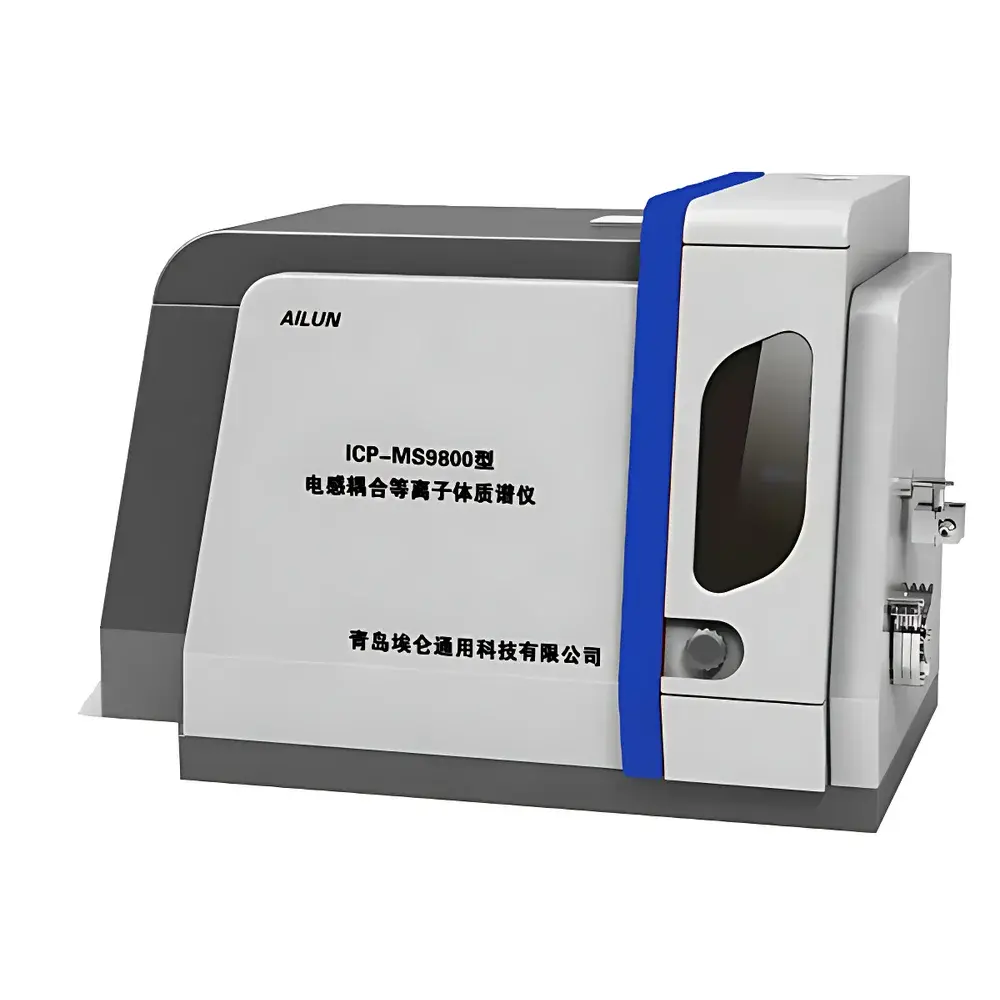
Ailun ICP-MS9800 Inductively Coupled Plasma Mass Spectrometer
| Brand | Ailun General / Qingdao Ailun |
|---|---|
| Origin | Shandong, China |
| Manufacturer Type | Authorized Distributor |
| Domestic Product Classification | Domestic |
| Model | ICP-MS9800 |
| Pricing | Upon Request |
Overview
The Ailun ICP-MS9800 is a high-performance, benchtop-inductively coupled plasma mass spectrometer engineered for trace elemental analysis at sub-pictogram-per-gram (ppt) detection levels. It operates on the fundamental principle of ionizing sample aerosols in a high-temperature argon plasma (~7,000–10,000 K), followed by mass separation and detection of elemental ions using a quadrupole mass analyzer. The system integrates a frequency-tunable RF generator to sustain stable plasma under variable matrix conditions—including organic solvents—enabling direct analysis without extensive dilution or digestion. Its compact architecture, modular mechanical design, and vibration-dampened optical and ion-optical pathways ensure operational robustness in both fixed laboratory and mobile deployment scenarios, including vehicle-mounted configurations compliant with ISO/IEC 17025 field-testing requirements.
Key Features
- Frequency-modulated RF plasma source: Enables stable ignition and sustained operation with aqueous and organic matrices (e.g., kerosene, diesel, ethanol-based extracts), eliminating need for oxygen addition or plasma re-ignition during solvent switching.
- Shielded torch interface with low-noise ion extraction optics: Reduces polyatomic interferences (e.g., 40Ar16O+, 40Ar12C+) and improves signal-to-background ratio for elements below mass 80, achieving typical detection limits of 0.08–0.35 fg g−1 for key isotopes (e.g., 7Li, 52Cr, 56Fe).
- Integrated gas management system: Uses flexible, low-permeability polymer tubing and precision mass flow controllers (MFCs) for Ar, He, and optional reaction gases (e.g., H2, NH3), minimizing leak points and ensuring long-term flow stability (< ±0.2% over 8 h).
- Three-axis motorized sample introduction platform: Allows precise, repeatable alignment between nebulizer, spray chamber, and torch without manual repositioning—critical for maintaining sensitivity reproducibility across multi-day campaigns.
- Mobile-ready mechanical design: Includes reinforced chassis, shock-absorbing feet, and thermally balanced electronics housing; validated for operation in ISO 14644 Class 8 cleanroom-equivalent vehicles with active thermal management (ambient range: 15–30 °C, RH ≤70%).
Sample Compatibility & Compliance
The ICP-MS9800 supports liquid samples introduced via standard pneumatic nebulization (glass concentric or microflow), as well as optional laser ablation (LA-ICP-MS) and hydride generation (HG-ICP-MS) interfaces. With integrated collision/reaction cell (CRC) technology utilizing He or H2 gas, it mitigates isobaric overlaps for As, Se, Cd, and Sb in complex environmental digests and biological fluids. The instrument meets analytical performance criteria outlined in EPA Method 6020B, ISO 17294-2:2016, and ASTM D5673 for trace metal quantification. Data acquisition and audit trails comply with GLP and 21 CFR Part 11 requirements when used with validated software configurations.
Software & Data Management
The Ailun ICP-MS Control Suite runs natively on Windows 10/11 and features a drag-and-drop method builder with real-time parameter visualization (plasma power, lens voltages, detector gain, gas flows). All acquisition parameters are version-controlled and stored in an XML-based method library compatible with Windows Explorer navigation. Quantitative workflows support internal standard correction (e.g., 115In, 187Re), isotope dilution (ID-ICP-MS), and interference-corrected calibration curves. Raw data (.raw) and processed results (.csv, .xlsx) are timestamped, digitally signed, and exportable with full metadata—including instrument configuration, calibration history, and QC flagging per ISO/IEC 17025 clause 7.7.
Applications
The ICP-MS9800 delivers reliable quantification in regulated and research environments requiring ultra-trace element detection: environmental monitoring of heavy metals in soil leachates and drinking water (per WHO guidelines); speciation analysis via HPLC-ICP-MS coupling for As(III)/As(V), Cr(III)/Cr(VI), and methylmercury; impurity profiling in semiconductor-grade chemicals (SEMI F57); residual catalyst analysis in pharmaceutical intermediates (ICH Q2(R2)); and isotopic ratio measurements in nuclear safeguards (e.g., 235U/238U). Its organic compatibility also supports direct analysis of lubricants, crude oil fractions, and plant-derived bio-oils per ASTM D7845.
FAQ
Does the ICP-MS9800 support hyphenated techniques such as HPLC-ICP-MS?
Yes—the system includes standardized analog/digital I/O ports and configurable dwell times to synchronize with external chromatographic systems; application notes for arsenic and selenium speciation are available upon request.
Is the instrument certified for field use under ISO/IEC 17025?
While the base unit is not pre-certified, its mechanical and thermal specifications meet the environmental robustness criteria for mobile testing labs; validation documentation and IQ/OQ protocols are provided to support client-led accreditation.
Can the software generate audit-trail-compliant reports for FDA-regulated laboratories?
When deployed with validated user access controls, electronic signatures, and backup retention policies, the software satisfies 21 CFR Part 11 requirements for electronic records and signatures.
What maintenance intervals are recommended for routine operation?
Daily: Torch cleaning and tuning; Weekly: Nebulizer inspection and vacuum pump oil check; Quarterly: Quadrupole mass calibration and detector gain verification using NIST-traceable standards.
Is remote diagnostics supported?
Yes—via secure TLS-encrypted VNC connection with prior authorization; service engineers can perform firmware updates, diagnostic sweeps, and parameter optimization without physical access.





