
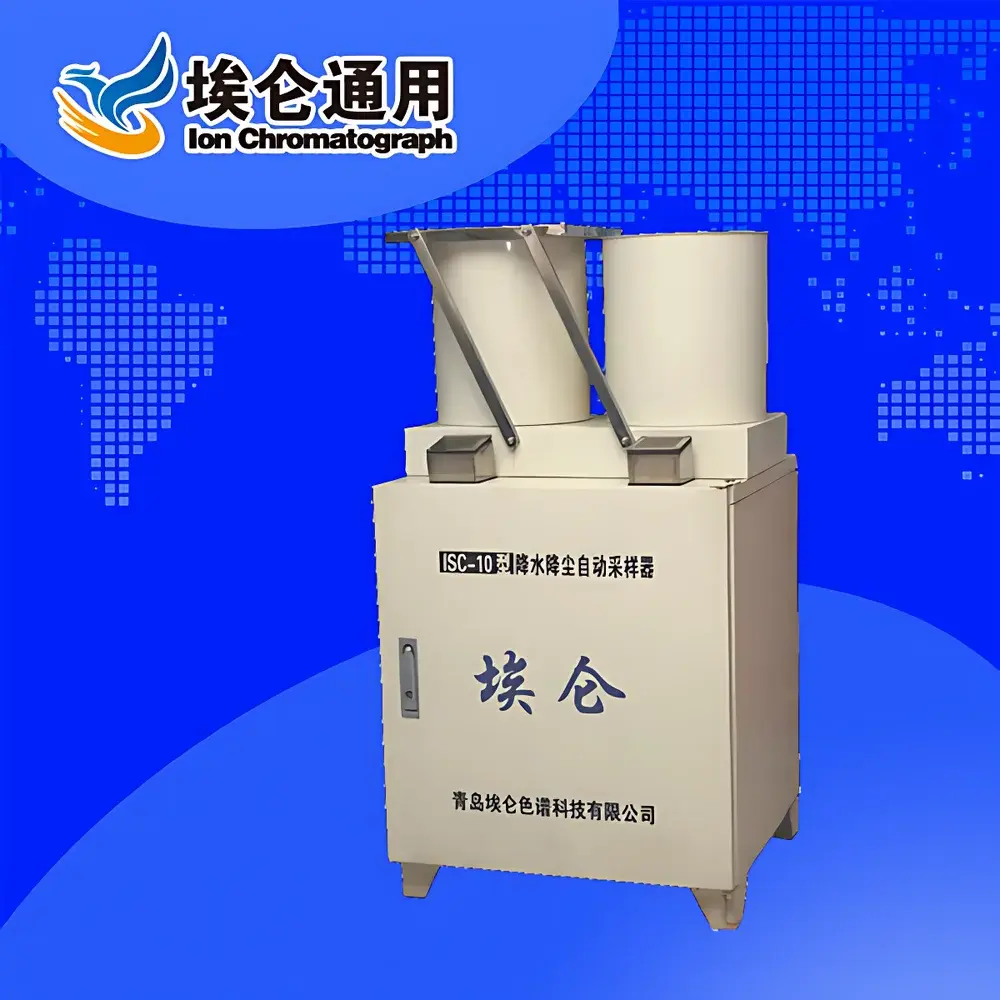
Ailun ISC-10 Automatic Precipitation and Dry Deposition Sampler
| Brand | Ailun General / Qingdao Ailun |
|---|---|
| Origin | Shandong, China |
| Manufacturer Type | Authorized Distributor |
| Regional Classification | Domestic (China) |
| Model | ISC-10 |
| Instrument Category | Automatic Sampler |
| Sampling Mode | Time-Programmed & Volume-Controlled |
| Instrument Form Factor | Portable Water Sampler |
| Single Sample Volume | 8000 mL |
| Sampling Volume Accuracy | ±0.01 mL |
| Sampling Speed Range | 0.01–15 mm/min |
| Programmable Sampling Interval | Yes |
| Minimum Sampling Depth | ≥1.0 m |
| Rainfall Detection Threshold | ≥0.02 mm/h or ≥0.5 mm raindrop diameter |
| Rain Gauge Range | 0–4 mm/min |
| Rainfall Measurement Accuracy | ±0.4 mm (≤10 mm) |
| Rain Gauge Resolution | 0.1 mm |
| Data Storage Capacity | ≥1000 rainfall events |
| Operating Temperature | −40 °C to +50 °C |
| Relative Humidity Tolerance | up to 99% RH |
| Wind Resistance | ≤ Beaufort Scale 9 |
| Power Supply | AC 220 V, 50 Hz / DC backup capable |
| Standby Power Consumption | 2 W |
| Compliance Standard | HJ/T 174–2005 |
Overview
The Ailun ISC-10 Automatic Precipitation and Dry Deposition Sampler is an engineered environmental monitoring instrument designed for unattended, long-term collection of atmospheric wet and dry deposition samples in compliance with Chinese national standard HJ/T 174–2005. It operates on a dual-mode sampling principle: triggering via real-time precipitation detection (using either comb-type or rotating mechanical sensors), then executing programmable, volume-accurate collection across multiple discrete sample vessels. The system integrates a precision rain gauge—available in tipping-bucket or siphon configurations—with electronic logging of start/stop time, accumulated rainfall depth, ambient temperature, and system fault status. All collected samples are maintained at 3–5 °C via integrated refrigeration, minimizing chemical degradation and biological activity during field deployment. Its robust stainless-steel chassis, anti-corrosion coating, and dust-protective inner lining ensure operational integrity under extreme climatic conditions, including −40 °C cold starts and 9-level wind exposure.
Key Features
- Stainless-steel mainframe with electrophoretic anti-corrosion coating and internally lined sample buckets featuring contamination-resistant polymer barriers
- Dual-sensor precipitation detection: comb-type sensor for high sensitivity (≥0.02 mm/h rainfall intensity or ≥0.5 mm raindrop diameter) and optional rotating sensor with user-adjustable activation threshold (0.01–15 mm/min)
- Eight-position rotating carousel accommodating ≥300 mm diameter sample buckets (minimum 8 L capacity per vessel)
- Automated lid actuation: full open/close cycle completed in ≤10 seconds; post-precipitation cover closure delay programmable from 1 to 60 minutes
- Onboard microprocessor with non-volatile memory storing ≥1000 rainfall events—including timestamp, duration, cumulative depth, temperature, and error codes
- Integrated refrigeration unit maintaining sample storage at 3–5 °C without external chillers or ice packs
- AC/DC dual-power architecture supporting continuous operation in off-grid locations; standby power draw ≤2 W
- Comprehensive lightning protection design meeting IEC 62305 Level IV surge immunity requirements for outdoor instrumentation
Sample Compatibility & Compliance
The ISC-10 is validated for collection of both wet deposition (rain, snow, fog drip) and dry deposition (aerosol-bound particulates, crustal material, trace metals) under ambient atmospheric conditions. Sample integrity is preserved through inert bucket liners and temperature-controlled storage. Each sampling event is assigned a unique temporal identifier, enabling traceability in regulatory reporting workflows. The instrument conforms to HJ/T 174–2005 “Technical Requirements and Testing Methods for Automatic Rainwater Samplers”, and its rain gauge subsystem meets metrological equivalency to ISO 9060:2017 Class B specifications for precipitation measurement. While not certified to ISO/IEC 17025, the system supports GLP-aligned data capture when paired with validated software protocols and audit-trail-enabled computing environments.
Software & Data Management
The ISC-10 interfaces with proprietary Windows-based acquisition software (compatible with Windows XP and later), enabling remote configuration, real-time status polling, and historical data retrieval via RS-232 or USB serial communication. The software provides calibrated rainfall visualization, automated report generation (PDF/CSV), and metadata tagging (site ID, operator, calibration date). All stored rainfall records include UTC timestamps, duration flags, and diagnostic alerts—facilitating integration into larger environmental data management systems (EDMS) compliant with EPA SW-846 or ISO 14001 frameworks. No cloud dependency or SaaS subscription is required; local database encryption and manual export controls satisfy institutional IT security policies.
Applications
- Long-term atmospheric deposition monitoring for acid rain studies, nutrient cycling assessments (e.g., N, S, Ca), and heavy metal flux analysis
- Urban air quality networks requiring synchronized wet/dry sample pairing for source apportionment modeling
- Remote ecological research stations where low-power autonomy and extreme-temperature resilience are critical
- Regulatory compliance sampling per provincial environmental bureaus’ routine monitoring programs
- Validation campaigns for satellite-based precipitation products (e.g., GPM IMERG) using ground-truth reference data
- Calibration support for co-located aerosol mass spectrometers and ion chromatography laboratories
FAQ
What is the minimum detectable rainfall intensity?
The ISC-10 detects precipitation at ≥0.02 mm/h using the comb-type sensor; with the rotating sensor option, the lower threshold is adjustable down to 0.01 mm/min.
Can the sampler operate without AC power for extended periods?
Yes—the dual-power architecture allows uninterrupted operation on DC backup; typical battery runtime exceeds 72 hours in intermittent rainfall scenarios.
Is the refrigeration system compressor-based or thermoelectric?
It employs a sealed, brushless DC thermoelectric cooler (Peltier-type), eliminating refrigerant handling and ensuring silent, vibration-free sample preservation.
How is sample cross-contamination prevented between sequential events?
Each bucket is physically isolated; the lid sealing mechanism achieves IP54-rated ingress protection, and the internal anti-static coating minimizes particle adhesion to bucket walls.
Does the instrument support remote firmware updates?
Firmware updates require local physical connection and authenticated software upload; no over-the-air (OTA) capability is implemented to maintain data sovereignty and cybersecurity compliance.







