
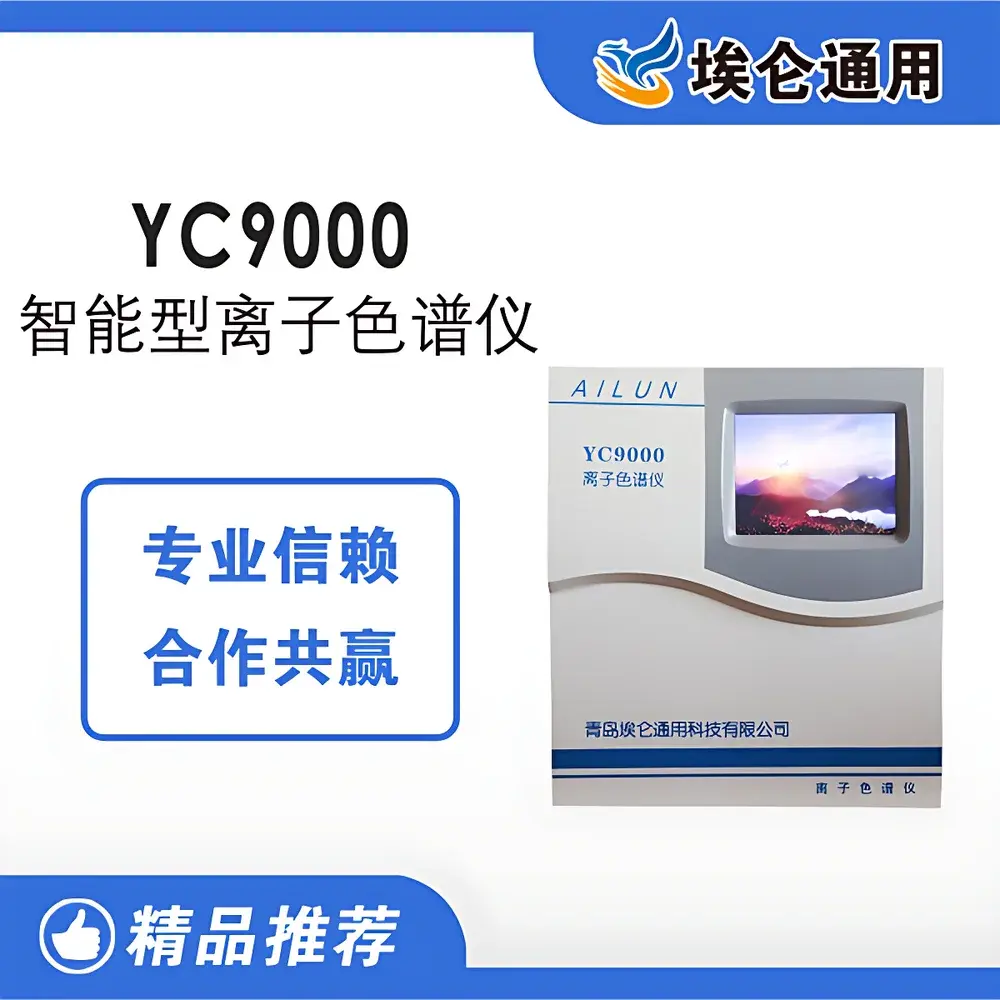
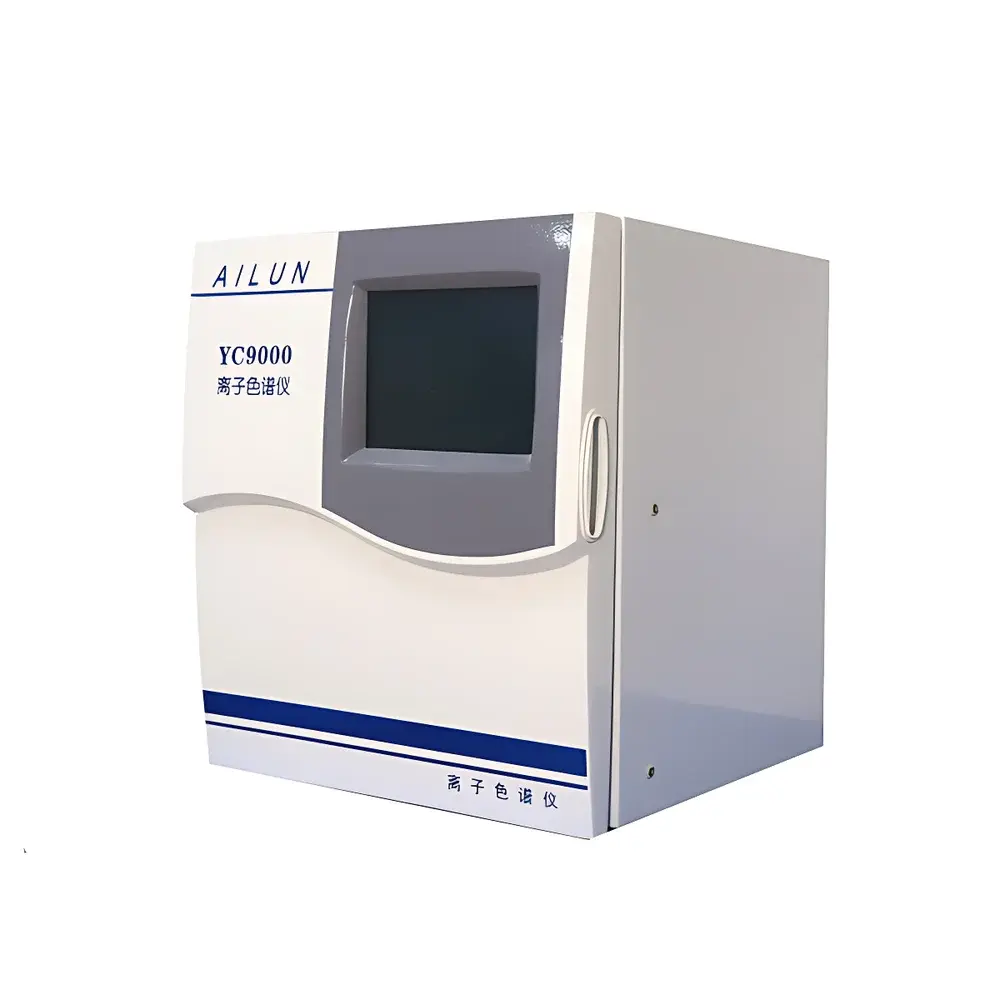
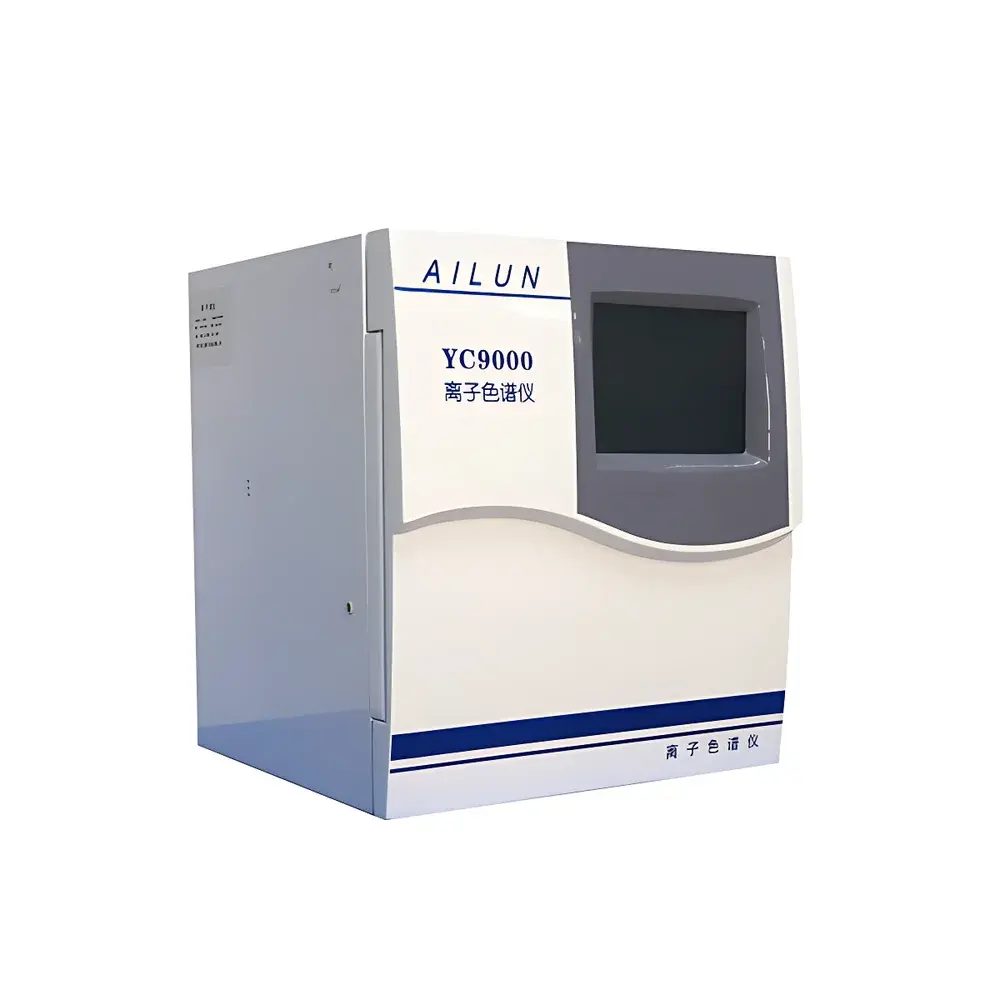
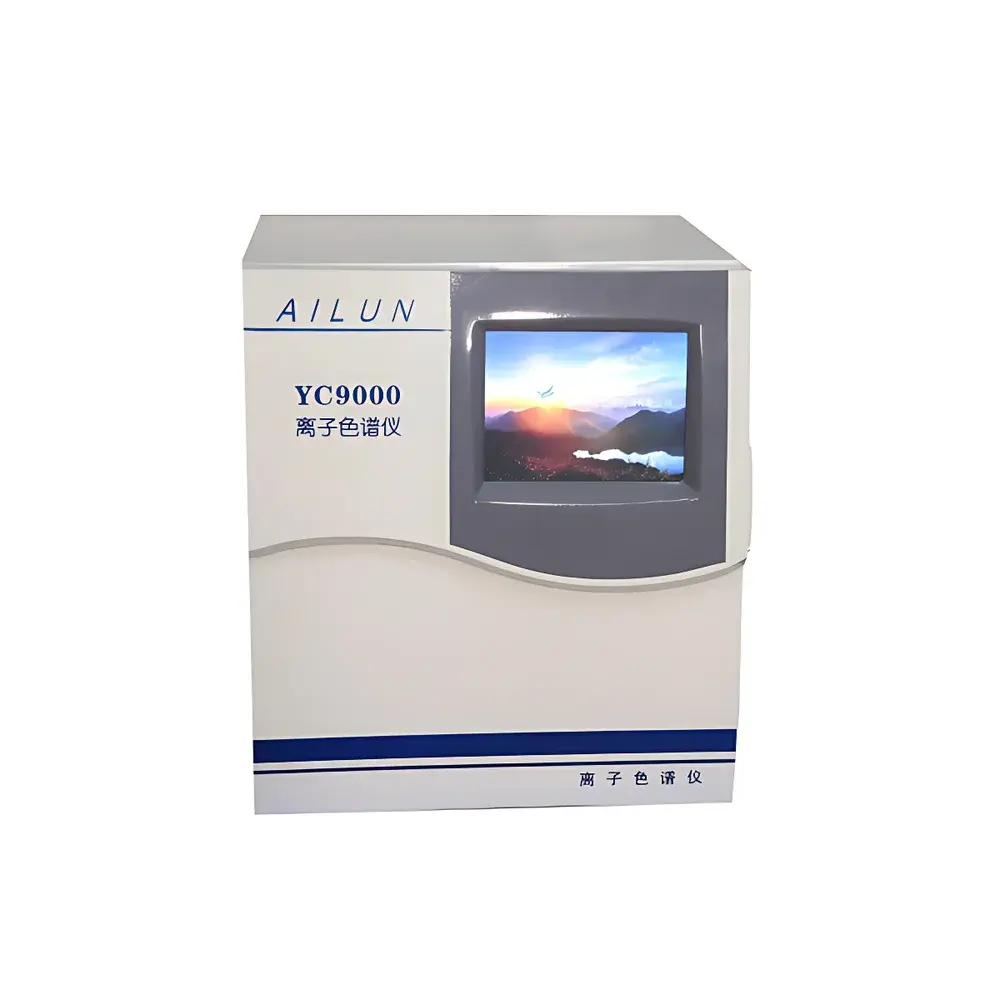
Ailun YC9000 Intelligent Ion Chromatograph
| Brand | Ailun General / Qingdao Ailun |
|---|---|
| Origin | Shandong, China |
| Manufacturer Type | Authorized Distributor |
| Country of Origin | China |
| Model | YC9000 |
| Instrument Type | Laboratory Benchtop |
| Application Scope | Universal Ion Analysis |
Overview
The Ailun YC9000 Intelligent Ion Chromatograph is a modular, high-performance benchtop ion chromatography system engineered for precision anion and cation analysis in diverse laboratory environments. It operates on the principle of suppressed conductivity detection following ion-exchange separation—utilizing high-efficiency anion- or cation-specific columns to resolve ionic species based on charge density, hydration radius, and affinity for the stationary phase. The system integrates a dual-channel capability with simultaneous multi-detector support (conductivity, optional UV/Vis), enabling concurrent quantification of common inorganic anions (e.g., F⁻, Cl⁻, NO₂⁻, Br⁻, NO₃⁻, PO₄³⁻, SO₄²⁻) and cations (e.g., Li⁺, Na⁺, NH₄⁺, K⁺, Mg²⁺, Ca²⁺) in a single run. Its architecture reflects modern IC design paradigms: minimized fluidic path length, inert wetted materials, active CO₂ management, and embedded real-time diagnostics—all contributing to enhanced baseline stability, low detection limits, and long-term reproducibility.
Key Features
- Modular functional architecture: Independent pump, injector, column oven, suppressor, and detector modules enable flexible configuration and field-upgradable functionality.
- Integrated intelligent MT (Module Tracking) technology: Automatic component recognition, self-optimization of flow rate, temperature, and suppression current; automatic logging of operational parameters and maintenance history for full traceability.
- Patented positive-pressure degassing system: Built-in rapid gas extraction unit continuously removes dissolved CO₂ from eluent, eliminating baseline drift and improving column efficiency and peak symmetry—no external helium or nitrogen purge required.
- In-line gas–liquid separator: Enables continuous degassing of mobile phase at ambient temperature, supporting stable isothermal suppression without external heat exchangers.
- Fully inert fluidic path: All sample- and eluent-contact components fabricated from PEEK or PTFE—including pump heads, injection valve rotor seals, column hardware, suppressor membranes, and conductivity cell—ensuring compatibility with acidic, alkaline, and organic-modified eluents while preventing metal leaching.
- High-resolution graphical LCD interface: Real-time monitoring of pressure, flow, temperature, conductivity signal, and system status; intuitive navigation for method setup, calibration, and sequence control.
Sample Compatibility & Compliance
The YC9000 supports aqueous matrices across environmental, industrial, pharmaceutical, and food safety applications—including drinking water, wastewater, soil extracts, semiconductor process chemicals, pharmaceutical excipients, and biological fluids (e.g., serum, urine). Its inert flow path ensures minimal adsorption or degradation of labile ions (e.g., cyanide, iodide, thiosulfate). The system complies with core regulatory expectations for analytical instrumentation: data integrity features include audit-trail-enabled software (supporting 21 CFR Part 11–compatible user authentication and electronic signatures when paired with compliant acquisition software), GLP/GMP-aligned method validation templates, and ISO/IEC 17025–relevant performance verification protocols. It meets ASTM D4327 (anion analysis in water), ISO 10304-1 (determination of dissolved anions), and USP (conductivity testing of purified water and water for injection) requirements when operated with validated methods.
Software & Data Management
The instrument interfaces with dedicated chromatography data system (CDS) software supporting both single- and multi-channel acquisition. Key capabilities include automated peak detection (adaptive thresholding for solvent front, tailing, shoulder, and noisy peaks), retention time alignment, quantitative calculation via peak height or area, linear/nonlinear calibration curve generation (with weighting options), and export of raw data in standard formats (e.g., .cdf, .csv). Software includes built-in tools for system suitability assessment (e.g., resolution, asymmetry, RSD of retention time), batch processing, report templating, and electronic signature workflows. Raw data files contain embedded metadata (instrument ID, method name, operator, date/time stamp, versioned firmware/software identifiers) to satisfy ALCOA+ principles (Attributable, Legible, Contemporaneous, Original, Accurate, Complete, Consistent, Enduring, Available).
Applications
The YC9000 serves laboratories requiring reliable, cost-effective ion analysis across regulated and research settings. Typical use cases include: monitoring anion contaminants (Cl⁻, SO₄²⁻, NO₃⁻) in municipal water supplies per EPA Method 300.1; quantifying organic acids (acetate, formate, oxalate) in fermentation broths; assessing ionic impurities in lithium-ion battery electrolytes; verifying chloride and sulfate levels in pharmaceutical APIs per ICH Q2(R2); analyzing fluoride in dental products; evaluating corrosion inhibitors (e.g., nitrite, molybdate) in cooling water systems; and screening nuclear fuel cycle samples for fission product anions (e.g., I⁻, TcO₄⁻). Its dual-channel operation allows parallel analysis of anions and cations—reducing total analysis time in quality control labs handling high sample volumes.
FAQ
Does the YC9000 require external gas for eluent degassing?
No. Its integrated positive-pressure degassing and in-line gas–liquid separation eliminate dependence on helium or nitrogen sparging.
Can the system be validated for GMP compliance?
Yes—when used with Part 11–enabled software and documented IQ/OQ/PQ protocols, it supports FDA and EMA regulatory submissions.
What column chemistries are supported?
Standard high-capacity anion-exchange (e.g., AS23, AS26) and cation-exchange (e.g., CS12A, CS16) columns from major vendors are compatible via standard 1/16″ PEEK tubing connections.
Is remote monitoring or network connectivity available?
The system supports Ethernet-based communication; remote status viewing and basic method triggering are possible via secure LAN integration.
What maintenance intervals are recommended for routine operation?
Suppressor replacement every 6–12 months (depending on sample load), pump seal inspection every 3 months, and annual calibration verification using NIST-traceable standards.
Related Products





