
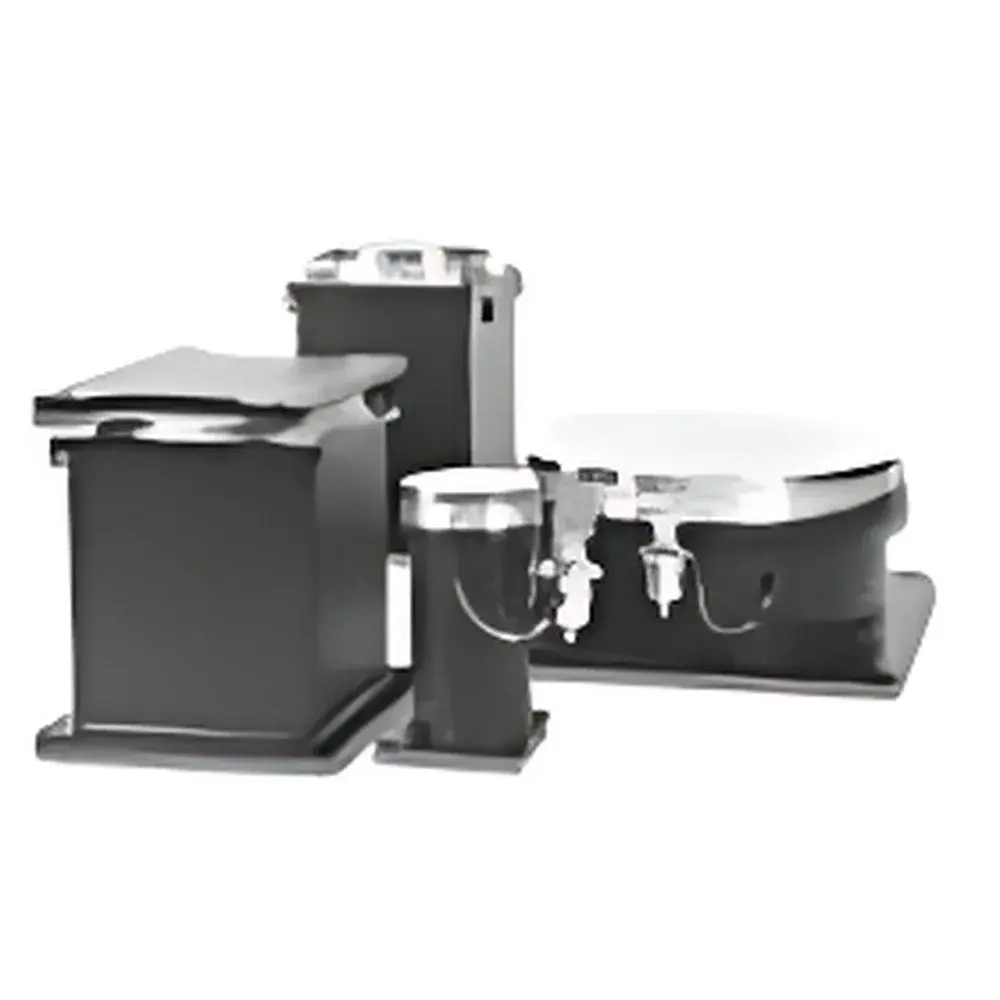
Air Injection Isolation Pad DVIM-T Series
| Origin | South Korea |
|---|---|
| Manufacturer Type | Distributor |
| Origin Category | Imported |
| Model | DVIM-T Series (T-Type) |
| Quotation | Upon Request |
| Vibration Isolation Principle | Pneumatic Air Cushion |
| Natural Frequency (Vertical/Horizontal) | 1.5–2.0 Hz |
| Damping Mechanism | Orifice-Type Air Damping |
| Roll-off Rate at 10 Hz | −32 to −35 dB |
| Leveling System | Triple Automatic Leveling Valves |
| Leveling Repeatability | ±0.05° / ±0.1° |
| Operating Supply | Compressed Air or Liquid Nitrogen (4–6 kg/cm²) |
Overview
The Air Injection Isolation Pad DVIM-T Series is an engineered passive vibration isolation solution designed for ultra-stable optical and metrological environments. Based on the principle of pneumatic spring isolation, it utilizes a sealed air chamber with precisely calibrated orifice damping to achieve low natural frequency suspension—critical for suppressing floor-borne vibrations in the 1–10 Hz range where most building and mechanical excitations dominate. Unlike elastomeric or spring-based isolators, the DVIM-T’s air-bearing architecture delivers consistent performance across variable payload conditions, with minimal hysteresis and no mechanical wear. Its vertical/horizontal natural frequency of 1.5–2.0 Hz enables effective attenuation of sub-Hz ground motion and low-frequency machinery resonance—making it suitable for applications demanding nanometer-scale positional stability, such as interferometric optical tables, electron beam lithography stages, and high-resolution scanning probe microscopy setups.
Key Features
- Pneumatic isolation platform with integrated orifice-type air damping for broadband attenuation, achieving −32 to −35 dB roll-off at 10 Hz.
- Triple automatic leveling valve system ensures rapid, repeatable horizontal alignment; leveling repeatability maintained within ±0.05° under static load and ±0.1° during dynamic re-leveling cycles.
- Modular T-type configuration compatible with standard optical breadboard mounting patterns; standardized M6 threaded holes distributed on 180–440 mm pitch grids per model variant.
- Load-adaptive air pressure regulation maintains constant natural frequency across the full rated payload range (500–6000 kg), verified per ISO 20486-1:2017 for passive vibration isolators.
- Robust aluminum alloy housing with corrosion-resistant surface treatment; operating supply flexibility supports both compressed air (4–6 kg/cm²) and liquid nitrogen vapor (for cryogenic lab integration).
- Low thermal drift design minimizes height variation under ambient temperature fluctuations (±0.02 mm over 15–30°C), critical for long-duration interferometric measurements.
Sample Compatibility & Compliance
The DVIM-T Series is engineered to support rigid optical platforms, granite metrology bases, and semiconductor inspection frames up to 6000 kg. Its footprint dimensions (210 × 210 mm to 490 × 490 mm) and height (220 mm fixed) allow seamless integration beneath ISO-standard optical tables (e.g., Thorlabs, Newport) and coordinate measuring machine (CMM) foundations. The system complies with mechanical safety requirements per EN 13155:2019 for lifting and supporting equipment, and its pneumatic circuitry adheres to ISO 8573-1 Class 3 for compressed air purity—ensuring compatibility with cleanroom-class instrumentation. While not intrinsically certified for medical or aerospace use, the platform meets foundational vibration control criteria referenced in ASTM E1776-22 (Standard Guide for Vibration Testing of Optical Instruments) and supports GLP/GMP-aligned validation protocols when paired with traceable calibration reports.
Software & Data Management
The DVIM-T Series operates as a fully passive, analog isolation system with no embedded electronics or firmware. Consequently, it requires no driver installation, network interface, or software license. However, its performance parameters—including settling time, leveling response, and pressure decay rate—are fully characterizable using third-party laser Doppler vibrometry (LDV) and digital inclinometer systems. For auditability in regulated environments, users may document operational parameters (supply pressure, load mass, leveling angle) via external data loggers compliant with FDA 21 CFR Part 11 when integrated into validated laboratory workflows. Technical documentation includes ISO/IEC 17025-traceable test reports for natural frequency and transmissibility curves.
Applications
- Stabilization of Michelson and Mach–Zehnder interferometers in gravitational wave detection R&D labs.
- Vibration decoupling for coordinate measuring machines (CMMs) performing ISO 10360-compliant dimensional metrology.
- Isolation base for electron backscatter diffraction (EBSD) systems and focused ion beam (FIB) workstations in materials science facilities.
- Support platform for atomic force microscopes (AFM), scanning tunneling microscopes (STM), and optical coherence tomography (OCT) systems requiring sub-nanometer displacement stability.
- Foundation isolation for synchrotron beamline end-stations and X-ray diffraction goniometers where micro-vibrational noise compromises Bragg peak resolution.
- Integration beneath semiconductor wafer inspection tools (e.g., KLA-Tencor, Applied Materials) meeting SEMI S2/S8 safety and stability requirements.
FAQ
What compressed air specifications are required for stable operation?
A clean, oil-free supply at 4–6 kg/cm² (57–86 psi) with dew point ≤ −20°C and particulate filtration ≤ 0.01 µm is recommended. ISO 8573-1 Class 3 compliance ensures long-term valve reliability.
Can the DVIM-T be used in vacuum or cleanroom environments?
The unit itself is not vacuum-rated, but it may be installed outside the vacuum chamber with feedthrough-compatible mounting. For ISO Class 5 (Class 100) cleanrooms, optional electropolished housings and silicone-free seals are available upon request.
Is recalibration required after relocation or load change?
No recalibration is needed—the system self-adjusts via passive air spring mechanics. However, verification of leveling repeatability and natural frequency (via LDV sweep) is advised after major reconfiguration per ISO 10816-1 Annex B.
Does the DVIM-T series support seismic anchoring?
Yes—integrated M12 anchor points (per model-specific drawings) enable compliance with ASCE 7-22 seismic restraint provisions when used with certified hold-down kits.
What is the expected service life under continuous operation?
With proper air quality management, the orifice damping elements and diaphragm seals exceed 10 years MTBF, as validated per MIL-HDBK-217F predictions for pneumatic control components.




