
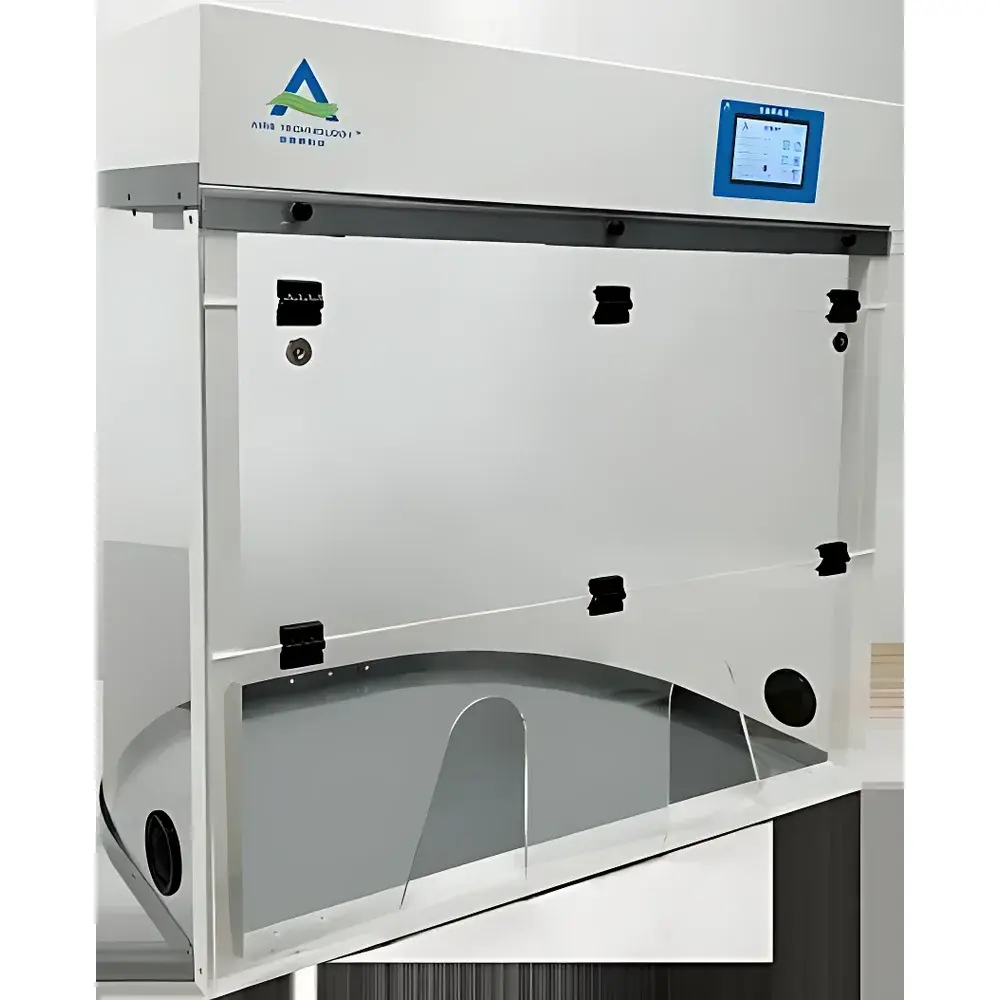
Airs AEH Clean-Air Teaching Fume Hood
| Brand | Airs |
|---|---|
| Origin | Shanghai, China |
| Manufacturer Type | Authorized Distributor |
| Product Origin | Domestic (China) |
| Model | AEH |
| Quotation | Upon Request |
| Cabinet Material | Polypropylene (PP) |
| Ventilation Type | Ductless (Recirculating) |
| External Dimensions (L) | 900 mm |
| Airflow Capacity | 210 m³/h |
| Filtration Module Rows | 1 |
| Display | 5-inch Medical-Grade HD Touchscreen |
| Real-Time Monitoring | Fan Status, Filter Efficiency (%), Face Velocity (m/s), Ambient Temperature & Humidity |
| Connectivity | Bluetooth/Wi-Fi Enabled Mobile App Integration |
| Activated Carbon Media | Optimized Coconut Shell-Based with Controlled Micropore/Mesopore/Macropore Distribution, Enhanced Specific Surface Area, Iodine Number & pH Stability, Reduced Desorption Risk |
Overview
The Airs AEH Clean-Air Teaching Fume Hood is a ductless, recirculating laboratory containment system engineered for educational environments where chemical handling safety, visibility, and pedagogical utility are prioritized. Unlike conventional ducted hoods requiring complex HVAC integration, the AEH operates via a closed-loop air purification process grounded in adsorption kinetics and validated airflow dynamics. Ambient air is drawn across the work surface at a controlled face velocity (typically 0.4–0.6 m/s, compliant with EN 14175-3 and ANSI/ASHRAE 110 test protocols), passed through a single-stage, high-capacity activated carbon filtration module, and returned to the lab space after >99.5% removal efficiency for common organic vapors (e.g., acetone, ethanol, formaldehyde, xylene) under standard loading conditions. Its core filtration media—derived from steam-activated coconut shell carbon—is manufactured under strict parametric control: iodine number ≥1,100 mg/g, BET surface area >1,200 m²/g, particle size distribution tightly maintained between 0.8–1.2 mm, and pH stabilized at 6.5–7.5 to minimize catalytic desorption. The unit’s structural integrity and chemical resistance are ensured by seamless polypropylene (PP) construction—welded, not bolted—capable of withstanding prolonged exposure to dilute acids, bases, and halogenated solvents.
Key Features
- 360° optically clear, seamless acrylic curved front panel—enabling unobstructed instructor-led demonstration and student observation from all angles without parallax distortion.
- Integrated 5-inch medical-grade capacitive touchscreen with real-time graphical display of operational parameters: fan RPM, calculated face velocity (m/s), relative humidity (%RH), ambient temperature (°C), and dynamic filter saturation index (% remaining service life).
- Dual-mode connectivity: local Bluetooth pairing for immediate diagnostics and Wi-Fi-enabled cloud synchronization for remote monitoring, firmware updates, and audit-log export via the Airs LabConnect mobile application (iOS/Android).
- Modular filtration architecture: standardized 1-row carbon cartridge (pre-configured for general chemistry teaching labs); optional upgrade path to dual-cartridge configuration (acid gas + organic vapor) available under model AEH-900-DP.
- Energy-efficient EC (electronically commutated) blower delivering stable 210 m³/h airflow at ≤45 dB(A) sound pressure level—meeting ISO 7730 thermal comfort guidelines for classroom settings.
Sample Compatibility & Compliance
The AEH is validated for safe use with low-to-moderate volatility chemicals commonly employed in undergraduate and vocational chemistry curricula—including but not limited to alcohols, ketones, esters, aliphatic hydrocarbons, and diluted aqueous reagents (pH 2–12). It is explicitly not rated for perchloric acid, hydrogen fluoride, radioactive isotopes, or nanoparticle aerosols. Regulatory alignment includes conformity with EN 14175-3 (fume hood performance testing), CE marking per Machinery Directive 2006/42/EC, and electrical safety compliance to IEC 61000-6-3 (EMC) and IEC 60335-1 (household and similar equipment). Filter replacement logs and usage history are timestamped and exportable to support GLP-aligned recordkeeping; data retention meets 21 CFR Part 11 requirements when used with Airs LabConnect’s role-based access and electronic signature modules.
Software & Data Management
The Airs LabConnect platform provides secure, encrypted data handling across device and cloud layers. Each AEH unit generates time-stamped operational records—including start/stop cycles, filter load trends, and alarm events (e.g., low airflow, high temperature)—stored locally for 90 days and optionally archived to on-premise servers or AWS-hosted instances. Audit trails include user ID, action type, and system response, supporting institutional QA/QC review. Export formats include CSV and PDF reports compatible with LIMS integration. Firmware updates are delivered over-the-air with SHA-256 signature verification and rollback capability. All mobile app interactions adhere to OAuth 2.0 authentication and TLS 1.3 encryption.
Applications
- Undergraduate general chemistry laboratories: safe dispensing and reaction observation of volatile reagents without facility ductwork modifications.
- Vocational training centers: hands-on instruction in hazard identification, PPE selection, and ventilation hierarchy principles per OSHA 1910.1200 and GHS Annex 3.
- High school STEM labs: visual demonstration of adsorption isotherms, breakthrough curve analysis, and real-time air quality metrics.
- Small-scale research prep areas: temporary containment for solvent transfers, sample weighing, and non-hazardous synthesis steps where permanent hood installation is impractical.
FAQ
What types of chemicals can be safely used in the AEH fume hood?
The AEH is validated for organic solvents with boiling points above 30°C and vapor pressures below 10 kPa at 20°C (e.g., methanol, acetone, ethyl acetate). It is not suitable for perchloric acid, hydrogen sulfide, ammonia gas, or particulates.
How often must the carbon filter be replaced?
Filter service life depends on cumulative chemical exposure; typical replacement interval is 6–12 months in teaching labs with moderate usage. The system alerts users at 85% saturation based on runtime, airflow decay, and VOC sensor feedback.
Does the AEH require external exhaust ducting or make-up air systems?
No. As a ductless recirculating unit, it operates independently of building HVAC infrastructure and does not consume conditioned lab air.
Is the PP cabinet resistant to nitric acid or sodium hydroxide solutions?
Yes—polypropylene exhibits excellent resistance to 30% NaOH and 20% HNO₃ at room temperature; extended contact with concentrated oxidizers (>65% HNO₃) is not recommended.
Can usage data be exported for regulatory audits?
Yes. Filter change logs, operational timestamps, and alarm histories are exportable as tamper-evident PDF or CSV files with embedded digital signatures, compliant with ISO/IEC 17025 documentation requirements.



