
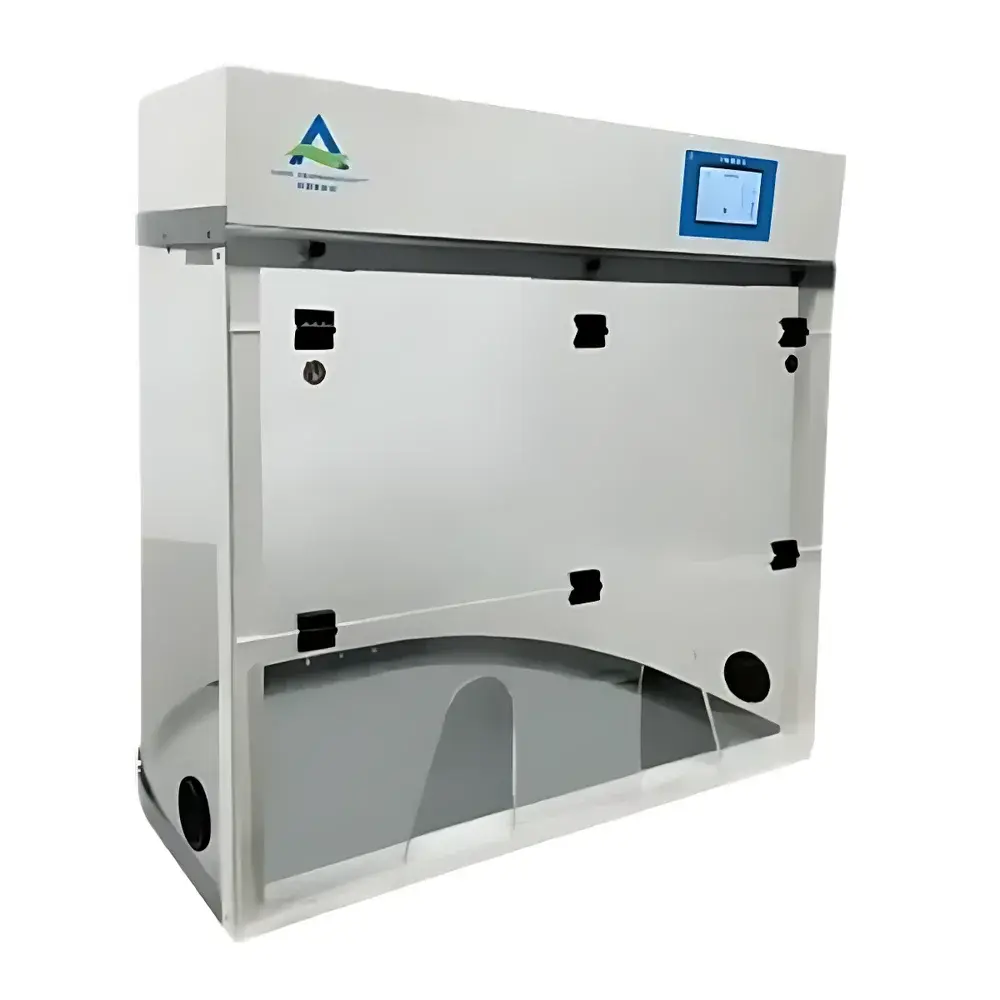
Airs AEH900 Teaching-Grade Ductless Fume Hood
| Brand | Airs |
|---|---|
| Origin | Shanghai, China |
| Manufacturer Type | Direct Manufacturer |
| Regional Classification | Domestic (China) |
| Model | AEH900 |
| Quotation | Upon Request |
| Construction Material | Fully Steel Enclosure |
| Ventilation Architecture | Ductless (Recirculating) |
| Primary Application Domain | Education & Healthcare Training |
| Ducting Configuration | Self-Contained, No External Ductwork Required |
| Work Area Dimensions (W×D×H) | 560 × 882 × 665 mm |
| Overall External Dimensions (W×D×H) | 602 × 900 × 857 mm |
| Average Face Velocity | 0.4–0.6 m/s |
| Airflow Capacity | 210 m³/h |
| Rated Power Consumption | 45 W (0.5 A) |
| Sound Pressure Level | ≤46 dB(A) |
Overview
The Airs AEH900 is a purpose-engineered ductless fume hood designed specifically for pedagogical environments—including university teaching laboratories, vocational training centers, and clinical education facilities in hospitals. Unlike conventional ducted hoods that rely on building exhaust infrastructure, the AEH900 employs a closed-loop air recirculation system with multi-stage filtration to safely capture and neutralize airborne contaminants generated during low-to-moderate hazard demonstrations. Its operational principle centers on drawing ambient laboratory air through a front-facing sash into an internal airflow path, where vapors and particulates are intercepted by a dual-stage filter assembly—typically comprising a pre-filter for coarse particulates and an activated carbon bed for organic vapors and acid gases. The purified air is then returned to the room, eliminating the need for external ducting while maintaining operator safety and energy efficiency. This architecture aligns with ISO 15195:2013 guidelines for performance testing of local exhaust ventilation systems and supports institutional sustainability goals through reduced HVAC load and zero structural retrofitting requirements.
Key Features
- 360° transparent polycarbonate viewing enclosure—enabling unobstructed observation of experimental procedures, reagent interactions, and technique execution from all angles; ideal for instructor-led demonstrations and student assessment.
- Ductless, self-contained design—eliminates dependence on centralized exhaust systems, reducing installation time, civil engineering costs, and facility downtime during deployment or relocation.
- Intelligent face velocity control—automatically adjusts fan speed in response to sash position and real-time airflow demand to sustain a stable 0.4–0.6 m/s average face velocity across the work opening, compliant with ANSI/ASHRAE 110-2016 acceptance criteria.
- Low-power, high-efficiency DC blower—rated at 45 W (0.5 A), delivering consistent 210 m³/h volumetric flow while maintaining acoustic performance ≤46 dB(A) at 1 m distance—critical for quiet classroom and simulation lab environments.
- Modular mobility options—compatible with either fixed-height solid base stands or swivel-caster assemblies, supporting rapid reconfiguration between fixed instructional stations and mobile demonstration carts.
- Full-steel structural frame with epoxy-coated interior surfaces—resistant to corrosion from incidental splashes of common educational reagents (e.g., dilute acids, bases, and organic solvents).
Sample Compatibility & Compliance
The AEH900 is validated for use with low-hazard chemical classes typically encountered in undergraduate chemistry, biology, and medical training curricula—including aqueous solutions, ethanol-based preparations, formaldehyde fixatives (≤10% v/v), and non-volatile salts. It is not intended for use with perchloric acid, hydrofluoric acid, radioactive materials, or highly volatile, low-molecular-weight organics (e.g., diethyl ether, pentane). Filter service life is determined by usage intensity and contaminant profile; replacement intervals must be documented per institutional GLP protocols. The unit complies with EN 14175-3:2022 (fume hood performance classification), meets CE marking requirements for electrical safety (EN 61000-6-3, EN 61000-6-4), and supports audit-ready operation under ISO/IEC 17025-accredited laboratory management systems.
Software & Data Management
While the AEH900 operates via embedded microcontroller logic without external software dependency, its intelligent control module logs operational metrics—including cumulative runtime, filter usage hours, and fan duty cycle—for maintenance scheduling and compliance reporting. Data export is supported via USB-C interface to standard CSV format, enabling integration into institutional CMMS platforms or LIMS dashboards. All system alerts (e.g., filter saturation, airflow deviation >±10%) trigger visual LED indicators and optional audible tones, with event timestamps traceable for regulatory review. The firmware architecture adheres to IEC 62443-3-3 security principles for industrial control devices and maintains full audit trail capability for FDA 21 CFR Part 11–aligned environments upon optional configuration.
Applications
- Chemistry laboratory instruction: Safe handling and visualization of titration, crystallization, distillation, and pH indicator experiments.
- Clinical skills training: Sterile preparation of IV admixtures, cytotoxic drug handling simulations, and diagnostic reagent dispensing under supervised conditions.
- Biology teaching labs: Dissection support with formalin vapor mitigation; microbial culture transfer demonstrations.
- Vocational technical education: HVAC technician training on airflow measurement and balancing; biomedical equipment servicing under controlled containment.
- Mobile science outreach: Deployment in temporary classrooms, field education units, or community health centers lacking permanent duct infrastructure.
FAQ
What types of chemicals can be safely used in the AEH900?
It is certified for low-volatility, low-toxicity substances commonly used in academic instruction—including diluted acids/bases, alcohols, acetone, and aqueous salt solutions. High-hazard agents (e.g., HF, HClO₄, cyanides) require ducted containment.
How often must the filters be replaced?
Filter lifespan varies with usage frequency and chemical load; typical replacement occurs every 6–12 months under standard teaching lab conditions. An integrated hour-meter and saturation indicator assist in scheduling.
Does the AEH900 require professional installation?
No ductwork or wall penetration is needed. Units are plug-and-play—only standard 230 V AC / 50 Hz power and level floor placement are required.
Can it be integrated into a campus-wide safety monitoring network?
Yes—via optional RS-485 or Modbus RTU interface (available as add-on module), enabling centralized status monitoring and remote alarm notification through existing BMS platforms.
Is the unit compliant with international safety standards for educational institutions?
Yes—it conforms to EN 14175-3:2022, ASHRAE 110-2016, and IEC 61000-6-3/6-4 electromagnetic compatibility requirements, and supports documentation for ISO 9001 and ISO/IEC 17025 quality management audits.



