
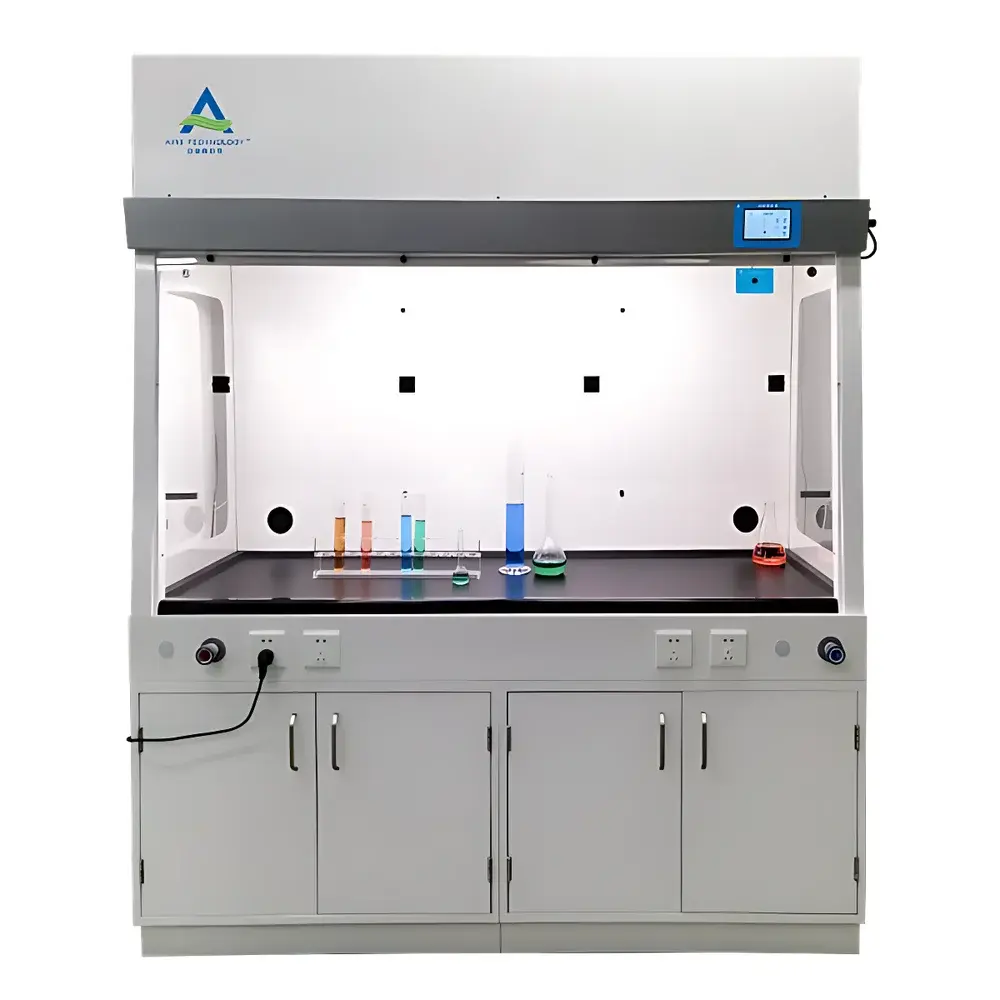
Airs AFH1302 Air-Cleaned Ductless Fume Hood
| Brand | Airs |
|---|---|
| Origin | Shanghai, China |
| Manufacturer Type | Direct Manufacturer |
| Country of Origin | Domestic (China) |
| Model | AFH1302 |
| Construction Material | All-Steel Cabinet |
| Ventilation Type | Ductless (Recirculating) |
| Work Area Dimensions (W×D×H) | 578 × 880 × 830 mm |
| Overall Dimensions (W×D×H) | 650 × 900 × 1105–1290 mm |
| Average Face Velocity | 0.4–0.6 m/s |
| Airflow Volume | 200–300 m³/h |
| Lighting Intensity | ≥600 Lux |
| Rated Power | 60 W / 0.6 A |
| Noise Level | ≤54 dB(A) |
| Compliance Scope | Medical & General Chemistry Laboratories |
| Configuration Options | Benchtop or Integrated Floor-Standing Version with Optional Casters |
Overview
The Airs AFH1302 Air-Cleaned Ductless Fume Hood is an engineered solution for localized chemical vapor containment in laboratories where infrastructure constraints—such as absence of dedicated exhaust ductwork, limited ceiling height, or building-wide HVAC limitations—preclude the installation of conventional ducted fume hoods. Unlike traditional constant-volume or variable-air-volume (VAV) hoods that rely on external exhaust systems and makeup air units, the AFH1302 operates on a closed-loop recirculation principle: ambient laboratory air is drawn through the work surface, passed sequentially through multi-stage filtration media (typically pre-filter, activated carbon, and optional HEPA or specialty adsorbent layers), and returned to the room at a controlled velocity and purified state. This architecture eliminates reliance on structural ventilation modifications while maintaining operator safety per internationally recognized exposure control principles—including those defined in ANSI/ASHRAE 110-2016 and EN 14175-3:2021 for ductless hood performance validation.
Key Features
- All-steel construction with electrophoretically coated finish ensures corrosion resistance, mechanical durability, and compatibility with routine decontamination protocols in medical and analytical chemistry environments.
- Integrated centrifugal blower and intelligent airflow management system maintain face velocity within the validated range of 0.4–0.6 m/s across the full sash opening profile, meeting minimum containment requirements for low-to-moderate volatility chemicals.
- Real-time monitoring interface displays face velocity, internal filter saturation status, ambient temperature, and operational runtime—accessible via embedded capacitive touchscreen or remotely via QR-code-authenticated mobile application.
- Benchtop and integrated floor-standing configurations provide deployment flexibility; optional locking casters enable repositioning without disassembly or facility modification.
- Energy-efficient operation (60 W nominal draw) reduces HVAC load by eliminating exhaust air loss—typical energy savings exceed 30% compared to equivalent ducted hoods in climate-controlled labs.
- Acoustic optimization delivers ≤54 dB(A) noise emission at 1 m distance, supporting compliance with ISO 15710:2020 workplace noise guidelines for continuous operator exposure.
Sample Compatibility & Compliance
The AFH1302 is designed for use with low-to-medium hazard chemicals including organic solvents (e.g., acetone, ethanol, hexane), dilute acids and bases, and non-radioactive volatile compounds. It is not intended for perchloric acid, hydrofluoric acid, radioactive materials, or highly toxic substances requiring Class I or II biological containment. Filter configuration must be selected based on chemical class and concentration—carbon loading capacity and breakthrough time are documented per ASTM D5228-18 adsorption testing methodology. The unit conforms to CE marking requirements under the Machinery Directive 2006/42/EC and Electromagnetic Compatibility Directive 2014/30/EU. While not certified to UL 1805 or NSF/ANSI 49, its design aligns with GLP-aligned documentation practices for filter replacement logs, performance verification records, and user training documentation.
Software & Data Management
The embedded microcontroller supports local data logging of fan runtime, filter usage hours, and real-time face velocity deviations. Mobile integration enables secure cloud-synced storage (AES-256 encrypted) of operational history, alarm events (e.g., low airflow, filter saturation warning), and maintenance timestamps. Audit trails comply with ALCOA+ principles—attributable, legible, contemporaneous, original, accurate, complete, consistent, enduring, and available—for internal quality review. No FDA 21 CFR Part 11 electronic signature functionality is included, as the device does not perform regulated analytical measurements.
Applications
- Routine reagent dispensing and small-scale synthesis in university teaching labs and R&D facilities.
- Preparation of pharmaceutical intermediates under non-GMP conditions where solvent handling occurs outside classified cleanrooms.
- Specimen processing and staining workflows in clinical pathology laboratories adhering to CLIA and CAP standards for environmental safety.
- Quality control testing in biotech manufacturing support labs requiring flexible, relocatable containment for method development.
- Field-deployable analytical setups in modular or temporary lab spaces, including containerized laboratories and mobile health units.
FAQ
What types of chemicals can be safely used in the AFH1302?
It is suitable for low-to-moderate volatility organic solvents, aqueous solutions of weak acids/bases, and non-hazardous vapors. Consult the filter compatibility matrix before use with halogenated compounds, aldehydes, or ammonia derivatives.
How often must the filters be replaced?
Replacement intervals depend on chemical type, concentration, and cumulative exposure time—typically 6–12 months under standard academic lab usage. The system triggers visual and audible alerts when carbon saturation exceeds 85% of rated capacity.
Does the AFH1302 require professional installation?
No ductwork, electrical conduit, or structural reinforcement is needed. Units are plug-and-play with standard 230 V / 50 Hz single-phase supply and occupy minimal floor space.
Can multiple AFH1302 units be managed centrally?
Yes—via the Airs LabLink mobile platform, up to 32 devices can be monitored simultaneously with customizable alert thresholds and exportable CSV reports.
Is calibration required before first use?
Factory-calibrated airflow sensors are provided with NIST-traceable certificate. Annual verification using a calibrated anemometer per ISO 17025-accredited procedure is recommended for regulated environments.



