
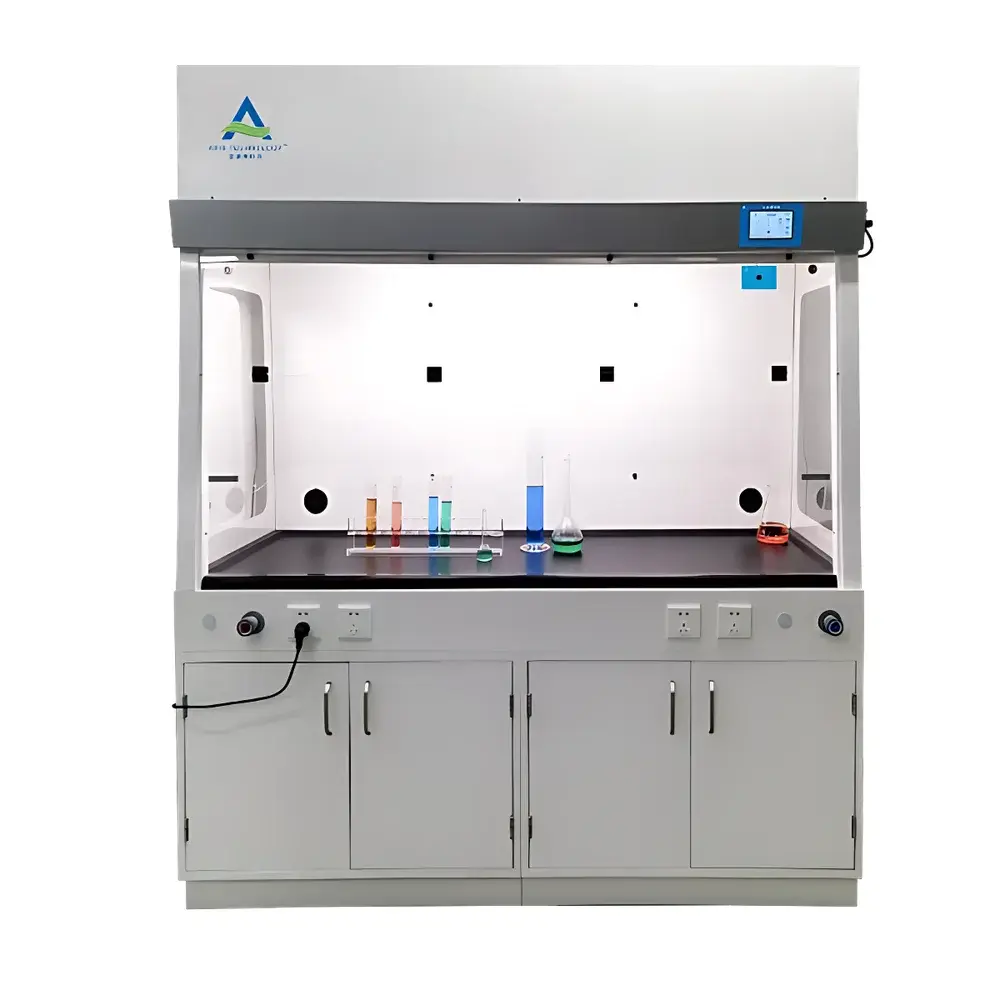
Airs AFH1804 Ductless Fume Hood
| Brand | Airs |
|---|---|
| Origin | Shanghai, China |
| Manufacturer Type | Direct Manufacturer |
| Country of Origin | China |
| Model | AFH1804 |
| Construction | Fully Steel Enclosure |
| Ventilation Type | Ductless (Recirculating) |
| Working Area Dimensions (W×D×H) | 578 × 880 × 830 mm |
| Overall Dimensions (W×D×H) | 650 × 900 × 1105–1290 mm |
| Average Face Velocity | 0.4–0.6 m/s |
| Airflow Capacity | 200–300 m³/h |
| Illumination | ≥600 Lux |
| Rated Power | 60 W / 0.6 A |
| Noise Level | ≤54 dB(A) |
| Compliance | Designed for general chemical laboratory use per ISO 10975 and EN 14175-3 guidelines |
Overview
The Airs AFH1804 Ductless Fume Hood is an engineered solution for containment and filtration of airborne chemical vapors, particulates, and low-to-moderate toxicity fumes in non-radioactive, non-explosive laboratory environments. Unlike conventional ducted hoods requiring structural HVAC integration, the AFH1804 operates on a closed-loop recirculation principle: ambient air is drawn through the work surface, passed sequentially through a multi-stage filtration system (typically pre-filter + activated carbon + optional HEPA), and returned to the lab after contaminant removal. This design eliminates dependency on external exhaust ductwork or dedicated make-up air systems—reducing installation complexity, architectural modification, and energy consumption associated with conditioned air replacement. The unit complies with fundamental safety performance criteria outlined in EN 14175-3 (2022) for ductless fume hoods and aligns with ISO 10975 recommendations for airflow uniformity and operator protection. Its fully steel construction ensures mechanical durability and chemical resistance under routine laboratory handling.
Key Features
- Fully steel enclosure with powder-coated white finish—designed for compatibility with modern laboratory aesthetics and ease of decontamination.
- Integrated centrifugal blower and intelligent control system enabling real-time monitoring of face velocity (0.4–0.6 m/s), filter saturation status, internal temperature, and operational runtime.
- Touchscreen HMI panel with intuitive interface for local parameter adjustment, alarm acknowledgment, and maintenance scheduling.
- Bluetooth-enabled connectivity supporting QR-code-based pairing with iOS/Android mobile applications for remote status viewing, historical log retrieval (including runtime, filter life estimation, and fault events), and manual start/stop commands.
- Two configuration options: desktop-mount version (for integration onto existing lab benches) and freestanding floor model—with optional locking casters for repositioning without tools or facility coordination.
- Low-noise operation (≤54 dB[A] at 1 m) and energy-efficient motor (60 W nominal power) support continuous use in shared or noise-sensitive environments such as teaching labs and QC facilities.
Sample Compatibility & Compliance
The AFH1804 is validated for use with common organic solvents (e.g., acetone, ethanol, hexane), dilute aqueous acids and bases, and low-volatility reagents typically encountered in pharmaceutical quality control, academic chemistry instruction, and clinical diagnostic preparation. It is not intended for perchloric acid, hydrofluoric acid, radioactive isotopes, or pyrophoric substances. Filtration efficiency depends on cartridge selection: standard carbon filters achieve >99.9% adsorption for VOCs with boiling points >60 °C and vapor pressures <10 mmHg; optional HEPA add-ons provide ≥99.97% retention of particles ≥0.3 µm. Units are supplied with CE marking documentation and meet electromagnetic compatibility (EMC) requirements per IEC 61326-1. While not certified to UL 508A or NFPA 45 by default, third-party validation for specific chemical classes can be arranged upon request.
Software & Data Management
The embedded firmware supports audit-ready data logging with timestamped records of fan runtime, face velocity deviations, filter usage hours, and system alerts (e.g., low airflow, filter exhaustion, sensor fault). All logs are exportable via USB or cloud-synced through the companion mobile application. The mobile platform enforces role-based access (operator vs. administrator) and maintains tamper-evident event history compliant with GLP principles. Though not FDA 21 CFR Part 11–certified out-of-the-box, the system architecture permits integration with validated LIMS or ELN platforms via Modbus RTU or MQTT protocols for centralized compliance reporting.
Applications
- Routine weighing, dilution, and sample preparation involving volatile organic compounds in pharmaceutical stability testing labs.
- Reagent dispensing and small-scale synthesis in university teaching laboratories where infrastructure flexibility is critical.
- Pre-analytical processing in clinical pathology departments handling formalin-fixed tissues or histological stains.
- Electronics manufacturing QA stations requiring localized solvent vapor control without facility retrofitting.
- Field-deployable research modules in modular or temporary lab spaces with limited HVAC capacity.
FAQ
What types of chemicals can be safely handled in the AFH1804?
It is suitable for low-to-moderate hazard chemicals including alcohols, ketones, esters, and halogenated solvents—provided they fall within the adsorption capacity of the installed carbon filter. Consult the filter specification sheet and perform compatibility verification prior to use with novel or high-boiling-point compounds.
How often must the filters be replaced?
Filter service intervals depend on usage intensity and chemical load. Under typical academic lab conditions (4–6 hrs/day, moderate solvent use), carbon filters require replacement every 6–12 months; pre-filters should be inspected monthly and cleaned or replaced quarterly.
Can the AFH1804 be installed in a room without external ventilation?
Yes—the unit is specifically designed for ductless operation and does not require connection to building exhaust or make-up air systems. However, adequate room air exchange (≥6 ACH) is recommended to prevent CO₂ buildup and maintain thermal comfort.
Is calibration traceable to national standards?
Face velocity sensors are factory-calibrated against NIST-traceable anemometers. Optional annual recalibration services—including certificate issuance—are available through authorized Airs service centers.
Does the hood comply with ISO 14644 cleanroom classifications?
No—the AFH1804 is not a laminar flow device and does not generate unidirectional airflow. It is intended for personnel and environmental protection, not product sterility assurance.



