
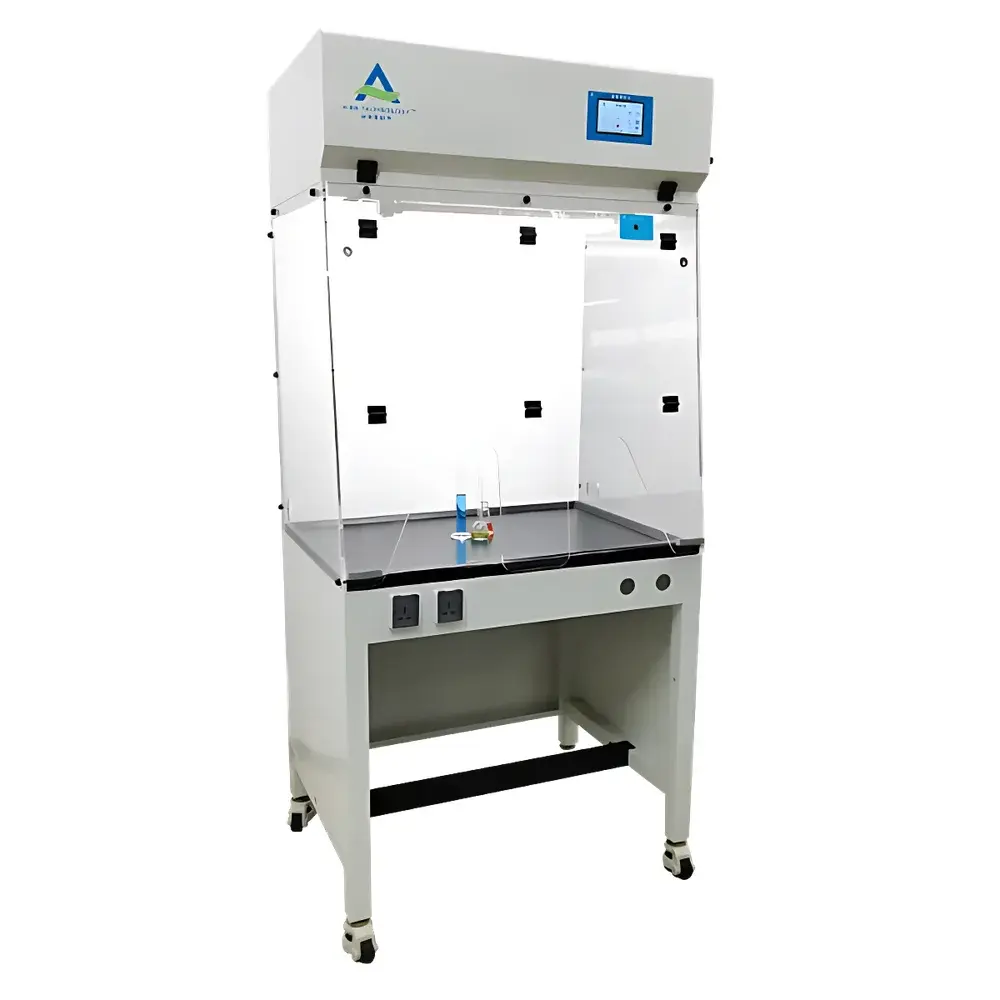
Airs AFH900 Ductless Fume Hood
| Brand | Airs |
|---|---|
| Origin | Shanghai, China |
| Manufacturer Type | Direct Manufacturer |
| Country of Origin | China |
| Model | AFH900 |
| Construction | All-Steel Cabinet |
| Ventilation Type | Ductless (Recirculating) |
| Working Area Dimensions (W×D×H) | 578 × 880 × 830 mm |
| Overall Dimensions (W×D×H) | 650 × 900 × 1105–1290 mm |
| Average Face Velocity | 0.4–0.6 m/s |
| Airflow Capacity | 200–300 m³/h |
| Illumination | ≥600 Lux |
| Rated Power | 60 W / 0.6 A |
| Noise Level | ≤54 dB(A) |
| Application Field | Healthcare & Clinical Laboratories |
| Real-Time Monitoring | Face Velocity, Filter Efficiency, Internal Temperature |
| Control Interface | Integrated Touch Panel + Mobile App (QR Code Pairing) |
| Mobility Options | Benchtop or Floor-Standing Configuration |
Overview
The Airs AFH900 Ductless Fume Hood is an engineered solution for containment and filtration of airborne chemical vapors, aerosols, and particulates in laboratories where infrastructure constraints preclude installation of traditional ducted exhaust systems. Unlike conventional fume hoods relying on external ductwork and dedicated HVAC make-up air, the AFH900 employs a closed-loop recirculation architecture: ambient laboratory air is drawn through the work area, passed sequentially through a multi-stage filtration system—including pre-filters, activated carbon beds optimized for organic vapor adsorption, and optional HEPA or ULPA secondary filters—and returned to the room at safe, filtered concentrations. This design eliminates dependency on building-level ventilation infrastructure while maintaining operator protection per ANSI/ASHRAE 110 and EN 14175-3 performance benchmarks for face velocity uniformity, containment integrity, and filter service life validation.
Key Features
- All-steel construction with epoxy-powder-coated finish ensures long-term corrosion resistance against common reagents including acids, bases, and solvents.
- Dual-mode operation: benchtop configuration for integration onto existing lab benches (minimum depth 600 mm), or floor-standing unit with adjustable height range (1105–1290 mm) accommodating ergonomic workflows.
- Integrated axial fan with electronically commutated motor (ECM) delivers stable airflow across the full 200–300 m³/h range, maintaining face velocity between 0.4–0.6 m/s under varying filter loading conditions.
- Real-time sensor suite monitors face velocity, internal temperature, and calculated filter saturation index—data displayed locally on a 7-inch capacitive touch interface with intuitive icon-based navigation.
- Cloud-connected mobile application enables remote status verification, operational logging (start/stop timestamps, runtime hours), and alert notifications for filter replacement thresholds or abnormal airflow events.
- Optional mobility kit includes industrial-grade dual-brake casters rated for 150 kg static load, facilitating reconfiguration during lab renovations or equipment relocation without structural modification.
Sample Compatibility & Compliance
The AFH900 is validated for use with low-to-moderate volatility chemicals commonly handled in clinical diagnostics, pharmaceutical quality control, and academic research settings—including ethanol, acetone, formaldehyde solutions (<5%), dilute hydrochloric and nitric acids, and aqueous buffer preparations. It is not intended for perchloric acid, hydrogen sulfide, radioactive isotopes, or nanoparticles requiring specialized filtration. The unit complies with ISO 15195:2018 for laboratory ventilation performance testing protocols and supports GLP-compliant documentation via timestamped audit logs exportable in CSV format. Filter replacement records—including date, operator ID, and post-replacement validation data—are retained for regulatory review cycles.
Software & Data Management
The embedded firmware implements secure Bluetooth Low Energy (BLE) pairing and TLS 1.2 encrypted cloud synchronization. The companion mobile application (iOS/Android) provides role-based access control, configurable alert thresholds, and automated generation of monthly usage reports aligned with ISO/IEC 17025 Clause 8.9 requirements for equipment monitoring. All operational parameters—including cumulative fan runtime, peak face velocity deviations, and filter differential pressure trends—are stored locally for ≥12 months and synchronized upon network availability. Data exports meet FDA 21 CFR Part 11 criteria for electronic records when used with organizational identity management integration.
Applications
- Clinical chemistry labs performing routine assays involving volatile reagents without dedicated exhaust ducts.
- Pharmaceutical QC laboratories conducting dissolution testing, standard preparation, or excipient handling in modular cleanroom environments.
- University teaching labs requiring rapid deployment of chemical containment during curriculum-driven experiments.
- Biotechnology startups operating in leased commercial spaces where landlord approvals for duct penetrations are prohibitive.
- Field-deployable diagnostic units requiring self-contained ventilation during mobile health campaigns.
FAQ
What types of filters are installed by default, and how often must they be replaced?
The standard configuration includes a 3.5 kg activated carbon filter bed with impregnated iodine for enhanced aldehyde retention, plus a G4-rated pre-filter. Replacement intervals depend on usage intensity and chemical profile; typical service life ranges from 6–12 months under moderate use (≤4 hrs/day). The system calculates remaining capacity based on cumulative airflow and VOC breakthrough modeling.
Can the AFH900 be integrated into a centralized laboratory monitoring system?
Yes—via optional Modbus RTU (RS-485) or BACnet MS/TP gateway module, enabling interoperability with building management systems (BMS) for HVAC coordination and energy reporting.
Is third-party certification available for containment validation?
Airs provides optional on-site ASHRAE 110 tracer gas testing (SF₆ or sulfur hexafluoride) with certified technician documentation, including smoke visualization and face velocity mapping reports compliant with ISO 15195 Annex B.
Does the unit require annual calibration or preventive maintenance?
While no recalibration is needed for factory-trimmed sensors, annual verification of fan performance, filter seal integrity, and touch-panel responsiveness is recommended per manufacturer’s PM schedule—documentation templates are included in the digital resource portal.



