
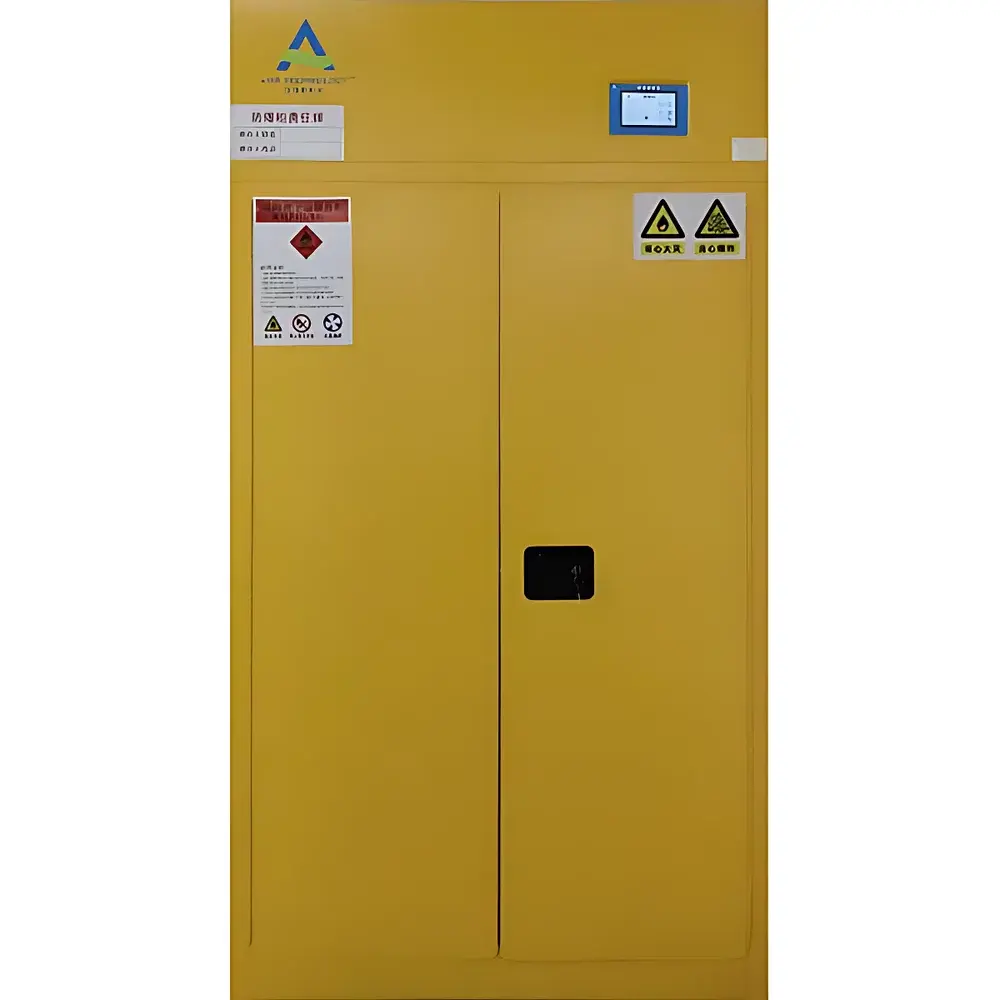
Airs AGS Fire-Resistant, Self-Purifying Chemical Storage Cabinet
| Brand | Airs |
|---|---|
| Origin | Shanghai, China |
| Manufacturer Type | Authorized Distributor |
| Regional Classification | Domestic (China) |
| Model | AGS Fire-Resistant Cabinet |
| Pricing | Available Upon Request |
| Airflow Capacity | 230 m³/h |
| Filter Configuration | Dual-stage (Pre-filter + H14 HEPA) |
| Cabinet Ventilation | Negative-pressure internal airflow |
| Monitoring | Real-time fan status, filter efficiency, temperature & humidity |
| Smart Management | Layer-level chemical inventory tracking (name, quantity, location), audit-ready logging |
| Optional Modules | Air quality sensor suite, differential pressure monitoring, pull-out storage trays, castor-mounted base |
Overview
The Airs AGS Fire-Resistant, Self-Purifying Chemical Storage Cabinet is an engineered safety solution for laboratories requiring secure, compliant, and intelligent storage of flammable, volatile, or hazardous chemicals. Designed in accordance with international fire safety principles—including compartmentalized fire-resistance construction (tested to UL 1275 / EN 14470-1 Class 30/90 standards)—the AGS cabinet integrates active air purification with continuous negative-pressure ventilation. Unlike passive storage cabinets, the AGS system continuously draws cabinet interior air through a dual-stage filtration train: a pre-filter captures particulates and coarse vapors, followed by a medical-grade H14 HEPA filter (EN 1822-1, ≥99.995% @ 0.3 µm) and optional activated carbon media for organic vapor adsorption. This ensures both personnel protection (via containment) and ambient air quality maintenance—critical in confined lab environments where ventilation infrastructure may be limited.
Key Features
- Fire-rated steel enclosure with intumescent seals and self-closing, dual-key locking mechanism for dual-access control and regulatory compliance (OSHA 1910.106, NFPA 30)
- Integrated EC centrifugal blower delivering stable 230 m³/h airflow at low noise (<52 dB(A)) and energy-efficient operation (≤120 W)
- Real-time digital monitoring interface displaying fan RPM, filter saturation status (based on pressure drop delta), internal temperature (±0.5°C), and relative humidity (±3% RH)
- Negative-pressure design maintained at –15 to –25 Pa (adjustable), verified via built-in differential pressure sensor with audible/visual alarm upon deviation
- Modular filter housing enabling hot-swap replacement without tools; filter life tracking via cumulative runtime and pressure differential algorithms
- Embedded microcontroller platform supporting firmware updates, event logging, and time-stamped operational history (retained for ≥12 months)
Sample Compatibility & Compliance
The AGS cabinet accommodates standard laboratory containers—including glass bottles (up to 4 L), HDPE carboys (up to 20 L), aerosol cans, and solvent waste jugs—within its adjustable, spill-containment shelving system. All internal surfaces are electropolished stainless steel (AISI 304) or chemical-resistant phenolic resin laminate, certified per ASTM D543 for resistance to acids, bases, ketones, and halogenated solvents. The system meets ISO/IEC 17025:2017 requirements for equipment used in accredited testing labs and supports GLP/GMP documentation workflows via exportable CSV logs. Optional integration with laboratory information management systems (LIMS) enables synchronization of chemical inventory data—including CAS number, SDS revision date, expiration tracking, and storage location—with institutional safety databases.
Software & Data Management
The AGS cabinet’s embedded control unit runs a deterministic real-time operating system (RTOS) with cryptographic timestamping and write-once audit trails. All operational events—including door openings, filter replacements, alarm triggers, and manual overrides—are logged with ISO 8601 timestamps and user ID (where networked). Data export complies with FDA 21 CFR Part 11 requirements: electronic signatures, audit trail integrity, and role-based access control (admin/operator modes). Inventory management software permits layer-specific chemical registration: users assign names, CAS numbers, quantities (mass/volume), storage dates, and hazard classifications (GHS pictograms). Searchable history supports quarterly physical audits, incident root-cause analysis, and regulatory inspections under ECHA REACH or OSHA Hazard Communication Standard (29 CFR 1910.1200).
Applications
- Secure storage of Class I–III flammable liquids (e.g., acetone, ethanol, hexane) in R&D and QC laboratories
- Controlled retention of reference standards and certified reference materials (CRMs) requiring stable thermal and vapor-free conditions
- Secondary containment for high-purity solvents used in HPLC, GC-MS, and spectroscopic calibration
- Integration into smart lab infrastructures where centralized monitoring of chemical inventory, air quality, and cabinet health is required
- Support for ISO/IEC 17025 Clause 6.4.10 (equipment verification) and ISO 14001 environmental management objectives
FAQ
Does the AGS cabinet require external ducting?
No. It operates as a recirculating, ductless system—air is purified and returned to the room. External exhaust is optional but not necessary for standard operation.
What is the service life of the H14 filter under typical lab usage?
Filter longevity depends on VOC load and exposure frequency; average service interval ranges from 6 to 12 months. The system calculates remaining life based on cumulative airflow and pressure differential thresholds.
Can the cabinet be integrated with existing LIMS or building management systems (BMS)?
Yes—via Modbus RTU (RS-485) or optional Ethernet/IP interface. API documentation and HL7/FHIR-compliant data schema are provided for enterprise integration.
Is the AGS cabinet suitable for storing oxidizers or pyrophoric substances?
No. It is certified for flammable liquids and general hazardous chemicals only. Oxidizers, water-reactive, or air-sensitive materials require specialized containment per NFPA 430 and local fire code provisions.
How is calibration and verification performed for internal sensors?
Temperature and humidity sensors are NIST-traceable and factory-calibrated. Field verification uses external reference probes; pressure sensors support zero-point auto-calibration during idle cycles.



