
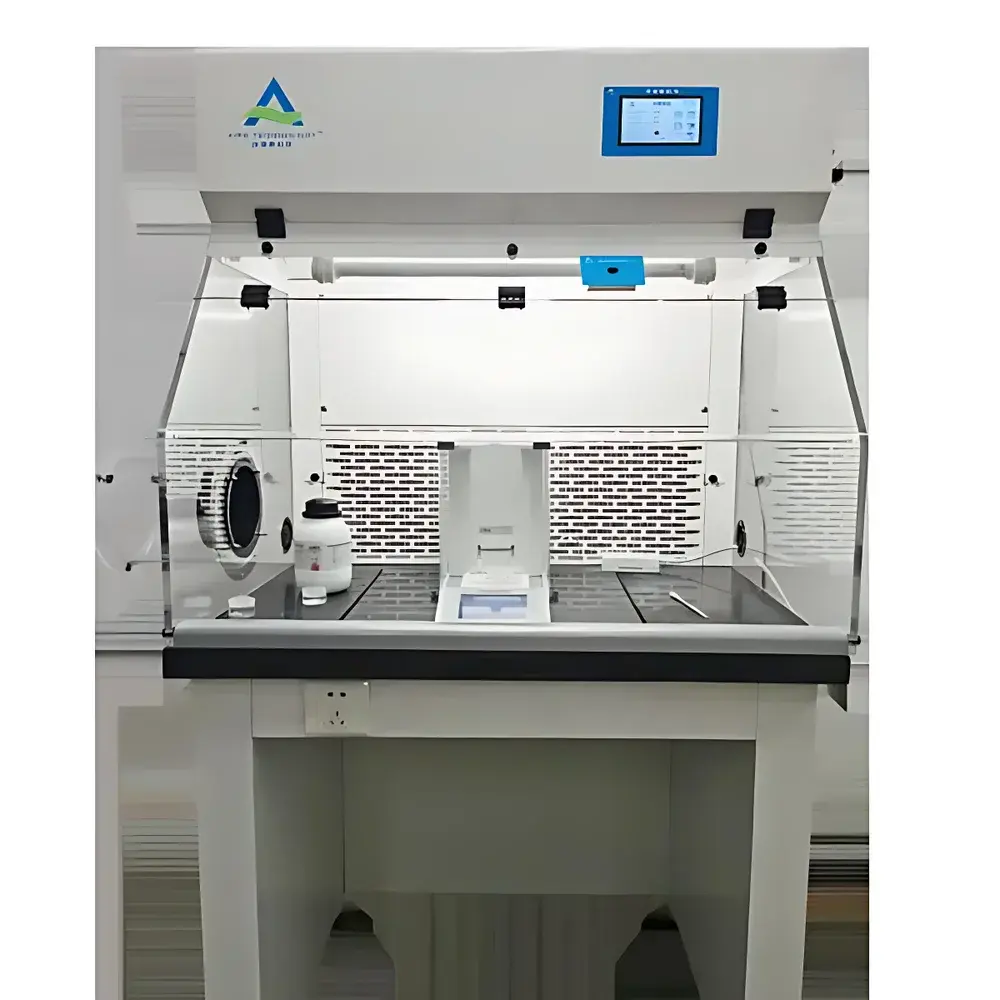
Airs AWF Series OEB 5-Compliant Balance Weighing Hood
| Brand | Airs |
|---|---|
| Origin | Shanghai, China |
| Manufacturer Type | Authorized Distributor |
| Region of Manufacture | Domestic (China) |
| Model | AWF |
| Pricing | Available Upon Request |
| External Dimensions (L×W×H, mm) | 900×650×880 / 1300×650×1080 |
| Internal Dimensions (L×D×H, mm) | 880×550×600 / 1280×550×600 |
| Airflow Capacity | 200–300 m³/h / 400–600 m³/h |
| Average Face Velocity | 0.3–0.45 m/s |
| Power Consumption | 45 W / 75 W |
| Voltage/Frequency | 90–240 V, 50–60 Hz |
| Sound Pressure Level | <54 dBA / <56 dBA |
| OEB Classification | OEB 5 |
| Filter Module Rows | 1 |
Overview
The Airs AWF Series OEB 5-Compliant Balance Weighing Hood is an engineered containment solution designed specifically for high-potency active pharmaceutical ingredient (HPAPI) handling and ultra-sensitive analytical weighing in regulated laboratory environments. Operating on a horizontal laminar airflow principle—air entering from the rear plenum, passing horizontally across the weighing zone, and exiting through integrated filtration—the system eliminates vertical particle settlement that compromises balance stability and operator safety. This airflow architecture meets the stringent exposure control requirements defined by the Occupational Exposure Banding (OEB) framework at Level 5—the highest risk category requiring ≤1 µg/m³ time-weighted average (TWA) airborne concentration. The hood integrates real-time environmental monitoring and failsafe alarm logic to support Good Manufacturing Practice (GMP), ISO 14644-1 Class 5 cleanroom-compatible workflows, and adherence to ICH Q5C, USP , and EMA Guideline on Setting Health-Based Exposure Limits.
Key Features
- Horizontal airflow design with rear-mounted intake plenum ensures laminar, turbulence-free air movement across the balance pan—minimizing vibration-induced drift and eliminating gravitational dust fallout onto precision load cells.
- OEB 5-certified containment performance validated per ISO 10648-2:1995 and EN 14175-3:2022 protocols, including tracer gas (SF₆) leakage testing and face velocity mapping across full operational range (0.3–0.45 m/s).
- Integrated multi-sensor array: differential pressure transducers (±0.5 Pa resolution), electrochemical gas sensors (VOC/HAP detection limit ≤0.1 ppm), capacitive humidity sensors (±2% RH), and thermal-anemometric face velocity probes (NIST-traceable calibration).
- Modular filter system featuring pre-filter + HEPA/ULPA + activated carbon composite cartridges; all filters certified to EN 1822-1:2022 (H14/E12) and ASTM D5227 for organic vapor adsorption capacity.
- Cylindrical, sealed waste collection chamber with integrated bag-out port—enabling safe, leak-tight disposal without breaching the primary containment boundary.
- Smart connectivity via embedded Wi-Fi module supporting MQTT/HTTPS communication; remote parameter access, alarm acknowledgment, and firmware updates through iOS/Android companion application (AirsLink v3.2).
Sample Compatibility & Compliance
The AWF hood accommodates standard analytical balances (up to 320 mm × 320 mm footprint) and microbalances (e.g., Mettler Toledo XPR, Sartorius Cubis® II) with minimal interference to draft shielding or draft compensation algorithms. It supports both dry powder dosing and low-volatility liquid dispensing under controlled humidity (30–60% RH) and temperature (18–25°C) conditions. All materials in contact with the airflow path—including stainless steel 316L work surface, polycarbonate viewing sash, and EPDM gasketing—comply with USP , ISO 10993-5 cytotoxicity standards, and REACH SVHC screening. Documentation packages include Factory Acceptance Test (FAT) reports, filter certification dossiers, and OEB 5 validation summary per ISPE Baseline Guide Volume 5 (2022).
Software & Data Management
Embedded firmware logs all monitored parameters at 10-second intervals, storing >12 months of time-stamped data locally on industrial-grade SD card (encrypted FAT32). Data export is supported in CSV and PDF formats compliant with FDA 21 CFR Part 11 requirements—including electronic signatures, audit trail activation (user ID, timestamp, action type), and immutable record retention. The web-based dashboard enables configurable alarm thresholds (e.g., face velocity deviation >±5%, CO₂ >1000 ppm), email/SMS alert escalation, and trend visualization using dual-Y axis plots for cross-parameter correlation analysis (e.g., humidity vs. static charge accumulation). Historical data retrieval supports GLP audit readiness and root cause investigation during out-of-specification (OOS) balance events.
Applications
- Weighing of oncology APIs, peptide therapeutics, and gene-editing compounds requiring OEB 5 containment.
- Formulation development involving nanomaterials (e.g., liposomal doxorubicin, siRNA conjugates) where electrostatic dispersion must be suppressed.
- Reference standard preparation under ISO/IEC 17025-accredited quality systems, where balance repeatability (≤0.0001% RSD) depends on stable thermal and aerodynamic conditions.
- GMP batch record documentation workflows integrating balance weight data with hood environmental metadata for electronic batch records (EBR).
- Research-scale cytotoxic compound handling in academic pharmacology labs operating under NIH Biosafety Level 2+ (BSL-2+) protocols.
FAQ
What OEB 5 validation documentation is provided with the AWF hood?
A full validation package includes IQ/OQ protocols executed per ASTM E2500-13, containment efficiency test reports (SF₆ challenge at 100 L/min), filter certificate of conformance (EN 1822, ASTM D5227), and a risk assessment aligned with ISO 14971:2019.
Can the AWF hood be integrated into a central BMS or MES platform?
Yes—via Modbus TCP (RTU over Ethernet) or OPC UA interface; configuration files and register maps are supplied upon request for seamless integration with Siemens Desigo, Honeywell Experion, or Werum PAS-X.
How often must filters be replaced, and is preventive maintenance scheduled automatically?
Filter service life is tracked algorithmically based on cumulative airflow hours and real-time pressure drop trends; notifications trigger at 85% loading threshold, with replacement reminders synced to the mobile app calendar.
Does the horizontal airflow design affect balance calibration stability?
No—unlike vertical downflow hoods, the rear-intake horizontal pattern produces negligible air momentum perpendicular to the balance pan, maintaining <0.1 µg zero drift over 8-hour continuous operation per ASTM E1772-21.
Is the AWF hood suitable for use with static-sensitive electronics during micro-weighing?
Yes—the grounded 316L work surface, ionized airflow path (optional add-on), and conductive flooring interface meet ANSI/ESD S20.20-2021 requirements for electrostatic discharge control in precision weighing applications.



