
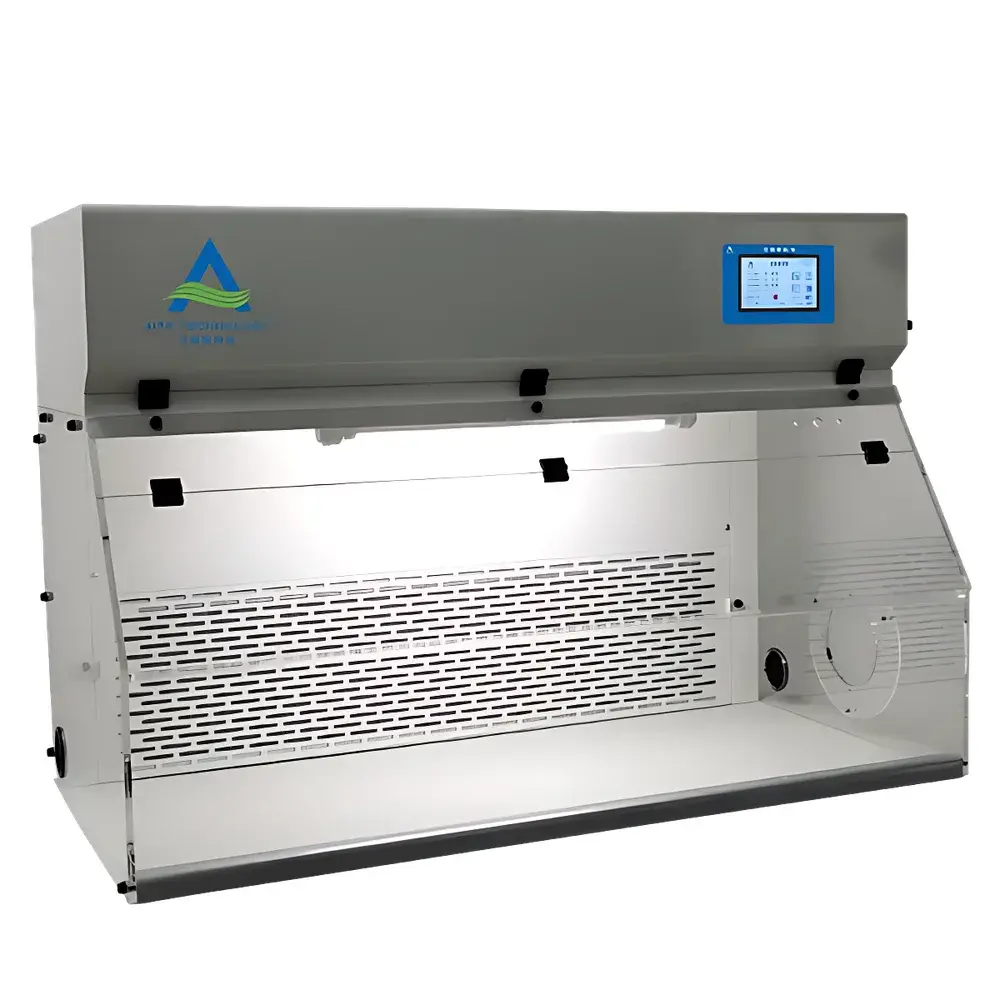
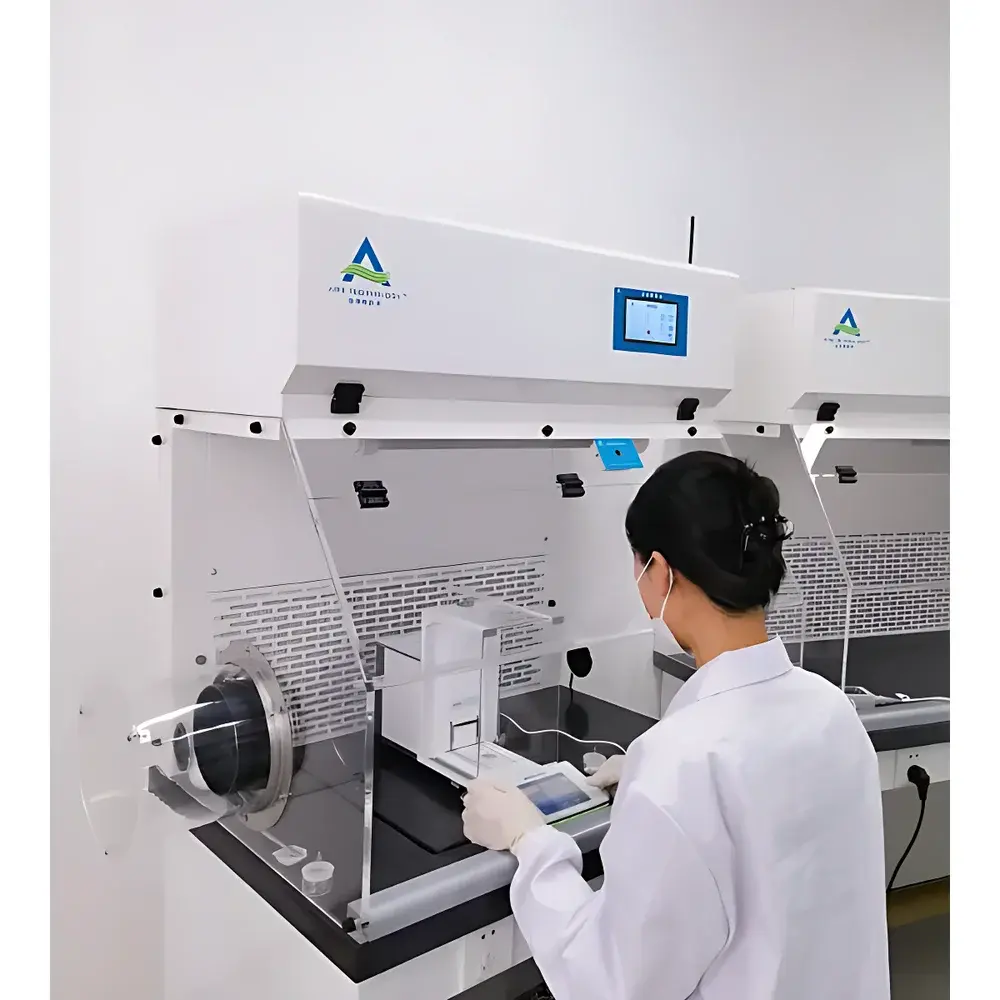
Airs AWF1302 Vibration-Isolation Balance Enclosure with Integrated Negative-Pressure Filtration System
| Brand | Airs |
|---|---|
| Origin | Shanghai, China |
| Manufacturer Type | Direct Manufacturer |
| Regional Classification | Domestic (China) |
| Model | AWF1302 |
| Pricing | Upon Request |
Overview
The Airs AWF1302 Vibration-Isolation Balance Enclosure is an engineered environmental control solution designed specifically for high-precision analytical and micro-balances in regulated laboratory environments. Unlike conventional fume hoods or generic enclosures, the AWF1302 integrates three critical functional layers: (1) passive vibration isolation via a rigid, damped stainless-steel platform structure; (2) active negative-pressure airflow management compliant with OEB Level 5 containment requirements (per ISPE Guidelines for Highly Potent Compounds); and (3) dual-stage particulate filtration with intelligent real-time monitoring. Its operational principle relies on laminar, inward-directed airflow maintained at 0.3–0.45 m/s across the working plane—validated through computational fluid dynamics (CFD) simulations and empirical tracer-gas testing—to prevent cross-contamination while eliminating aerodynamic interference with balance weighing stability. The enclosure’s structural rigidity, acoustic damping, and thermal mass minimize floor-borne and airborne vibrations, ensuring repeatability < ±0.0001 g for balances with readability down to 0.1 µg.
Key Features
- Vibration-isolation platform constructed from 30 mm-thick, stress-relieved stainless steel with integrated elastomeric damping mounts—designed to attenuate frequencies > 5 Hz by ≥92% (ISO 2631-2 compliant).
- OEB 5-compliant negative-pressure containment: continuous inward face velocity monitoring with automatic fan speed modulation to maintain 0.3–0.45 m/s across full sash travel range (tested per EN 14175-3).
- Dual-stage filtration architecture: rear-mounted MERV-13 pre-filter (capturing >90% of particles ≥1 µm) followed by ULPA H14 final filter (≥99.9995% @ 0.1 µm), significantly extending service life and reducing maintenance frequency.
- Airs-Touch intelligent control system with 7-inch capacitive touchscreen interface—displaying real-time metrics including static pressure differential (±1 Pa resolution), temperature (±0.3°C), relative humidity (±2% RH), and filter pressure drop (kPa).
- Secure mobile integration via AirsLink™ iOS/Android application enabling remote status monitoring, alarm notification (e.g., filter saturation, airflow deviation >±5%), and audit-ready event logging.
- Front-access design with seamless white epoxy-coated steel housing—compatible with ISO 14644-1 Class 7 cleanroom aesthetics and GMP facility color-coding standards.
Sample Compatibility & Compliance
The AWF1302 accommodates standard benchtop analytical balances (up to 300 mm × 300 mm footprint) and microbalances with external draft shields. It supports handling of potent compounds (OEL < 10 ng/m³), cytotoxic agents, and low-volatility APIs without compromising weighing accuracy or operator safety. All airflow and filtration performance data are traceable to internal calibration protocols aligned with ASTM E2500-13 (Guide for Specification, Design, and Verification of Pharmaceutical and Biopharmaceutical Manufacturing Systems) and support GLP/GMP validation documentation. The system meets electrical safety requirements per IEC 61010-1 and includes built-in safeguards against overpressure, motor stall, and filter bypass—certified for use in laboratories operating under FDA 21 CFR Part 11-compliant data integrity frameworks.
Software & Data Management
The embedded Airs-Touch OS logs all operational parameters at 1-second intervals, storing ≥180 days of local history on encrypted onboard flash memory. Exportable CSV reports include timestamps, user ID (via optional RFID badge integration), alarm events, and calibration verification records. Audit trail functionality complies with ALCOA+ principles (Attributable, Legible, Contemporaneous, Original, Accurate, Complete, Consistent, Enduring, Available), supporting regulatory inspections. Remote access requires TLS 1.2+ encrypted authentication; no cloud storage is enabled by default—data residency remains fully on-premise unless explicitly configured per institutional IT policy.
Applications
- Weighing of highly potent active pharmaceutical ingredients (HPAPIs) during formulation development and QC release testing.
- Preparation of reference standards and certified reference materials requiring ISO/IEC 17025 traceability.
- Handling of nanomaterials, radioactive tracers, and allergenic compounds where inhalation exposure must be reduced to ALARP levels.
- Stability-indicating assay workflows involving hygroscopic or oxidation-sensitive reference substances.
- Regulatory submissions requiring documented environmental control for compendial methods (e.g., USP <41>, Ph. Eur. 2.1.6).
FAQ
Does the AWF1302 affect balance readability or drift during operation?
No. CFD modeling and gravimetric validation confirm that face velocity uniformity and absence of turbulent eddies within the weighing zone result in zero measurable impact on balance stability (drift ≤0.00005 g over 60 min, per internal test protocol AWF-VP-2023-087).
How often must filters be replaced, and is recalibration required after replacement?
MERV-13 pre-filters typically last 12–18 months; ULPA H14 filters last 24–36 months under typical HPAPI lab usage. Filter replacement triggers automatic airflow revalidation—no manual recalibration is needed, as the system self-verifies face velocity and pressure differentials post-service.
Can the AWF1302 be integrated into a centralized laboratory building management system (BMS)?
Yes. Modbus TCP and BACnet/IP interfaces are available as factory-configurable options, enabling real-time telemetry of airflow, temperature, humidity, and alarm states to enterprise-level infrastructure.
Is the enclosure suitable for use with electrostatic-sensitive balances?
Yes. All internal surfaces are grounded via 10⁶–10⁹ Ω dissipative coating, and airflow velocity is maintained below the 0.5 m/s threshold known to induce triboelectric charging in precision weighing environments.



