
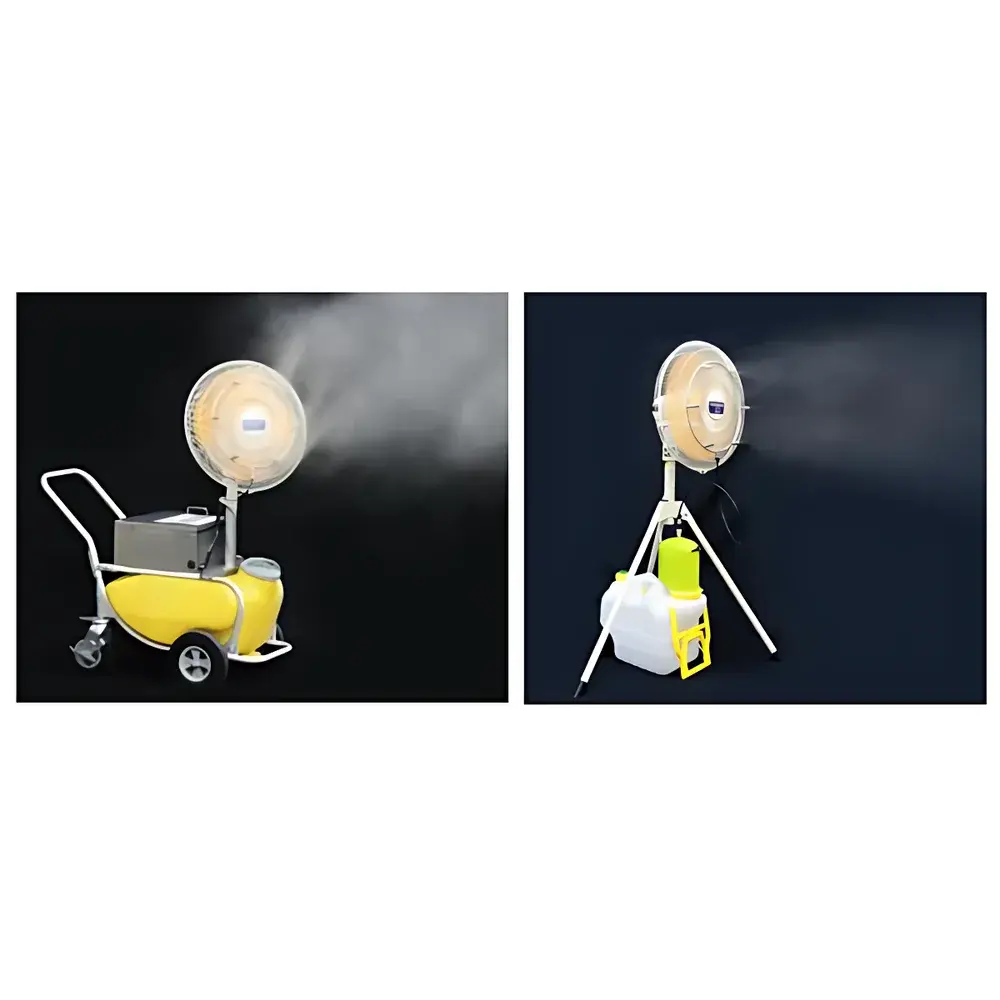
AIRSENSE COOLJETTER Series Cold-Fan Atomizing Disinfection System
| Brand | AIRSENSE |
|---|---|
| Origin | Japan |
| Manufacturer Type | Authorized Distributor |
| Import Status | Imported |
| Model | COOLJETTER |
| Quotation | Available Upon Request |
| Dimensions | Not Applicable (Wall/Ceiling-Mounted Fixed Installation) |
| Reservoir Capacity | Not Specified |
| 雾化输出速率 | Not Specified |
| Sensing Distance | Not Specified |
Overview
The AIRSENSE COOLJETTER Series Cold-Fan Atomizing Disinfection System is an engineered solution for continuous, non-contact, spatial disinfection in controlled laboratory and cleanroom environments. Unlike thermal nebulizers or ultrasonic misters, the COOLJETTER employs a proprietary cold-fan atomization mechanism—combining high-efficiency axial airflow with precision-engineered nozzle geometry—to generate a fine, low-velocity aerosol plume without heat-induced degradation of active disinfectant compounds (e.g., alcohol-based formulations, hydrogen peroxide solutions, or quaternary ammonium blends). This principle ensures chemical stability, consistent droplet size distribution (typically within the 10–50 µm aerodynamic diameter range), and reduced evaporation loss during dispersion. Designed for fixed-location deployment, the system operates autonomously within defined zones—such as biosafety cabinets, pass-through chambers, sample preparation areas, or personnel entry vestibules—supporting routine decontamination protocols aligned with ISO 14644-1 cleanroom classification requirements and WHO-recommended environmental hygiene standards.
Key Features
- Cold-fan atomization technology: Eliminates thermal stress on sensitive biocidal agents, preserving efficacy and shelf-life compatibility.
- 360° horizontal rotational spray head: Motorized azimuthal adjustment enables programmable sweep patterns to maximize volumetric coverage uniformity across static target zones.
- Integrated liquid-level sensing: Capacitive or optical level detection triggers visual/audible alerts and automatic shutdown to prevent dry-run operation and ensure dosing consistency.
- Triple-layer safety control architecture: Combines hardware interlocks (e.g., door-position sensors, airflow verification), firmware-based cycle validation, and real-time status monitoring via embedded diagnostics.
- Fixed-mount modular design: Optimized for ceiling or wall integration; no floor footprint required—ideal for ISO Class 5–8 cleanrooms and GMP-compliant QC laboratories.
- Low-maintenance operation: Non-clogging nozzle geometry and corrosion-resistant fluid path materials (316L stainless steel and PTFE-lined components) support extended service intervals under validated disinfectant chemistries.
Sample Compatibility & Compliance
The COOLJETTER system is compatible with EPA-registered hospital-grade disinfectants, alcohol-based sanitizers (60–90% v/v ethanol/isopropanol), stabilized hydrogen peroxide (0.1–7.5%), and quaternary ammonium compounds meeting ASTM E2197 and EN 13697 standards. It does not support viscous or particulate-laden solutions. While the unit itself carries CE marking for electromagnetic compatibility (EMC Directive 2014/30/EU) and RoHS compliance, final validation of disinfection efficacy must be performed per facility-specific protocols—including log-reduction testing against surrogate organisms (e.g., Geobacillus stearothermophilus spores for sterilant validation or Staphylococcus aureus for intermediate-level disinfection) per ISO 15883-1 and EN 17125. Integration into GLP/GMP workflows requires documented IQ/OQ/PQ qualification and inclusion in facility master validation plan (MVP).
Software & Data Management
The COOLJETTER operates via a dedicated local control interface with configurable scheduling (daily/weekly cycles), runtime logging (start/stop timestamps, actuation count), and fault-code history. Optional RS-485 Modbus RTU or Ethernet/IP connectivity enables integration into centralized building management systems (BMS) or laboratory information management systems (LIMS). Audit-trail functionality—including operator ID tagging, parameter change logs, and event-driven data export—supports compliance with FDA 21 CFR Part 11 requirements when deployed in regulated pharmaceutical or clinical diagnostic settings. Firmware updates are delivered via secure USB interface with cryptographic signature verification.
Applications
- Continuous background disinfection in ISO-certified microbiology labs and cell culture suites.
- Automated decontamination of airlocks, gowning rooms, and material transfer hatches between classified zones.
- Supplemental surface treatment in high-touch areas adjacent to analytical instrumentation (e.g., HPLC workstations, balances, pipette calibration benches).
- Post-procedure fogging in BSL-2 containment labs prior to maintenance access.
- Environmental hygiene reinforcement in QA/QC laboratories conducting sterility testing per USP and Ph. Eur. 5.1.1.
FAQ
Is the COOLJETTER suitable for use with hydrogen peroxide vapor (HPV) systems?
No—the COOLJETTER is designed exclusively for cold liquid atomization and is not rated for vapor-phase hydrogen peroxide generation or containment. HPV applications require dedicated vaporization chambers and explosion-proof engineering.
Can the spray duration and frequency be customized per shift schedule?
Yes—via the onboard scheduler or external BMS integration, users may define up to eight daily time slots with independent runtime (1–30 minutes) and interval settings.
Does the system meet UL or IEC 61000-4 immunity standards?
The unit complies with IEC 61000-6-2 (immunity) and IEC 61000-6-4 (emissions) for industrial environments; full UL listing is available upon request for North American installations.
What maintenance documentation is provided for regulatory audits?
AIRSENSE supplies a comprehensive technical dossier including mechanical drawings, electrical schematics, risk analysis (FMEA), and traceable calibration certificates for all embedded sensors—aligned with ISO 9001:2015 and ISO/IEC 17025 requirements.



