
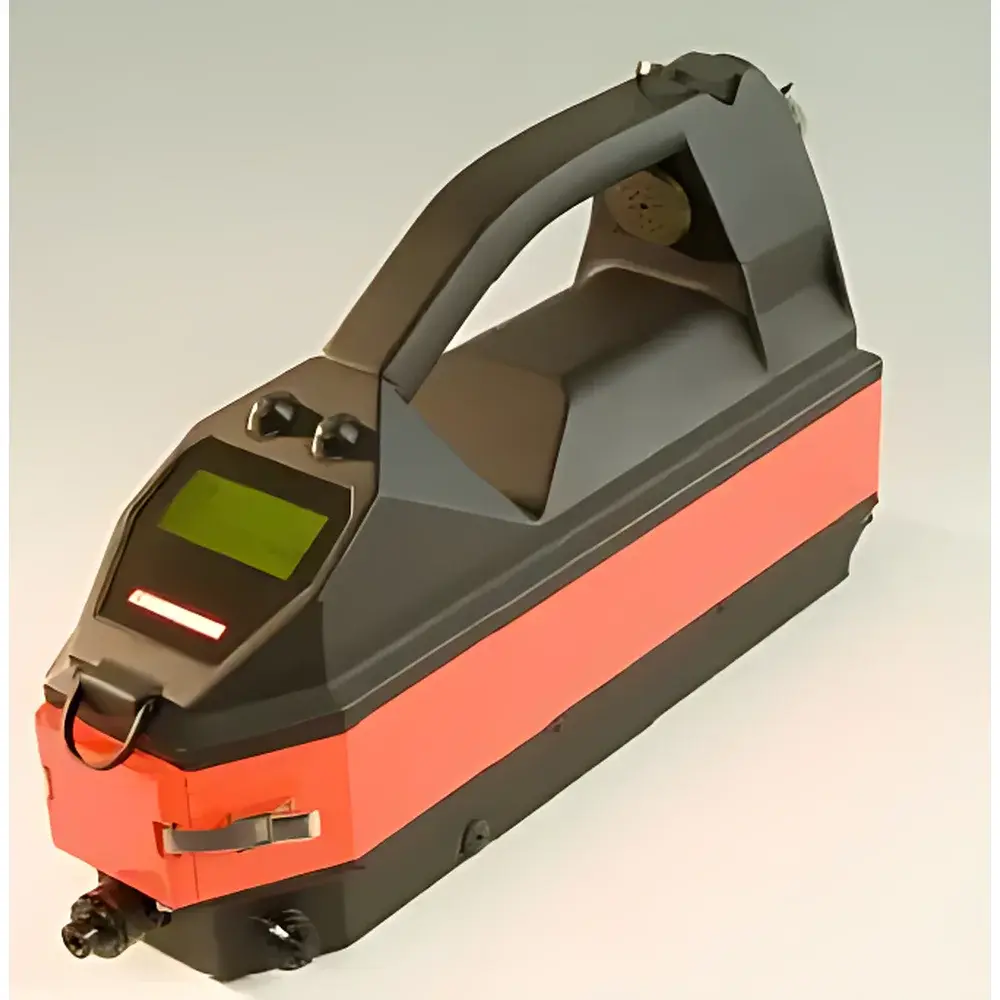
AIRSENSE GDA-FR Portable Multi-Gas Detector with Hybrid Sensor Array
| Brand | AIRSENSE |
|---|---|
| Origin | Germany |
| Instrument Type | Portable |
| Detection Principle | Hybrid IMS/PID/MOS/EC Sensor Fusion |
| Core Configuration | Multi-Channel VOC & Inorganic Gas Detector |
| Operating Temperature | −30 °C to 50 °C |
| Relative Humidity Range | 5–95% RH (non-condensing) |
| Power Supply | Rechargeable Li-ion Battery (30 W, 8 h runtime) |
| Weight | 4.2 kg |
| Sample Introduction | Integrated Auto-Sampling Pump with Continuous Gas Flow |
| Cycle Time | 5 min |
| Response Time | 2–60 s |
| Detection Library | >300 Pre-Calibrated Compounds (VOCs, Inorganic Gases, Electronic Specialty Gases), Expandable |
| Data Interfaces | RS-232, Ethernet, Wireless Transmission |
| Software | WinMuser GDA Suite |
| Heating Module | Integrated IR Heater for Solid/Surface Residue Volatilization |
| Alarm Logic | Template-Based Pattern Recognition with User-Configurable Thresholds |
Overview
The AIRSENSE GDA-FR is a field-deployable, multi-sensor gas detection platform engineered for rapid, reliable identification and semi-quantitative analysis of volatile organic compounds (VOCs), inorganic toxic gases, and specialty electronic gases in industrial, emergency response, and environmental compliance settings. Unlike conventional single-principle detectors, the GDA-FR implements a fused-sensor architecture—simultaneously integrating four orthogonal detection modalities: Ion Mobility Spectrometry (IMS) with 63Ni radioactive ionization source (dual-polarity capability), Photoionization Detection (PID) at 10.6 eV photon energy, Metal Oxide Semiconductor (MOS) arrays, and electrochemical (EC) sensors. This multi-channel approach generates a composite spectral fingerprint for each analyte, enabling high-confidence pattern matching against an expandable reference library of over 300 pre-characterized compounds. The system operates on a template-based classification algorithm—not reliant on absolute calibration curves—thereby mitigating cross-sensitivity artifacts common in single-technology instruments. Its design complies with IEC 60079-0 (explosive atmospheres) and EN 50104 (gas detectors for toxic gases), supporting use in Zone 1 hazardous locations when equipped with appropriate housing options.
Key Features
- Multi-Channel Fingerprinting: Eight parallel sensor channels (dual-polarity IMS + PID + dual MOS + dual EC) acquire synchronized response vectors per sampling event, significantly reducing false positives through multivariate pattern discrimination.
- Sub-ppb Detection Sensitivity: Achieves detection limits ranging from low ppb to sub-ppm levels across compound classes—validated per ISO 16000-6 for formaldehyde, benzene, and toluene; applicable to US EPA Method TO-15 target analytes.
- Adaptive Operational Modes: Four context-aware modes: (1) Source Tracing (auto-dilution ramping), (2) Ambient Monitoring (low-dilution, long-term trend logging), (3) PID-Optimized Quantification (reference-compound normalization), and (4) Surface Residue Analysis (integrated IR heater, 50–300 °C controllable).
- Rapid Deployment Architecture: Cold-start operational readiness in <5 s; no mandatory warm-up cycle required for preliminary screening—critical for first-responder applications under NFPA 472 protocols.
- Modular Maintenance Design: All sensor modules, filters, and pump assemblies are hot-swappable via standardized bayonet interfaces; service intervals documented per ISO/IEC 17025 traceability requirements.
Sample Compatibility & Compliance
The GDA-FR accepts gaseous samples directly from ambient air, ducted exhaust streams, or headspace above solids/liquids (via IR-assisted thermal desorption). It detects compounds with ionization potentials ≤10.6 eV (PID-active), dipole moment and molecular weight-dependent mobility (IMS-active), redox activity (EC-active), or surface adsorption affinity (MOS-active). Validated compatibility includes ammonia, hydrogen sulfide, chlorine, phosgene, silane, arsine, phosphine, acetone, xylene, chloroform, and fluorinated refrigerants. Regulatory alignment includes conformity with EU Directive 2014/68/EU (PED), RoHS 2011/65/EU, and electromagnetic compatibility per EN 61326-1. For pharmaceutical cleanroom monitoring, the instrument supports audit-trail-enabled data export compliant with FDA 21 CFR Part 11 when used with WinMuser GDA v4.2+ and validated network configuration.
Software & Data Management
WinMuser GDA is a Windows-based analytical suite supporting real-time signal visualization, library expansion, calibration validation, and report generation. Each measurement session logs raw channel responses, temperature/humidity metadata, GPS coordinates (when connected), and operator-defined annotations. Data exports support CSV, XML, and ASTM E2500-compliant .xdf formats. The software implements role-based access control (RBAC), electronic signature workflows, and immutable audit trails meeting GLP/GMP documentation standards. Custom library development—per customer-specific analytes—is performed using proprietary spectral registration protocols aligned with ISO/IEC 17025 method validation guidelines.
Applications
- Chemical spill response and leak source localization in petrochemical facilities
- Confined space entry pre-screening per OSHA 1910.146 and ANSI Z88.2
- Pharmaceutical manufacturing: residual solvent verification on equipment surfaces
- Electronics fabrication: ultra-high-purity gas line integrity testing (e.g., NF3, WF6)
- Environmental site assessment: vadose zone VOC mapping and landfill perimeter monitoring
- Fire investigation: detection of accelerant residues (e.g., gasoline, kerosene markers)
FAQ
Does the GDA-FR require daily calibration?
No—field calibration is recommended only after sensor replacement, exposure to saturation-level concentrations, or every 30 days for routine QA/QC. A full calibration kit (span gas, zero air, and reference standards) is available as an optional accessory.
Can the detection library be updated onsite?
Yes—library updates are performed via encrypted USB key or secure HTTPS upload through WinMuser GDA. New compound entries require spectral characterization by AIRSENSE’s application lab, with typical turnaround of 5–10 business days.
Is the 63Ni source exempt from nuclear regulatory licensing?
Yes—the IMS module contains a 370 MBq 63Ni source certified under IAEA RS-G-1.9 as “exempt quantity” (Class III), requiring no national radiation safety license in EU, US, Canada, or Australia.
What is the expected lifetime of the IMS drift tube?
Under normal operating conditions (≤8 h/day, 25 °C average), the IMS drift tube maintains performance specifications for ≥5 years or 10,000 operational cycles—verified via accelerated aging tests per MIL-STD-810H.
How does the GDA-FR handle humidity interference?
The system employs dynamic humidity compensation algorithms trained on >12,000 empirical measurements across 5–95% RH; additionally, Nafion™-based moisture scrubbers are integrated upstream of all sensors to minimize condensation-induced signal drift.







