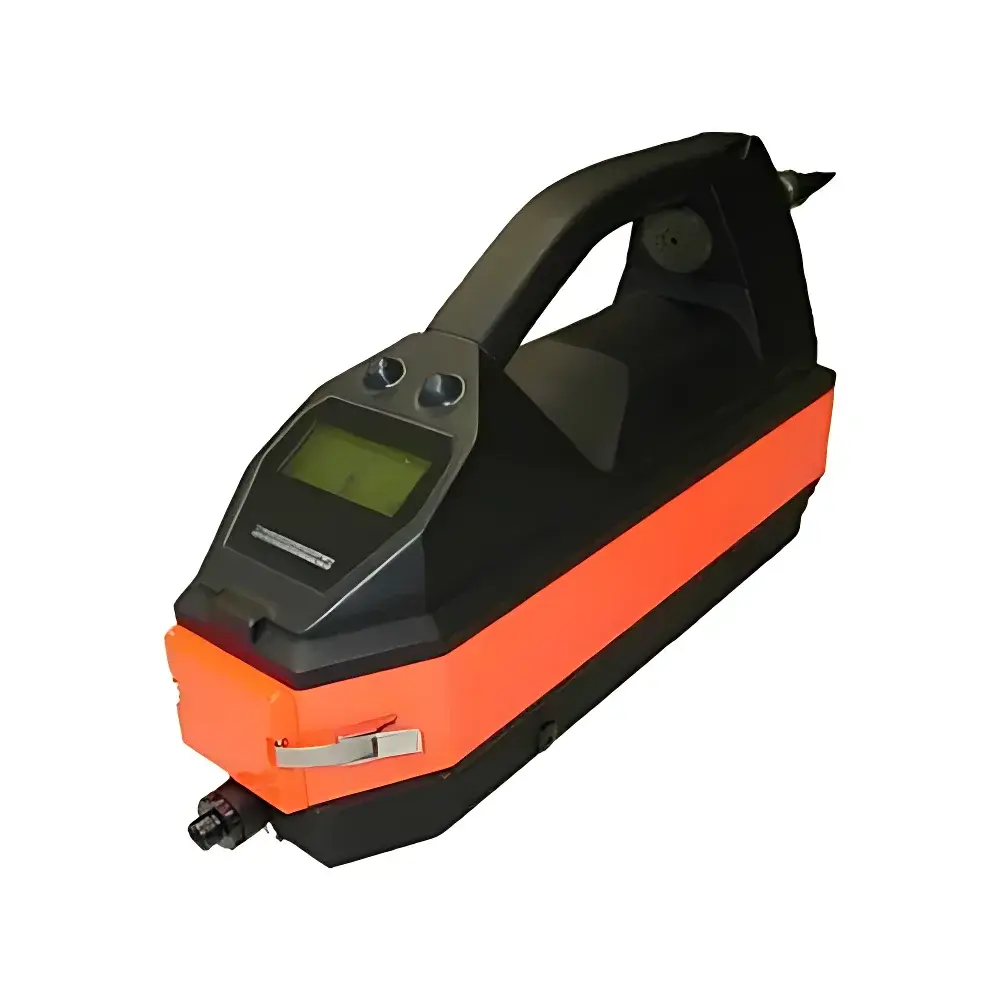
AIRSENSE GDA-FR Portable Multi-Sensor Hazardous Gas Analyzer
| Brand | AIRSENSE |
|---|---|
| Origin | Germany |
| Model | GDA-FR |
| Detection Principles | Ion Mobility Spectrometry (IMS), Photoionization Detection (PID), Metal Oxide Semiconductor (MOS), Electrochemical (EC) |
| Sensor Architecture | 8-channel parallel detection array |
| Response Time | <10 seconds for qualitative/quantitative identification |
| Target Analytes | 40+ industrial toxic gases and chemical warfare agents (CWAs) |
| Compliance | Designed for field deployment under ISO 17025-aligned operational protocols, compatible with GLP/GMP documentation workflows |
Overview
The AIRSENSE GDA-FR Portable Multi-Sensor Hazardous Gas Analyzer is an engineered field-deployable instrument designed for rapid, on-site identification and quantification of volatile hazardous compounds in ambient air. It integrates four complementary analytical technologies—Ion Mobility Spectrometry (IMS), Photoionization Detection (PID), Metal Oxide Semiconductor (MOS), and Electrochemical (EC) sensing—within a single compact chassis. Each sensor modality operates in parallel across eight independent gas sampling channels, generating a multi-dimensional response signature per analyte. This signature functions as a unique “chemical fingerprint,” enabling high-confidence classification against an embedded reference library containing retention drift-corrected IMS spectra, PID ionization energy thresholds, MOS resistance kinetics, and EC redox potential profiles. The system does not rely on chromatographic separation; instead, it leverages real-time multivariate pattern recognition to resolve overlapping signals from complex gas mixtures—critical in emergency response scenarios where time-to-decision is measured in seconds.
Key Features
- Eight-channel parallel gas intake architecture ensures simultaneous signal acquisition from all four sensor types, minimizing temporal misalignment and enhancing reproducibility.
- Integrated auto-dilution module dynamically adjusts sample concentration to maintain sensor linearity across wide dynamic ranges (ppb to % v/v), eliminating manual dilution errors.
- Self-cleaning cycle activates between measurements using controlled thermal desorption and purge gas flow, mitigating cross-contamination and sensor drift during extended field use.
- Low-humidity sensitivity design minimizes interference from ambient water vapor—a known challenge for IMS and MOS sensors—through optimized inlet conditioning and algorithmic compensation.
- Intuitive touchscreen interface with multilingual support (including English and Chinese) enables operation by first responders without specialized analytical training.
- Ruggedized IP65-rated enclosure meets MIL-STD-810G shock and vibration requirements for transport in emergency vehicles, aircraft cargo holds, or handheld deployment in industrial zones.
Sample Compatibility & Compliance
The GDA-FR is validated for direct analysis of undiluted ambient air samples at standard temperature and pressure (STP). It detects 40+ priority compounds—including inorganic acidic gases (HCl, HF, HCN, SO₂, Cl₂), low-molecular-weight organics (formaldehyde, acetaldehyde, vinyl chloride), nitrogen oxides, and internationally regulated chemical warfare agents (CWA) such as sarin (GB), soman (GD), VX, mustard agent (HD), lewisite (L), and arsine (AsH₃). Method performance aligns with ASTM E2912–22 (Standard Guide for Field Screening of Airborne Chemical Warfare Agents) and supports data traceability required under ISO/IEC 17025:2017 for accredited laboratories. Instrument firmware includes audit-trail logging compliant with FDA 21 CFR Part 11 principles when connected to secure enterprise networks.
Software & Data Management
The onboard operating system runs AIRSENSE’s proprietary ChemID™ software suite, which performs real-time spectral deconvolution, library matching, and concentration estimation using calibrated response factors. All raw sensor waveforms, processed fingerprints, GPS-tagged location metadata, operator ID, and timestamp are stored locally in encrypted SQLite databases. USB-C and Bluetooth 5.0 interfaces enable secure export to LIMS or incident command systems. Optional cloud synchronization provides remote fleet monitoring, firmware over-the-air (FOTA) updates, and centralized calibration certificate management—all accessible via role-based web portal with TLS 1.3 encryption.
Applications
The GDA-FR serves mission-critical roles in civil defense and industrial safety operations: rapid screening at airport security checkpoints and cargo inspection bays; continuous perimeter monitoring in chemical manufacturing parks and storage facilities; mobile reconnaissance during HAZMAT incidents involving unknown releases; environmental compliance verification near landfill vents or wastewater treatment off-gases; and tactical CWA detection during peacekeeping or disaster relief deployments. Its portability and sub-10-second decision latency make it suitable for integration into unmanned ground vehicles (UGVs) and drone-mounted payloads for inaccessible or high-risk zones.
FAQ
What regulatory standards does the GDA-FR support for forensic or evidentiary use?
It generates auditable data packages meeting ISO/IEC 17025 documentation requirements and supports chain-of-custody reporting templates aligned with EN 14181 for automated monitoring systems.
Can the internal library be expanded with user-defined compounds?
Yes—via AIRSENSE’s certified Library Builder Toolkit, which requires laboratory validation of new IMS/PID/MOS/EC response profiles under controlled conditions.
How often does the system require recalibration in field operation?
Factory-calibrated sensors retain accuracy for 6 months under typical usage; annual NIST-traceable recalibration is recommended, with optional on-site verification kits available.
Is the instrument suitable for indoor confined-space entry monitoring?
It meets OSHA 1910.146 criteria for pre-entry atmospheric testing when used in conjunction with certified bump-test procedures and documented zero/span verification logs.
Does the GDA-FR provide quantitative results traceable to SI units?
Yes—concentration outputs are reported in µg/m³ or ppmv, referenced to NIST SRM-certified gas standards and corrected for local barometric pressure and temperature.