
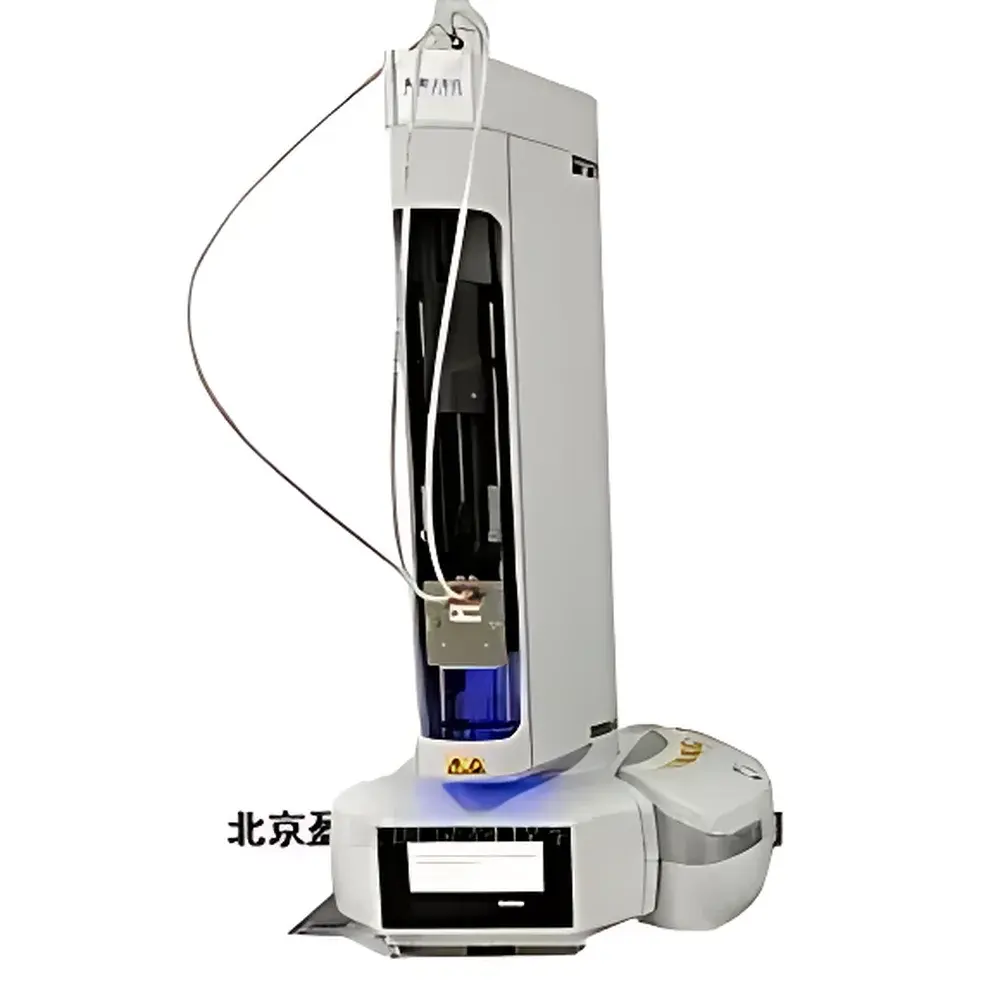
AIRSENSE HT2000 Automated Headspace Sampler for PEN-Series Electronic Nose Systems
| Brand | AIRSENSE |
|---|---|
| Origin | Germany |
| Model | HT2000 |
| Sample Tray Capacity | 14-position or 42-position (selectable) |
| Heating Temperature Range | Off / 40–170 °C |
| Heating Time | Off / 0–999 min |
| Vibration Mode | Oscillatory agitation |
| Vibration Cycle | Off / 0–9.9 min |
| Sample Analysis Time | 0–60 min |
| Dimensions (H×W×D) | 696 × 330/350 × 320/520 mm (door open/closed |
| Power Supply | 100–240 V AC, 50–60 Hz, 1.6 A |
| Weight | 10 kg |
Overview
The AIRSENSE HT2000 Automated Headspace Sampler is an engineered interface module designed exclusively for seamless integration with PEN-series electronic nose systems. It operates on the principle of dynamic headspace sampling—thermally desorbing volatile organic compounds (VOCs) from solid or liquid samples under controlled temperature and agitation conditions, then delivering the equilibrated vapor phase to the sensor array of the connected electronic nose. This instrumentation eliminates manual sample introduction, enabling unattended operation across extended experimental sequences while preserving analytical reproducibility. The HT2000 is not a standalone analytical instrument but a critical pre-analytical automation platform that standardizes VOC release kinetics—key to achieving inter-laboratory comparability in olfactory pattern recognition studies.
Key Features
- Programmable thermal desorption: Independent control of heating temperature (40–170 °C), duration (0–999 min), and ramp profiles ensures method-specific optimization for diverse matrices including foodstuffs, pharmaceuticals, polymers, and environmental samples.
- Oscillatory agitation during heating: Vibration-based mixing enhances mass transfer and accelerates headspace equilibrium—particularly beneficial for viscous, heterogeneous, or particulate-laden samples where diffusion-limited VOC release would otherwise compromise signal stability.
- Modular sample handling: Supports two interchangeable sample trays—14-position for high-precision validation runs and 42-position for high-throughput screening—both compatible with standard 20 mL headspace vials (crimp-sealed or screw-cap).
- Intelligent mechanical coordination: Synchronized lid actuation, vial piercing, carrier gas flow initiation, and sensor chamber purging are executed via embedded motion logic, minimizing carryover and ensuring consistent injection volume (±1.5% RSD).
- Robust architecture: Constructed with corrosion-resistant stainless steel internal pathways and PTFE-coated fluidic interfaces to withstand aggressive VOCs and prevent adsorption artifacts over prolonged operational cycles.
Sample Compatibility & Compliance
The HT2000 accommodates a broad spectrum of sample types—including raw agricultural products, fermented beverages, tablet coatings, wastewater extracts, and microbial cultures—without requiring derivatization or solvent extraction. Its sealed headspace vial environment maintains sample integrity and prevents atmospheric contamination. From a regulatory standpoint, the system supports audit-ready workflows aligned with GLP and GMP frameworks: all method parameters (temperature setpoints, timing sequences, vibration cycles) are stored with timestamped metadata in the host software, satisfying traceability requirements per ISO/IEC 17025:2017 Clause 7.7 and FDA 21 CFR Part 11 for electronic records and signatures.
Software & Data Management
Controlled via AIRSENSE’s proprietary e-Nose Suite v5.x, the HT2000 integrates bidirectionally with PEN-series instruments to synchronize sampling events with sensor response acquisition. The software enforces method-driven sequencing: users define multi-step protocols (e.g., “equilibrate at 60 °C for 15 min → agitate at 300 rpm for 2 min → inject → flush → repeat”) and deploy them across batched sample sets. All operational logs—including real-time temperature curves, vibration duty cycles, and vial identification via optional barcode scanning—are archived in encrypted SQLite databases compliant with data retention policies. Export formats include CSV, HDF5, and .mat for downstream multivariate analysis (PCA, LDA, PLS-DA) in MATLAB, Python (scikit-learn), or SIMCA.
Applications
- Food authenticity and spoilage detection: Quantifying off-flavor markers (e.g., hexanal, 2-nonanone) in edible oils and dairy products during accelerated shelf-life testing.
- Pharmaceutical excipient characterization: Monitoring volatile impurities in lyophilized formulations and detecting residual solvents per ICH Q3C guidelines.
- Microbial volatile organic compound (MVOC) profiling: Differentiating fungal species (e.g., Aspergillus vs. Penicillium) in indoor air quality assessments.
- Environmental odor source attribution: Screening landfill leachate or wastewater treatment plant emissions against reference odorant libraries.
- Material science: Assessing VOC emissions from automotive interior plastics under ISO 12219-4 thermal aging conditions.
FAQ
Is the HT2000 compatible with non-PEN electronic noses?
No—the HT2000 is mechanically and electronically optimized for PEN-series instruments only. Its pneumatic interface, communication protocol (RS-485 + TTL trigger), and sample introduction geometry are proprietary to AIRSENSE’s ecosystem.
Can the HT2000 be used for quantitative analysis?
It supports semi-quantitative profiling when coupled with internal standards and calibration curves generated using certified VOC mixtures; however, absolute quantification requires parallel GC-MS validation per ISO 11359-2.
What maintenance intervals are recommended?
Vial piercer needles should be replaced every 500 injections; the carrier gas filter requires replacement quarterly; and the internal O-rings must be inspected annually for compression set.
Does the system support remote monitoring?
Yes—via Ethernet-connected e-Nose Suite workstations, users can monitor real-time status (temperature, vibration, cycle progress), receive email alerts on protocol completion or fault conditions, and initiate emergency abort sequences.
Is validation documentation provided?
AIRSENSE supplies a Factory Acceptance Test (FAT) report, IQ/OQ templates aligned with ASTM E2655-20, and a full set of electrical safety and EMC test certificates (CE, FCC, RoHS).




