
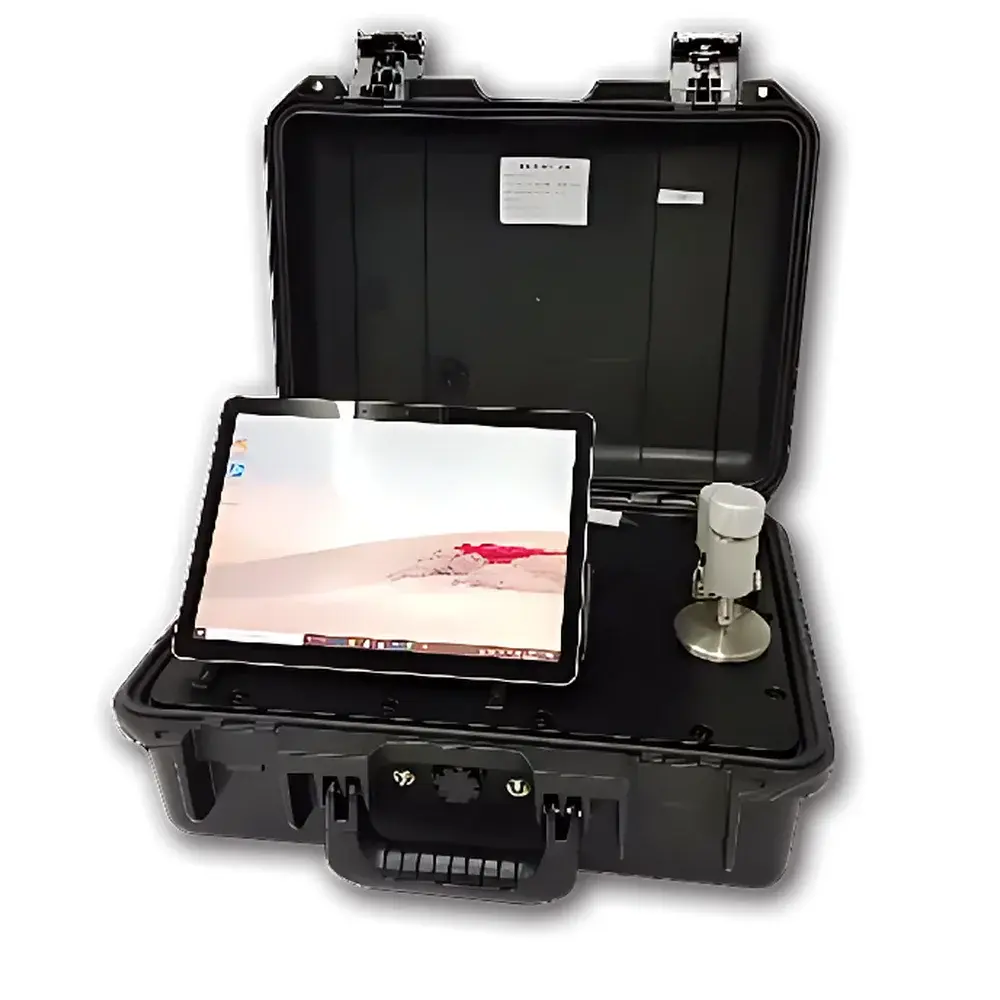
AIRSENSE MI10 Portable Fourier Transform Infrared (FTIR) Spectrometer
| Brand | AIRSENSE |
|---|---|
| Origin | Imported |
| Instrument Type | Portable |
| Instrument Principle | Fourier Transform Infrared (FTIR) |
| Model | MI10 |
| Wavenumber Range | 500–5000 cm⁻¹ |
| Spectral Resolution | 2 cm⁻¹ |
| Compliance | Designed for field-deployable chemical identification in accordance with ISO 17025-aligned operational workflows |
| Software | Embedded real-time spectral acquisition and library-matching interface |
| Data Handling | On-device storage with USB export and optional cloud-sync capability |
| Environmental Rating | IP54-rated enclosure for dust and splash resistance |
| Power Supply | Rechargeable Li-ion battery (≥4 h continuous operation) |
| Dimensions & Weight | 320 × 240 × 120 mm |
Overview
The AIRSENSE MI10 Portable Fourier Transform Infrared (FTIR) Spectrometer is an engineered solution for rapid, on-site molecular identification of unknown chemical substances under non-laboratory conditions. Based on Michelson interferometry and digital signal processing of infrared absorption spectra, the MI10 delivers high-fidelity mid-infrared transmission and attenuated total reflectance (ATR) measurements across a broad wavenumber range (500–5000 cm⁻¹). Its core design prioritizes field robustness without compromising spectral fidelity—achieving a nominal resolution of 2 cm⁻¹, sufficient for reliable functional group assignment and compound class differentiation. Unlike benchtop FTIR systems requiring controlled environments and extensive sample preparation, the MI10 integrates optical alignment stability, thermal drift compensation, and vibration-damped optics into a single ruggedized chassis. It is expressly intended for use in time-critical scenarios including hazardous material (HAZMAT) response, forensic field screening, emergency medical triage, post-disaster environmental assessment, and mobile quality control in regulated manufacturing settings.
Key Features
- Compact, hand-carried form factor (≤3.8 kg) with integrated ATR sampling module and battery-powered operation (≥4 h runtime)
- Real-time spectral acquisition and onboard chemometric matching against preloaded spectral libraries (e.g., ASTM E1421, NIST IR Database subsets)
- IP54-rated magnesium alloy housing with shock-absorbing elastomer corners for field durability
- Touchscreen-enabled user interface with guided workflow navigation—no prior spectroscopy training required
- Zero-sample-prep capability for solids, liquids, gels, pastes, and powders via direct contact ATR measurement
- Firmware-upgradable architecture supporting over-the-air (OTA) library updates and algorithm enhancements
- Embedded audit trail functionality compliant with GLP documentation requirements (user login, timestamped spectra, operator ID tagging)
Sample Compatibility & Compliance
The MI10 supports direct analysis of heterogeneous, unprocessed samples—including corrosive, volatile, or thermally labile materials—without dilution, pelletization, or solvent extraction. Its diamond-crystal ATR accessory enables reproducible contact-based measurement across viscosity ranges from low-viscosity solvents to semi-solid polymers. The instrument meets mechanical and electromagnetic compatibility requirements per IEC 61326-1 (industrial environments) and conforms to optical safety standards IEC 60825-1 (Class 1 laser). While not certified for GMP production release testing, its data integrity features—including immutable spectral metadata, electronic signature support, and exportable .spa/.csv files—align with FDA 21 CFR Part 11 expectations for field-deployed analytical tools used in investigative or triage contexts.
Software & Data Management
The embedded MI10 Control Suite provides intuitive point-and-shoot operation: auto-zeroing, background subtraction, peak detection, and best-match ranking against customizable spectral libraries. All acquired spectra are time-stamped, geotagged (via optional Bluetooth GPS), and stored locally in vendor-neutral formats compatible with third-party chemometrics platforms (e.g., GRAMS/AI, MATLAB, Python SciPy). Data export occurs via USB-C or Wi-Fi to secure institutional servers; encrypted cloud synchronization is available through AIRSENSE’s validated CloudLink service. Audit logs record every user action—including spectrum acquisition, library search, report generation, and firmware update events—with SHA-256 hashing for tamper-evident integrity verification.
Applications
- Hazardous materials identification during CBRNE incident response (e.g., industrial spills, illicit drug seizures, explosive residue screening)
- Field-based pharmaceutical excipient verification and counterfeit medicine detection
- Environmental forensics: rapid classification of hydrocarbon contaminants, plastic fragments, or pesticide residues in soil/water matrices
- Emergency medical support: bedside identification of toxic alcohols, organic solvents, or adulterants in biological fluids
- Academic and industrial R&D: mobile reaction monitoring, polymer degradation tracking, and catalyst characterization under non-ideal conditions
- Regulatory inspections: on-the-spot verification of raw material conformity against pharmacopoeial monographs (USP , EP 2.2.24)
FAQ
Does the MI10 require routine calibration with NIST-traceable standards?
Yes—while factory-aligned, users must perform daily background acquisition and periodic verification using polyethylene or polystyrene reference films per ISO 17025 Clause 6.5.3.
Can the MI10 be used for quantitative analysis?
It is optimized for qualitative and semi-quantitative screening; absolute quantification requires method-specific validation per ICH Q2(R2) guidelines and external calibration standards.
Is spectral library expansion supported?
Yes—custom libraries may be imported in JCAMP-DX format; AIRSENSE provides annual subscription-based updates aligned with EPA, OSHA, and NATO HAZMAT reference sets.
What maintenance is required in field deployment?
No optical alignment servicing is needed; routine cleaning of the ATR crystal with isopropanol and lint-free wipes suffices. Battery health monitoring and firmware patching are automated via the Control Suite.
How does the MI10 handle spectral interference from ambient humidity or CO₂?
The system applies dynamic atmospheric compensation algorithms using built-in reference interferograms, minimizing water vapor and carbon dioxide absorption artifacts common in portable FTIR devices.




