
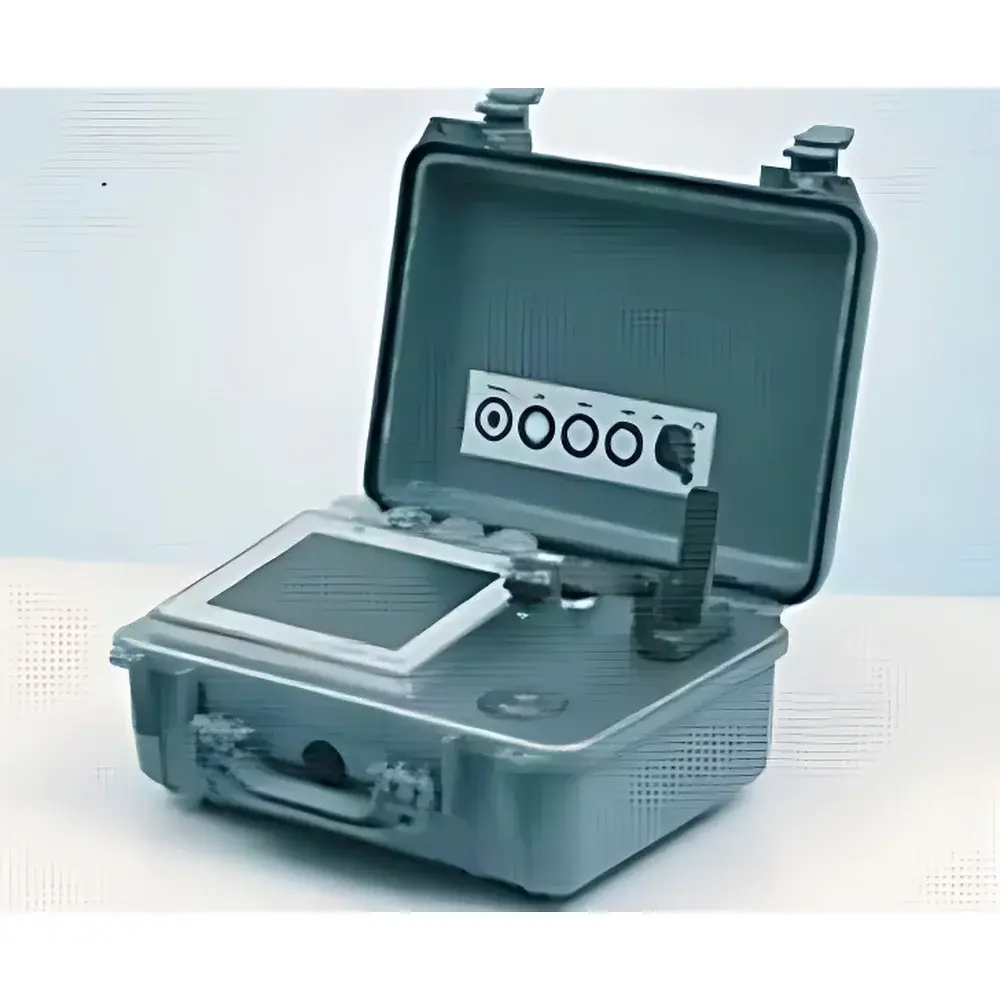
AIRSENSE Mobile-IR Portable FTIR Spectrometer for Solid and Liquid Chemical Identification
| Brand | AIRSENSE |
|---|---|
| Origin | Germany |
| Model | Mobile-IR |
| Design | Integrated ATR-based Portable FTIR System |
| Spectral Range | 4000–600 cm⁻¹ (typical) |
| Spectral Resolution | ≤4 cm⁻¹ (user-selectable) |
| Library | >14,000 reference spectra of hazardous, industrial, and environmental chemicals |
| Compliance | IP67-rated enclosure |
| Data Interface | Wi-Fi, USB, Bluetooth |
| Operating System | Embedded Linux with OPUS/Mentor software suite |
| Display | High-brightness capacitive touchscreen (≥10.1″) |
| Power | Rechargeable Li-ion battery (≥6 h continuous operation) |
| Weight | <5.2 kg |
| Dimensions | 320 × 240 × 180 mm (L×W×H) |
Overview
The AIRSENSE Mobile-IR is a field-deployable Fourier Transform Infrared (FTIR) spectrometer engineered for rapid, on-site qualitative identification of unknown chemical substances in emergency response, environmental monitoring, and industrial safety applications. Unlike conventional benchtop FTIR systems, the Mobile-IR integrates a high-stability Michelson interferometer, diamond-coated attenuated total reflectance (ATR) sampling interface, and thermoelectrically cooled DTGS detector into a single ruggedized platform. Its operational principle relies on the unique vibrational absorption signatures of molecular bonds—each compound exhibits a characteristic infrared fingerprint across the mid-IR spectral region (4000–600 cm⁻¹). This enables unambiguous identification without prior knowledge of sample composition. Designed specifically for first responders and field chemists, the instrument delivers laboratory-grade spectral fidelity under non-laboratory conditions—including post-disaster zones, confined spaces, outdoor hazardous material (HazMat) incidents, and contaminated industrial sites.
Key Features
- IP67-rated magnesium-alloy chassis with shock-absorbing polymer overmolding, certified for operation in temperatures from −10 °C to +50 °C and humidity up to 95% RH (non-condensing)
- Single-point ATR crystal (ZnSe or diamond option) enabling direct contact analysis of solids, liquids, gels, pastes, and powders—no solvent extraction, dilution, or pelletization required
- Real-time spectral acquisition in ≤5 seconds per measurement; full interferogram processing and library search completed within 10–15 seconds
- Embedded dual-core ARM processor running a hardened Linux OS; preloaded OPUS/Mentor software with intuitive workflow-driven interface and multilingual support (EN/DE/FR/ES)
- Wireless connectivity via IEEE 802.11ac Wi-Fi and Bluetooth 5.0 for remote data export, firmware updates, and cloud-synchronized spectral library management
- Battery-powered operation with hot-swappable Li-ion modules supporting ≥6 hours of continuous use; optional vehicle DC input (12–24 V) for extended deployments
Sample Compatibility & Compliance
The Mobile-IR accommodates heterogeneous samples without preparation: viscous oils, aqueous solutions, crystalline solids, polymer fragments, biological tissues, and particulate-laden swabs. Its ATR geometry ensures consistent penetration depth (~0.5–2 µm), minimizing scattering effects and enhancing reproducibility across matrix types. The system complies with IEC 60529 (IP67), MIL-STD-810G (shock/vibration), and ATEX/IECEx Zone 2 certification (optional configuration) for use in potentially explosive atmospheres. All spectral libraries are curated against NIST, EPA, and EU REACH reference datasets and include CAS-number-indexed entries for regulatory traceability. Instrument validation protocols align with ISO/IEC 17025 requirements for field-portable analytical equipment used in environmental forensics.
Software & Data Management
OPUS/Mentor provides role-based access control, audit-trail logging (per FDA 21 CFR Part 11 requirements), and encrypted local storage of raw interferograms, processed spectra, and search reports. Users may import custom spectral libraries in JCAMP-DX format or generate new references via onboard peak annotation tools. Search algorithms employ correlation coefficient matching, Euclidean distance scoring, and derivative-based spectral preprocessing to reduce false positives in complex mixtures. Measurement metadata—including GPS coordinates, operator ID, ambient temperature/humidity, and time stamp—is automatically embedded in exported .spa and .csv files. Remote fleet management is supported via AIRSENSE CloudLink, enabling centralized library versioning and compliance reporting across multi-unit deployments.
Applications
- Rapid identification of unknown residues at fire investigation scenes (e.g., accelerants, polymers, combustion byproducts)
- Field screening of soil/water contaminants during spill response (e.g., chlorinated solvents, PAHs, pesticides)
- Verification of raw material identity and counterfeit detection in pharmaceutical supply chains
- On-site verification of cleaning agent residues in food processing facilities (per FDA Food Code §110.80)
- First-responder triage of suspected chemical warfare agents or toxic industrial chemicals (TICs) under CWA Annex provisions
- Academic and government research requiring mobile spectral acquisition in remote or infrastructure-limited settings
FAQ
Does the Mobile-IR require annual calibration verification?
Yes—users must perform daily background acquisition and quarterly performance qualification using NIST-traceable polystyrene film standards. Full calibration certificates are issued upon request per ISO/IEC 17025.
Can the instrument identify mixtures or only pure compounds?
It primarily identifies major components in binary or ternary mixtures when spectral interference is minimal. Quantitative deconvolution is not supported; confirmatory GC-MS or HPLC analysis is recommended for complex matrices.
Is spectral library expansion subject to export control restrictions?
Library updates containing controlled substance references (e.g., DEA Schedule I–II compounds) require end-user declaration per EAR §744.11 and may be restricted for non-EU/non-US entities.
What maintenance is required beyond routine cleaning?
ATR crystal cleaning with spectroscopic-grade methanol and lint-free wipes is recommended after each use. Interferometer alignment checks are performed automatically during startup; no user intervention is needed.
How does the Mobile-IR ensure data integrity during wireless transmission?
All Wi-Fi transfers use TLS 1.2 encryption; locally stored data is AES-256 encrypted at rest. Audit logs record every file export event with cryptographic hash verification.
Related Products







