
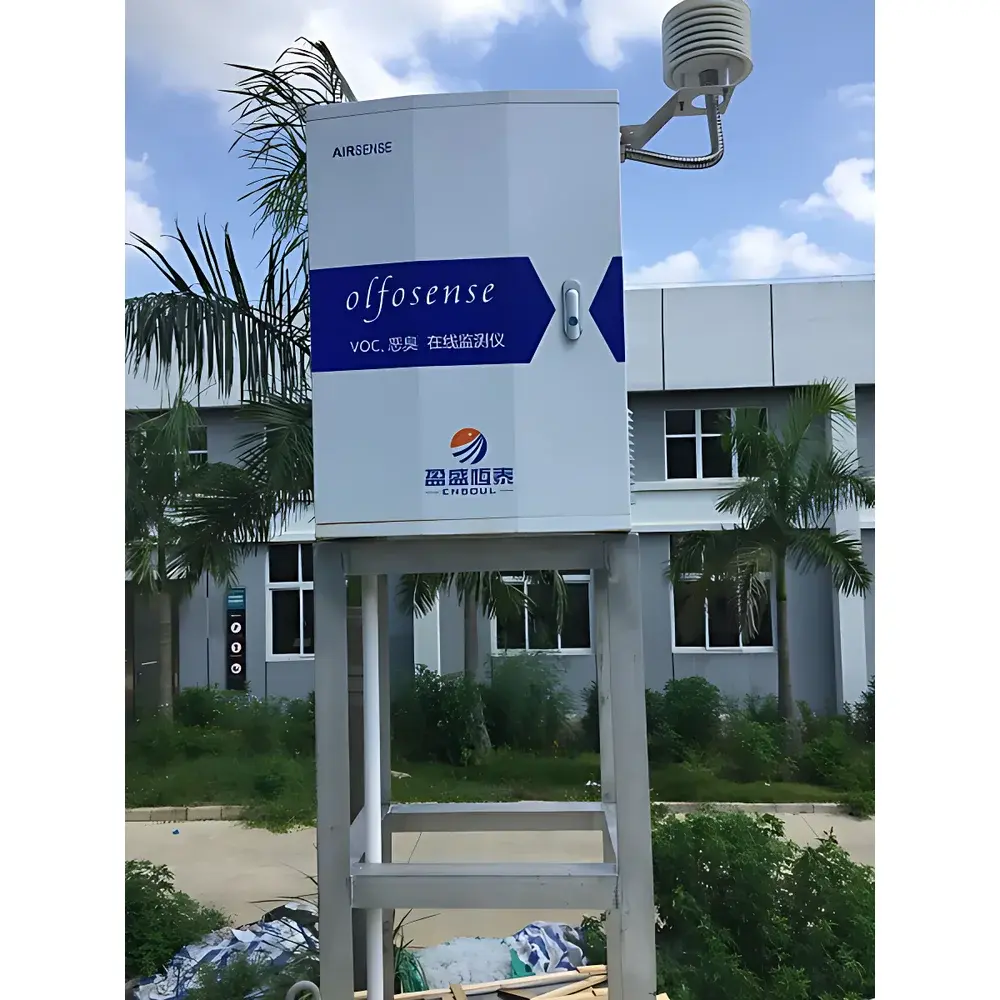
AIRSENSE e-Nose Online Odor Concentration Monitoring System
| Brand | AIRSENSE |
|---|---|
| Origin | Germany |
| Instrument Type | Online |
| Detection Principle | Hybrid Sensor Array (Metal Oxide Semiconductor, Photoionization Detector, Electrochemical Sensors) |
| Accuracy | ±2% FS |
| Flow Rate Range | 10–400 mL/min |
| Response Time | <1 s |
| Operating Temperature | −30°C to +100°C |
| Operating Humidity | 0–90% RH |
| Sensor Configuration | 4× MOS, 1× PID, 2–4× electrochemical sensors |
| Output Parameters | H₂S, NH₃, TVOC, user-selectable target odorants (1–2), and dimensionless odor unit (OU) concentration |
| Communication Interfaces | WiFi, GSM, GPRS, 3G, Ethernet |
| Data Management | Cloud database, local LAN, or open-network deployment |
| Compliance Ready | Designed for integration into GLP/GMP- and ISO 16000-compliant environmental monitoring workflows |
Overview
The AIRSENSE e-Nose Online Odor Concentration Monitoring System is an industrial-grade, real-time gas sensing platform engineered for continuous, unattended measurement of complex odor emissions in ambient and process environments. Unlike single-analyte gas detectors, this system employs a multi-modal sensor array rooted in biomimetic electronic nose (e-nose) principles—combining metal oxide semiconductor (MOS), photoionization detector (PID), and electrochemical transduction mechanisms to resolve overlapping volatile organic compounds (VOCs) and inorganic odorants such as hydrogen sulfide (H₂S) and ammonia (NH₃). Its architecture is optimized for dynamic, heterogeneous emission sources—including wastewater treatment plants, landfill sites, livestock facilities, chemical manufacturing units, food processing lines, and urban odor hotspots—where odor composition varies temporally and spatially. The system calculates odor concentration in standardized odor units (OU/m³) per EN 13725 and ISO 16000-8, enabling regulatory comparability across jurisdictions without requiring olfactometric lab validation for every measurement cycle.
Key Features
- Hybrid sensor array: 4 MOS sensors for broad-spectrum VOC sensitivity, 1 high-sensitivity PID (10.6 eV lamp) for aromatic and chlorinated compounds, and 2–4 electrochemical cells calibrated for H₂S, NH₃, SO₂, Cl₂, or NO₂
- Real-time output of individual gas concentrations (ppb–ppm range) plus dimensionless OU value derived from multivariate pattern recognition algorithms trained on certified reference odor mixtures
- Sub-second response time (<1 s T₉₀) with continuous sampling at adjustable flow rates (10–400 mL/min), ensuring detection of transient plumes and short-duration emission events
- Robust environmental operation: IP65-rated enclosure rated for −30°C to +100°C ambient temperature and 0–90% RH non-condensing humidity
- Flexible connectivity: Dual-mode communication via embedded WiFi/Ethernet for local network integration and optional cellular modules (GSM/GPRS/3G) for remote telemetry in low-infrastructure zones
- Open API and Modbus TCP/RTU protocols enable seamless integration with SCADA, DCS, or third-party environmental management software (EMS)
- Scalable deployment architecture: Supports unlimited node expansion; multiple units synchronize time-stamped data to centralized cloud or on-premise SQL databases
Sample Compatibility & Compliance
The system is validated for direct analysis of ambient air, stack effluents, and headspace gases from biological treatment units without pre-concentration or chromatographic separation. It complies with the functional requirements of ISO 16000-28 (indoor air—odor assessment) and aligns with methodological frameworks referenced in EU Directive 2010/75/EU (IED) for odor impact assessment. While not a replacement for dynamic olfactometry (EN 13725) in legal compliance reporting, it serves as a Tier-1 screening tool for trend identification, alarm triggering, and source attribution—particularly where rapid response and spatial coverage are prioritized over absolute olfactometric precision. Data audit trails support GLP-aligned recordkeeping, and optional 21 CFR Part 11-compliant software modules provide electronic signature, role-based access control, and immutable change logs.
Software & Data Management
The integrated web-based interface supports real-time visualization of concentration time-series, OU heatmaps overlaid on Google Maps™ geospatial layers, and automated report generation (PDF/CSV). Trend analysis tools include rolling 24-hr OU averages, wind-rose–correlated odor dispersion modeling, and threshold-based event logging with email/SMS alerts. Historical datasets are stored in structured relational format (PostgreSQL-compatible schema), allowing custom SQL queries for QA/QC validation or statistical process control (SPC) charting. Firmware updates and sensor calibration profiles are remotely deployable, minimizing field maintenance intervals.
Applications
- Continuous odor surveillance at municipal wastewater treatment plants and sludge dewatering facilities
- Compliance monitoring for industrial permits requiring odor abatement verification (e.g., petrochemical refineries, pulp & paper mills)
- Dynamic source apportionment in mixed-use urban zones with co-located food service, waste transfer, and residential areas
- Process optimization in anaerobic digestion systems via real-time H₂S/NH₃ feedback control
- Early-warning networks for landfill gas migration or composting facility off-gas anomalies
- Research-grade longitudinal studies of odorant speciation under varying meteorological conditions
FAQ
Does this system replace laboratory olfactometry for regulatory reporting?
No. It functions as a high-temporal-resolution screening and trending tool aligned with ISO 16000-28 guidance—not a certified EN 13725 analytical method. Regulatory submissions still require accredited olfactometric analysis.
Can the OU database be customized with site-specific odor standards?
Yes. The system includes a configurable odor library module supporting import of user-defined calibration vectors, reference mixture spectra, and local weighting factors for OU calculation.
What maintenance is required for long-term field deployment?
Sensors undergo automatic baseline correction during idle cycles; annual recalibration against traceable gas standards is recommended. MOS elements have typical lifespans of 24–36 months under continuous operation.
Is meteorological data integration supported natively?
Yes—optional integrated anemometer, wind vane, temperature, and relative humidity sensors connect via RS-485 or analog inputs, enabling real-time odor dispersion context.
How is data security handled in cloud deployments?
All cloud communications use TLS 1.2+ encryption; database instances are isolated per client, with optional private VPC hosting and SOC 2-aligned access governance policies.







