
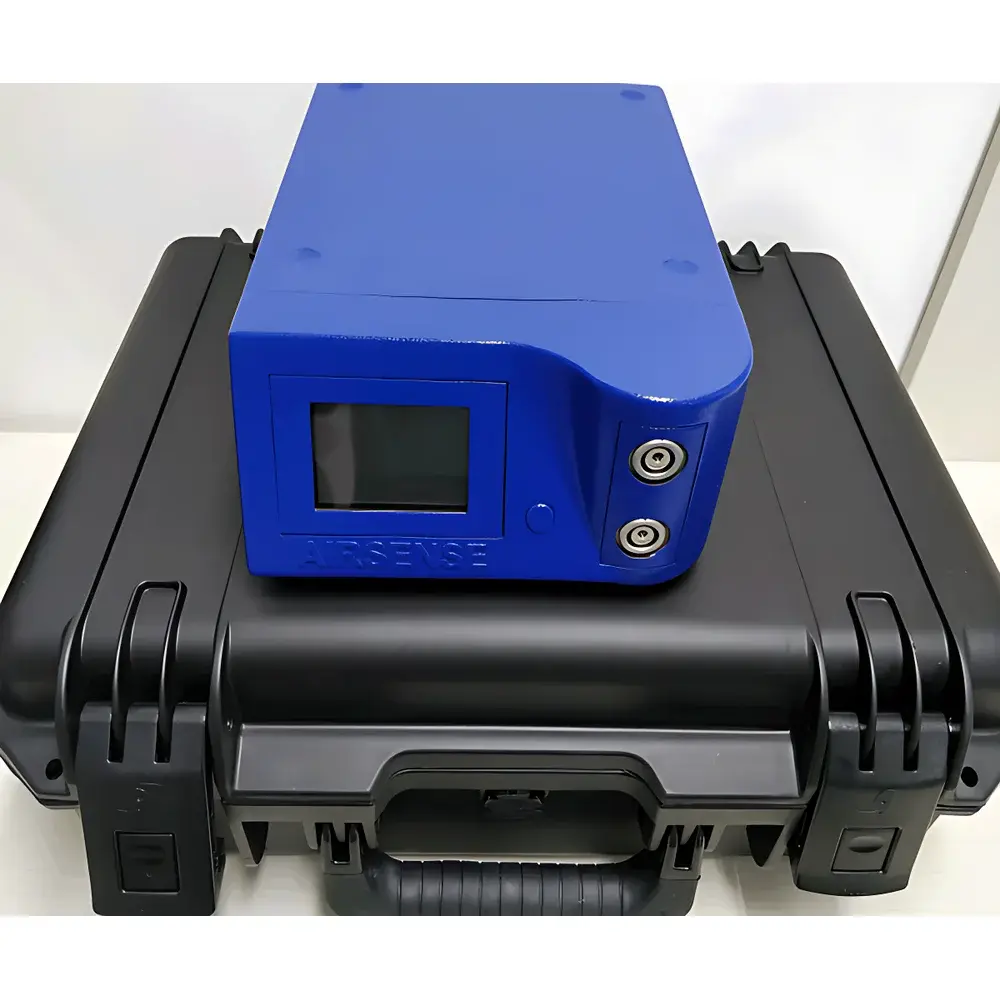
AIRSENSE PEN3 Electronic Nose
| Brand | AIRSENSE |
|---|---|
| Origin | Germany |
| Model | PEN3 |
| Type | Olfactory Analysis System (Electronic Nose) |
| Sensor Technology | Metal Oxide Semiconductor (MOS) Array |
| Data Acquisition | Standalone Operation with Onboard LCD Display & Internal Data Storage |
| Sampling Modes | Manual, Automated Headspace, Adsorption-Desorption Gas Interface, Optional Pre-concentration Unit |
| Compliance | Designed for GLP/GMP-aligned workflows |
Overview
The AIRSENSE PEN3 Electronic Nose is a compact, field-deployable olfactory analysis system engineered for reproducible, non-destructive volatile organic compound (VOC) profiling. Based on an array of heated metal oxide semiconductor (MOS) sensors—each exhibiting distinct cross-sensitivity patterns—the instrument captures dynamic headspace signatures from gaseous samples in real time. Unlike conventional chromatographic or mass spectrometric methods, the PEN3 relies on pattern recognition algorithms (e.g., PCA, LDA, SIMCA) to translate sensor response trajectories into discriminant models for classification, clustering, or quantitative prediction. Its design prioritizes operational autonomy: integrated microprocessor control, high-resolution LCD interface, and internal flash memory enable full data acquisition, preprocessing, and storage without external computing infrastructure—making it suitable for laboratory, pilot-scale, and mobile environmental monitoring applications.
Key Features
- Modular MOS sensor array comprising 10 individually calibrated, temperature-controlled metal oxide elements, optimized for broad-spectrum VOC detection (ppb–ppm range sensitivity)
- Integrated thermal management system ensuring stable sensor baseline and long-term signal reproducibility (>12 months typical sensor lifetime under routine calibration)
- Robust mechanical housing with sensor protection module, minimizing drift due to particulate contamination or mechanical shock
- Self-contained operation mode: real-time visualization of sensor kinetics, baseline correction status, and measurement progress via 4.3-inch TFT-LCD panel
- Multi-modal sampling architecture supporting direct manual injection, automated headspace sampling (compatible with standard 20 mL vials), adsorption-desorption interfaces (e.g., Tenax TA tubes), and optional cryo-trap preconcentration units
- Onboard data logging capacity (≥10,000 measurement cycles) with timestamped CSV export via USB 2.0 interface
Sample Compatibility & Compliance
The PEN3 accepts liquid, solid, semi-solid, and gaseous samples requiring no derivatization or solvent extraction. It accommodates standard headspace vials (20 mL crimp-top), Petri dishes, and custom sample holders for in situ monitoring. All firmware and data handling protocols are structured to support audit-ready documentation practices aligned with Good Laboratory Practice (GLP) and current Good Manufacturing Practice (cGMP). The system facilitates electronic signature implementation and audit trail generation per FDA 21 CFR Part 11 requirements when used with validated third-party software extensions. It complies with ASTM E2785-11 for method validation of electronic nose systems and meets performance criteria outlined in ISO 22064 for odor measurement instrumentation—including repeatability ( 0.92 under controlled reference gas challenges).
Software & Data Management
The PEN3 operates with proprietary WinMuster™ software (Windows-based), enabling sensor calibration, measurement sequence programming, multivariate statistical modeling, and report generation. Raw sensor resistance-time curves are exported in ASCII format for integration with MATLAB, Python (scikit-learn, Pandas), or R environments. Built-in tools support principal component analysis (PCA), linear discriminant analysis (LDA), soft independent modeling of class analogy (SIMCA), and partial least squares regression (PLSR). All processed datasets retain full metadata (operator ID, ambient T/RH, sampling duration, sensor heating profile), ensuring traceability. Data encryption, user-level access control, and versioned project archiving are supported to meet institutional data integrity policies.
Applications
- Food & Beverage Quality Control: Shelf-life assessment (meat spoilage, dairy oxidation), origin authentication (coffee, honey, olive oil), flavor consistency monitoring (yogurt, juice, spirits), and off-odor detection (packaging migration, microbial contamination)
- Pharmaceutical Development: Microbial identification on agar media, excipient compatibility screening, fermentation endpoint determination, and odor profiling of APIs and final dosage forms
- Materials Science: VOC emission testing of polymers, adhesives, and packaging substrates per ISO 16000-9; sensory equivalence evaluation of synthetic vs. natural aroma compounds
- Environmental Monitoring: Odor source attribution in wastewater treatment plants, biogenic VOC flux quantification in agricultural soils, landfill leachate off-gas characterization, and natural gas leak screening using methane-selective sensor weighting
FAQ
What sensor technology does the PEN3 employ?
It utilizes an array of 10 thermally modulated metal oxide semiconductor (MOS) sensors, each with tailored catalytic surface chemistry to generate differential response patterns to volatile organic compounds.
Can the PEN3 operate without a computer connection?
Yes—the instrument features embedded firmware and local storage, allowing fully autonomous measurement execution, real-time display, and data retention independent of PC linkage.
Is the system compliant with regulatory documentation standards?
When deployed with validated software configurations and procedural controls, it supports 21 CFR Part 11 compliance, including electronic signatures, audit trails, and role-based access management.
What types of sampling interfaces are supported?
Standard configurations include manual syringe injection, automated headspace vial sampling, and gas-phase interfaces for adsorption-desorption cartridges; optional cryogenic preconcentration modules extend detection limits for trace analytes.
How is sensor drift managed during extended use?
Each sensor undergoes periodic auto-zeroing during idle intervals, and the system includes reference gas calibration routines that can be scheduled daily, weekly, or per batch to maintain inter-run comparability.




