
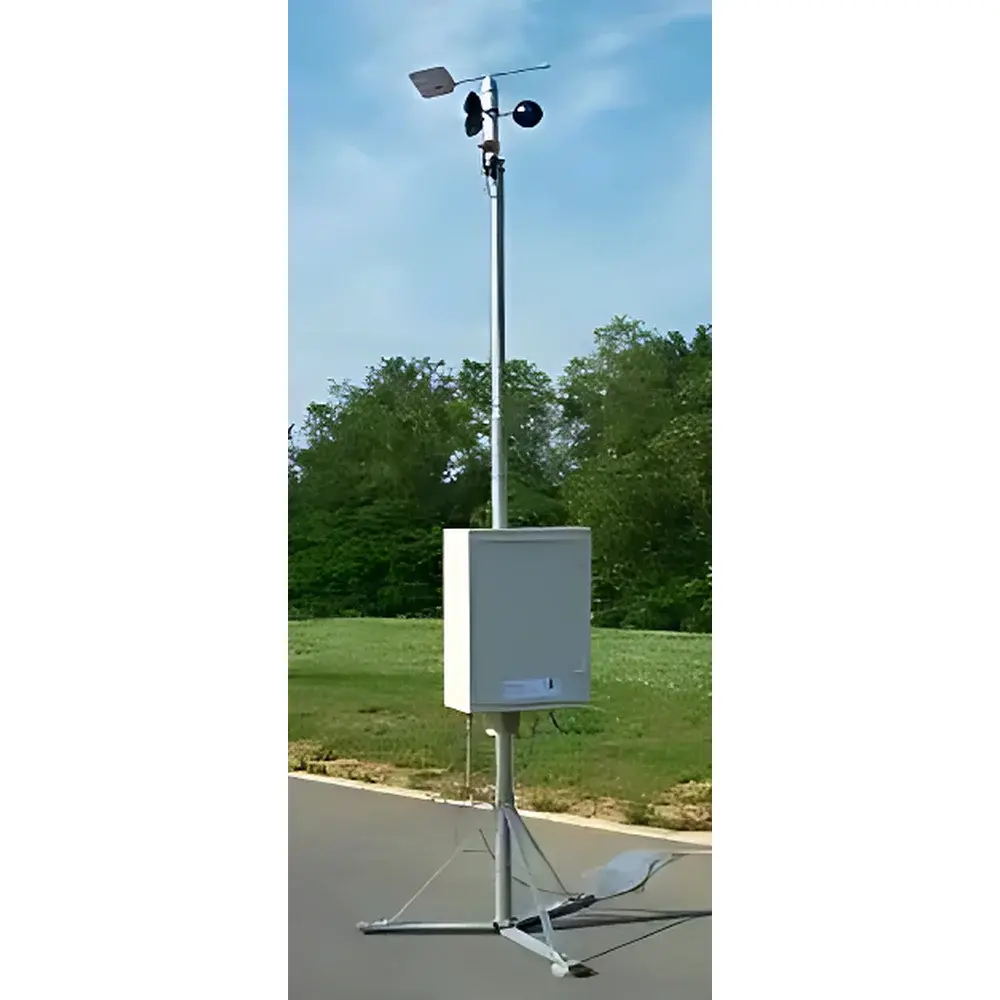
AIRSENSE PEN3-meteo Automated Odor Monitoring Station
| Brand | AIRSENSE |
|---|---|
| Origin | Germany |
| Model | PEN3-meteo |
| Sensor Array | 10 MOS metal oxide sensors |
| Odor Unit Quantification | OU/m³ per EN 13725 |
| Data Logging | Integrated DCR computer (Mini-ITX, 40 GB HDD, 512 MB RAM, Windows XP) |
| Connectivity | Wi-Fi + optional GSM/GPRS module for SMS alerts |
| Meteorological Integration | Co-located anemometer and wind vane with real-time digital output |
| Compliance | EN 13725:2003 certified odor quantification methodology |
Overview
The AIRSENSE PEN3-meteo Automated Odor Monitoring Station is a fully integrated, field-deployable environmental monitoring system engineered for continuous, unattended quantification of ambient odor intensity in compliance with the European standard EN 13725:2003. Unlike conventional gas analyzers targeting individual compounds, the PEN3-meteo operates on the principle of biomimetic pattern recognition—leveraging an array of 10 calibrated metal oxide semiconductor (MOS) sensors to capture multidimensional “odor fingerprints” from complex volatile organic mixtures. These sensor response patterns are processed in real time using multivariate statistical algorithms—including Principal Component Analysis (PCA), Partial Least Squares (PLS) regression, Mahalanobis distance, and Euclidean distance metrics—to derive odor concentration expressed in European Odour Units per cubic meter (OU/m³). The system’s architecture integrates three functional subsystems: the PEN3 electronic nose, a dedicated meteorological station (wind speed and wind direction), and a ruggedized DCR data acquisition computer—enabling spatial-temporal correlation between odor events and atmospheric dispersion conditions.
Key Features
- Real-time, continuous odor monitoring at 1–60 minute configurable intervals, with automatic baseline correction and drift compensation
- EN 13725-compliant odor quantification validated against dynamic olfactometry reference methods
- Integrated meteorological sensors providing synchronized wind vector data (0–60 m/s range, ±2° directional accuracy) directly linked to odor plume trajectory modeling
- Onboard DCR computer with embedded Windows XP OS, 40 GB solid-state storage, and 512 MB RAM for local data buffering, algorithm execution, and event-triggered logging
- Wireless communication stack supporting IEEE 802.11b/g Wi-Fi for LAN/WAN telemetry and optional GSM/GPRS module for SMS-based alarm notifications upon threshold exceedance
- Modular hardware design allowing field recalibration, sensor replacement, and firmware updates without system downtime
Sample Compatibility & Compliance
The PEN3-meteo is designed for ambient air sampling in outdoor environments including wastewater treatment plants, composting facilities, livestock operations, landfill perimeters, and industrial buffer zones. It does not require pre-concentration or chemical derivatization and responds to broad-spectrum odorants—including sulfur compounds (e.g., H₂S, mercaptans), nitrogenous volatiles (e.g., ammonia, amines), short-chain fatty acids (e.g., butyric acid), and aromatic hydrocarbons. All odor concentration calculations adhere strictly to EN 13725:2003 procedures for dynamic dilution olfactometry equivalence. System validation documentation supports audit readiness under EU Industrial Emissions Directive (IED) reporting requirements and aligns with ISO/IEC 17025 principles for measurement traceability. While not FDA- or GLP-certified (as it is not used in pharmaceutical manufacturing), its data structure and metadata tagging comply with basic ALCOA+ principles for environmental data integrity.
Software & Data Management
The PEN3-meteo runs proprietary AIRSENSE Analyzer software, which provides real-time visualization of sensor response heatmaps, PCA score plots, and temporal OU/m³ trend charts. Raw sensor voltage traces, meteorological timestamps, and calculated odor units are stored in ASCII-delimited text files with ISO 8601-compliant timestamps. Data export supports CSV, XML, and OPC UA protocols for integration into SCADA or LIMS platforms. The software includes configurable alarm logic (e.g., 30-min moving average > 50 OU/m³ triggers SMS), user-access control levels (operator, technician, administrator), and built-in audit trail logging for all parameter changes and calibration events. Remote access is enabled via secure VNC over encrypted Wi-Fi; no cloud dependency is required for core functionality.
Applications
- Regulatory compliance monitoring for odor emissions near sensitive receptors (residential zones, schools, hospitals)
- Source attribution studies combining wind rose analysis with odor event clustering to identify dominant emission points
- Performance evaluation of odor abatement technologies (e.g., biofilters, activated carbon units, chemical scrubbers)
- Long-term trend analysis of seasonal odor variability correlated with temperature, humidity, and operational load
- Pre-emptive incident response—SMS alerts enable rapid on-site verification and mitigation before community complaints escalate
- Supporting environmental impact assessments (EIAs) and permitting applications under national odor management frameworks
FAQ
Does the PEN3-meteo require periodic calibration with certified odor standards?
Yes—biannual calibration using certified n-butanol standard gas (per EN 13725 Annex B) is recommended to maintain sensor response linearity and inter-unit comparability.
Can the system distinguish between different odor sources (e.g., sewage vs. animal waste)?
It does not perform compound-specific identification, but trained pattern recognition models can classify odor types with >85% cross-validated accuracy when built from representative field-collected reference signatures.
Is the DCR computer compatible with modern operating systems?
The unit ships with Windows XP Embedded for deterministic real-time performance; however, AIRSENSE provides migration support packages for Windows 10 IoT Enterprise deployments upon request.
What is the typical detection limit for odor concentration?
The practical lower limit of quantification is approximately 10 OU/m³ under stable ambient conditions, subject to airflow uniformity and background VOC interference.
How is data security managed during wireless transmission?
Wi-Fi communications use WPA2-PSK encryption; SMS alerts transmit only threshold-exceedance flags—not raw sensor data—to minimize exposure surface.
Related Products







