
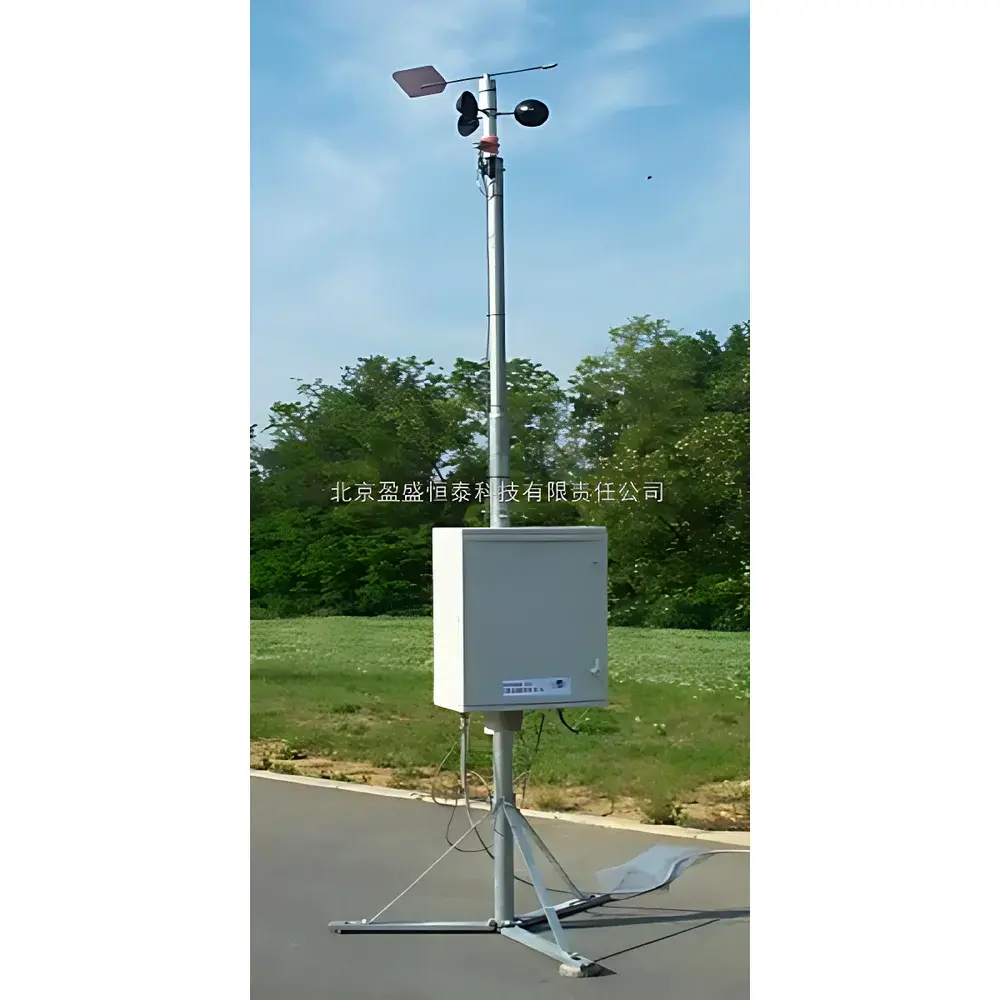
AIRSENSE PEN3-meteo Automated Olfactometry Monitoring System
| Brand | AIRSENSE |
|---|---|
| Origin | Germany |
| Model | meteo |
| Compliance | EN 13725 |
| Output Unit | Odor Units per cubic meter (OU/m³) |
| Sensor Array | 10 MOS (Metal Oxide Semiconductor) sensors |
| Data Acquisition | Continuous, 24/7 |
| Communication | Wi-Fi + optional GSM/GPRS |
| Meteorological Integration | Integrated anemometer & wind vane |
| Software Algorithms | PCA, PLS regression, Mahalanobis & Euclidean distance analysis |
| Calibration Reference | EN 13725-compliant dynamic olfactometry |
Overview
The AIRSENSE PEN3-meteo Automated Olfactometry Monitoring System is a field-deployable, regulatory-grade instrument engineered for continuous, real-time quantification of odor intensity in ambient air—expressed as Odor Units per cubic meter (OU/m³). Unlike conventional gas-specific analyzers, the PEN3-meteo operates on the principle of biomimetic pattern recognition: its 10-channel metal oxide semiconductor (MOS) sensor array captures multidimensional volatile organic compound (VOC) response profiles—referred to as “odor fingerprints”—which are then statistically mapped against reference olfactometric data. This approach bridges the gap between human-perceived odor annoyance and instrumental measurement, enabling objective, traceable, and legally defensible odor assessment in compliance with EN 13725:2022 (“Air Quality — Determination of Odour Concentration by Dynamic Olfactometry”). The system is not a single-point gas detector but a holistic environmental monitoring platform integrating chemical sensing, meteorological profiling, automated data processing, and remote telemetry—designed specifically for long-term deployment at wastewater treatment plants, landfill sites, composting facilities, and industrial perimeters where nuisance odor emissions pose regulatory or community relations challenges.
Key Features
- Regulatory-aligned odor quantification: Delivers OU/m³ output traceable to EN 13725-compliant dynamic olfactometry via PLS (Partial Least Squares) regression modeling.
- Integrated meteorological module: Co-located ultrasonic anemometer and wind vane provide real-time wind speed (0–60 m/s, ±0.1 m/s resolution) and wind direction (0–360°, ±2° resolution), enabling plume trajectory modeling and source attribution.
- Autonomous operation: Fully automated sampling, signal acquisition, baseline correction, and data logging—configured via pre-defined schedules without manual intervention.
- Wireless telemetry architecture: Dual-mode communication—Wi-Fi for local LAN integration and optional GSM/GPRS for cellular-based alarm notifications and remote firmware updates.
- Onboard data handling: Embedded Mini-ITX controller (Intel Celeron, 512 MB RAM, 40 GB HDD, Windows XP Embedded) runs proprietary acquisition software with audit-trail logging compliant with GLP principles.
- Alarm-driven incident response: Threshold-triggered SMS alerts (configurable OU/m³ setpoints) and timestamped event logs support rapid operational response and regulatory reporting.
Sample Compatibility & Compliance
The PEN3-meteo is designed for unattended, long-term monitoring of complex odorant mixtures in outdoor and semi-enclosed environments—including hydrogen sulfide, mercaptans, volatile fatty acids, indoles, skatoles, ammonia, and low-molecular-weight aldehydes and ketones. It does not identify individual compounds but resolves overall odor character and intensity based on multivariate sensor response patterns. All calibration, validation, and performance verification procedures adhere to EN 13725:2022 Annex B (Instrumental Odour Monitoring Systems) and ISO/IEC 17025 requirements for competence of testing and calibration laboratories. The system supports user-defined correlation curve development using locally collected dynamic olfactometry reference data—ensuring methodological alignment with site-specific emission profiles and regional regulatory expectations. No consumables or carrier gases are required; sensor arrays are field-replaceable with factory calibration certificates.
Software & Data Management
The PEN3-meteo’s embedded software suite provides full lifecycle data management: raw sensor voltage traces, PCA score plots, PLS-predicted OU/m³ time series, wind-rose overlays, and event-based export (CSV, XML). All data entries include immutable timestamps, operator ID (if logged in), and instrument status flags (e.g., flow fault, sensor saturation, temperature drift). Audit trails meet FDA 21 CFR Part 11 criteria for electronic records and signatures when deployed under GxP-regulated environmental monitoring programs. Remote access enables configuration changes, firmware upgrades, and historical data retrieval via secure HTTPS interface. Data integrity is preserved through cyclic redundancy checks (CRC-32) on all transmitted packets and local write-caching during network outages.
Applications
- Continuous compliance monitoring at wastewater treatment plants and anaerobic digesters—correlating odor intensity with process parameters (e.g., pH, ORP, sludge retention time).
- Landfill perimeter monitoring to detect early-stage leachate gas migration and verify cover integrity.
- Rapid-response odor incident assessment: On-site deployment within 15 minutes to map spatial odor gradients and estimate source strength using inverse dispersion modeling.
- Performance evaluation of biofiltration and activated carbon abatement systems—tracking removal efficiency across varying load conditions.
- Baseline characterization and trend analysis for environmental impact assessments (EIAs) and permitting applications under EU Industrial Emissions Directive (IED) and U.S. EPA NSPS Subpart JJJJ.
- Research-grade odor correlation studies supporting development of next-generation instrumental olfactometry standards.
FAQ
How does the PEN3-meteo ensure traceability to human olfaction?
It employs EN 13725-compliant dynamic olfactometry reference data to build PLS regression models—mapping sensor response vectors directly to panel-determined odor concentrations.
Can the system operate unattended for extended periods?
Yes—designed for continuous 24/7 operation with internal temperature/humidity compensation, automatic zero-gas purging cycles, and watchdog-controlled power management.
Is third-party validation data available?
Independent verification reports from TÜV Rheinland and VITO (Belgium) confirm repeatability ≤±12% RSD and linearity (R² ≥0.98) across 10–100,000 OU/m³ range under field conditions.
What meteorological parameters does the integrated station measure?
Wind speed, wind direction, ambient temperature, relative humidity, and atmospheric pressure—all sampled synchronously with odor measurements at 1 Hz.
Does the system require routine recalibration with certified odor standards?
No—sensor drift is compensated algorithmically using adaptive baseline correction; however, annual performance verification against EN 13725 reference samples is recommended for regulatory continuity.
Related Products







