
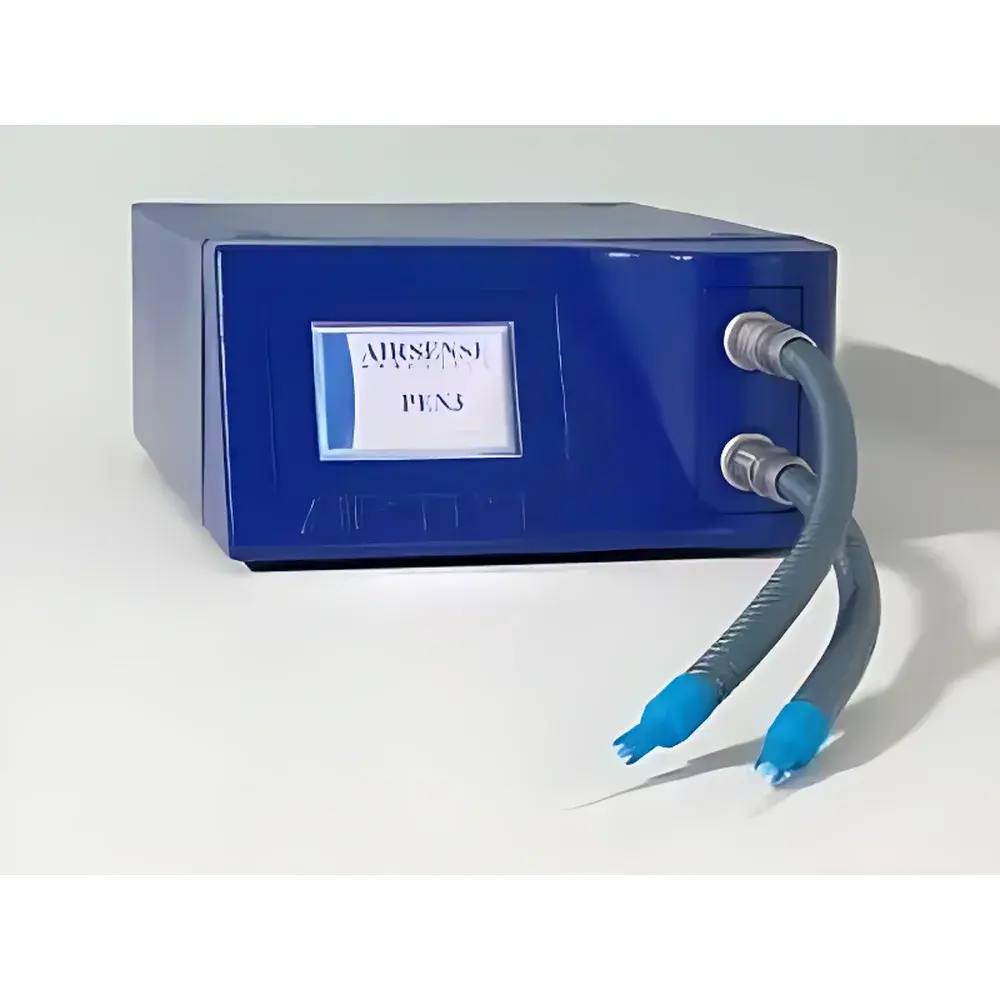
AIRSENSE PEN3 Portable Electronic Nose (Gas Fingerprint Analyzer)
| Brand | AIRSENSE |
|---|---|
| Origin | Germany |
| Model | PEN3 |
| Sensor Array | 10 metal oxide semiconductor (MOS) sensors |
| Sensor Volume | 1.8 mL |
| Operating Temperature | 110 °C (sensor tube) |
| Response Time | <1 s |
| Measurement Cycle | ~60 s (20 s exposure + 40 s recovery) |
| Sampling Flow Rate | 10–400 mL/min (internally regulated) |
| Sampling System | Dual built-in pumps (sample + zero air) |
| Zero Air Source | Activated charcoal-filtered ambient air or zero-air generator |
| Display | Integrated LCD screen |
| Interface | USB and/or RS232 |
| Digital I/O | TTL & digital signal ports |
| Operating Ambient | 0–40 °C, 5–95% RH (non-condensing) |
| Power | 30 W, 110–230 V AC or optional 12 V DC |
| Weight | 2.3 kg |
| Dimensions | 255 × 190 × 92 mm |
| Safety Compliance | IEC 61010-1 |
| Detection Limit | 0.1–5 ppm (general VOCs), 0.1 ppm (H₂S), 1 ppm (benzene) |
| Software | WinMuster v5.x (PCA, LDA, DFA, K-NN, PLS, BP-ANN) |
| OS Compatibility | Windows XP and later |
| Calibration Stability | Automated drift compensation over 12 months |
| Warranty | 1 year |
Overview
The AIRSENSE PEN3 Portable Electronic Nose is an engineered gas fingerprint analyzer designed for real-time, non-destructive odor and volatile organic compound (VOC) profiling under ambient conditions. Unlike conventional single-analyte gas detectors, the PEN3 operates on bio-inspired pattern recognition principles—mimicking human olfaction through a cross-reactive sensor array and multivariate statistical analysis. Its core measurement principle relies on transient resistance changes in ten distinct metal oxide semiconductor (MOS) sensors upon exposure to complex gaseous mixtures. Each sensor exhibits unique, partially overlapping sensitivity profiles across chemical classes (e.g., aldehydes, sulfur compounds, aromatics, alcohols), generating a multidimensional response vector—the “gas fingerprint.” This vector is then processed using chemometric algorithms to classify, quantify, or discriminate odor samples with high reproducibility. The system is explicitly optimized for field-deployable environmental monitoring, where background air serves as the reference matrix—ensuring direct physiological relevance to human olfactory perception and regulatory odor assessment frameworks such as EN 13725 and ASTM E544.
Key Features
- Field-Ready Portability: Compact housing (255 × 190 × 92 mm), 2.3 kg mass, and dual power options (AC 110–230 V or DC 12 V) enable seamless deployment in mobile labs, wastewater treatment plants, landfill perimeters, and emergency response vehicles.
- Robust Gas Handling Architecture: Patented flow control system with dual internal pumps (sampling + zero air) maintains precise, pulse-free airflow (10–400 mL/min) across variable ambient pressure and humidity—critical for stable baseline establishment and quantitative repeatability in open environments.
- High-Fidelity Sensor Array: Ten individually calibrated MOS sensors housed in stainless-steel tubes (1.8 mL volume, heated to 110 °C) deliver sub-second response kinetics and rapid thermal desorption—minimizing carryover and extending operational lifetime beyond 12 months without recalibration.
- Adaptive Signal Conditioning: Onboard temperature/humidity compensation, automatic range adjustment (including programmable sample dilution), and real-time zero-air referencing ensure measurement integrity across diverse matrices—from humid biogas streams to dry industrial stack emissions.
- Modular Integration Capability: TTL/digital I/O ports and standardized USB/RS232 interfaces support synchronized operation with external enrichment devices (e.g., EDU thermal desorption units), GC-MS systems, or SCADA platforms for hybrid analytical workflows.
Sample Compatibility & Compliance
The PEN3 is validated for direct analysis of undiluted ambient air, headspace vapors, and process gas streams containing low-molecular-weight VOCs, reduced sulfur compounds (e.g., H₂S, mercaptans), nitrogenous bases, and oxygenated organics. It complies with IEC 61010-1 for electrical safety in laboratory and industrial settings. While not a certified reference method per se, its output correlates robustly with human sensory panel data under EN 13725 protocols—enabling development of instrument-based odor quantification models acceptable for regulatory reporting in EU member states. Data acquisition and processing meet GLP-aligned traceability requirements: WinMuster software logs operator ID, timestamp, calibration history, and raw sensor voltage traces with audit-trail functionality compatible with FDA 21 CFR Part 11 when deployed on validated Windows environments.
Software & Data Management
WinMuster v5.x provides a complete chemometrics environment for both acquisition and interpretation. Raw sensor resistance curves are normalized and aligned prior to multivariate analysis. Built-in algorithms include Principal Component Analysis (PCA) for exploratory visualization, Linear Discriminant Analysis (LDA) and Discriminant Function Analysis (DFA) for supervised classification, k-Nearest Neighbors (K-NN) with Euclidean or Mahalanobis distance metrics for pattern matching, Partial Least Squares (PLS) regression for semi-quantitative estimation, and Backpropagation Artificial Neural Networks (BP-ANN) for nonlinear modeling of complex odor mixtures. All models are exportable as standalone prediction engines. Data files (.wmd format) retain full metadata—including hardware configuration, environmental logs, and user annotations—ensuring FAIR (Findable, Accessible, Interoperable, Reusable) data stewardship.
Applications
- Real-time odor emission monitoring at wastewater treatment facilities and municipal solid waste landfills, aligned with continuous compliance reporting obligations.
- Rapid source identification and boundary delineation during odor nuisance complaints or accidental release events (e.g., biogas leaks, chemical spills).
- Performance evaluation of odor abatement technologies—such as biofilters, activated carbon beds, and plasma reactors—via longitudinal fingerprint tracking of influent/effluent streams.
- Correlation modeling between instrumental responses and human olfactometry scores to support replacement of labor-intensive sensory panels in routine QA/QC.
- VOC screening in ambient urban air, agricultural emissions (e.g., ammonia, dimethyl sulfide), and industrial fugitive sources (e.g., fertilizer production, petrochemical storage).
- Method development for coupling with GC-MS: PEN3 pre-screens complex mixtures to prioritize target analytes and optimize chromatographic methods.
FAQ
How does the PEN3 differ from traditional gas chromatographs or PID detectors?
The PEN3 does not separate or identify individual compounds. Instead, it characterizes holistic odor quality and intensity via pattern recognition—making it ideal for applications where mixture complexity exceeds resolution limits of targeted instruments.
Can the PEN3 quantify specific compounds like hydrogen sulfide or benzene?
It provides semi-quantitative estimates within defined calibration ranges (e.g., 0.1 ppm LOD for H₂S) but requires compound-specific calibration standards and validation against reference methods for regulatory-grade quantification.
Is the system suitable for unattended long-term monitoring?
Yes—when integrated with external power management, weatherproof enclosures, and remote data logging via USB or RS232, the PEN3 supports autonomous operation for weeks with periodic zero-air purging.
What maintenance is required for sustained accuracy?
Annual verification of sensor response profiles and flow calibration is recommended; the automated drift compensation algorithm maintains baseline stability between services.
Does WinMuster support automated report generation for regulatory submissions?
Yes—customizable templates generate PDF reports containing sensor response heatmaps, PCA score plots, classification confidence metrics, and raw data exports compliant with ISO/IEC 17025 documentation requirements.
Related Products







