
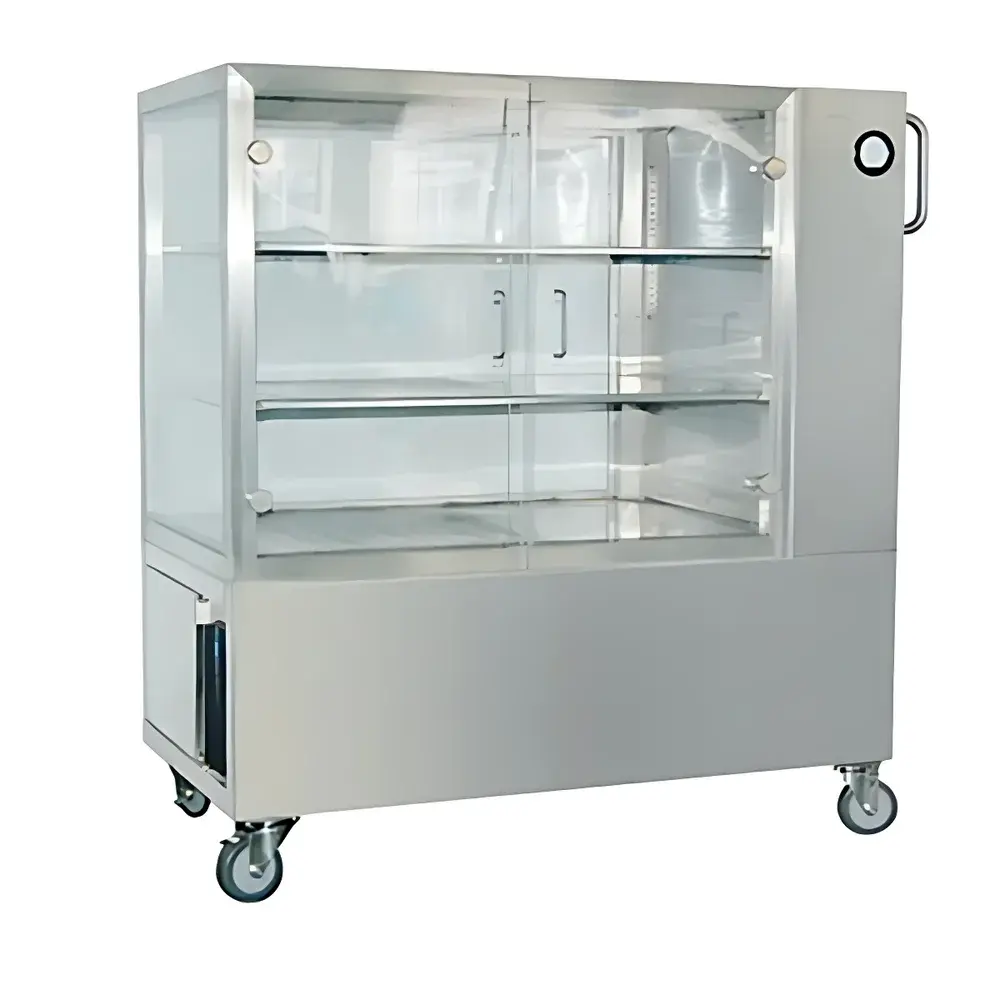
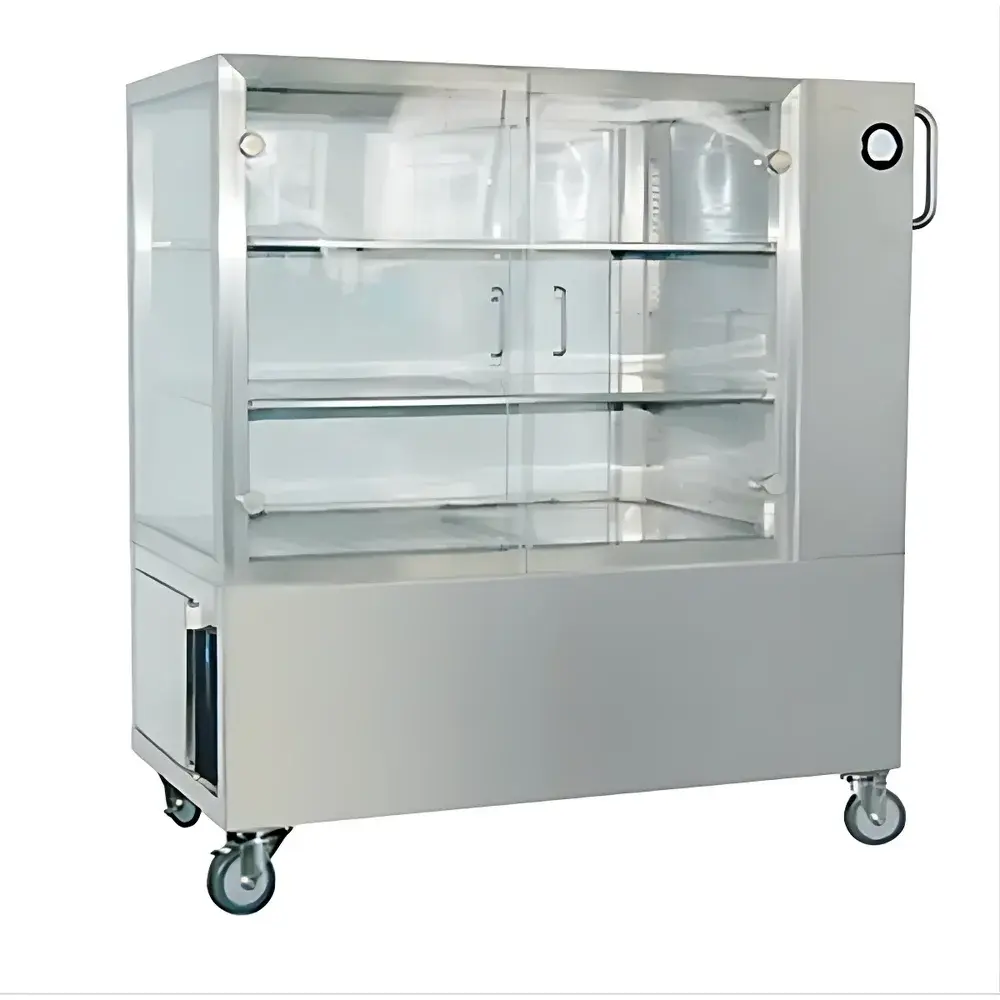
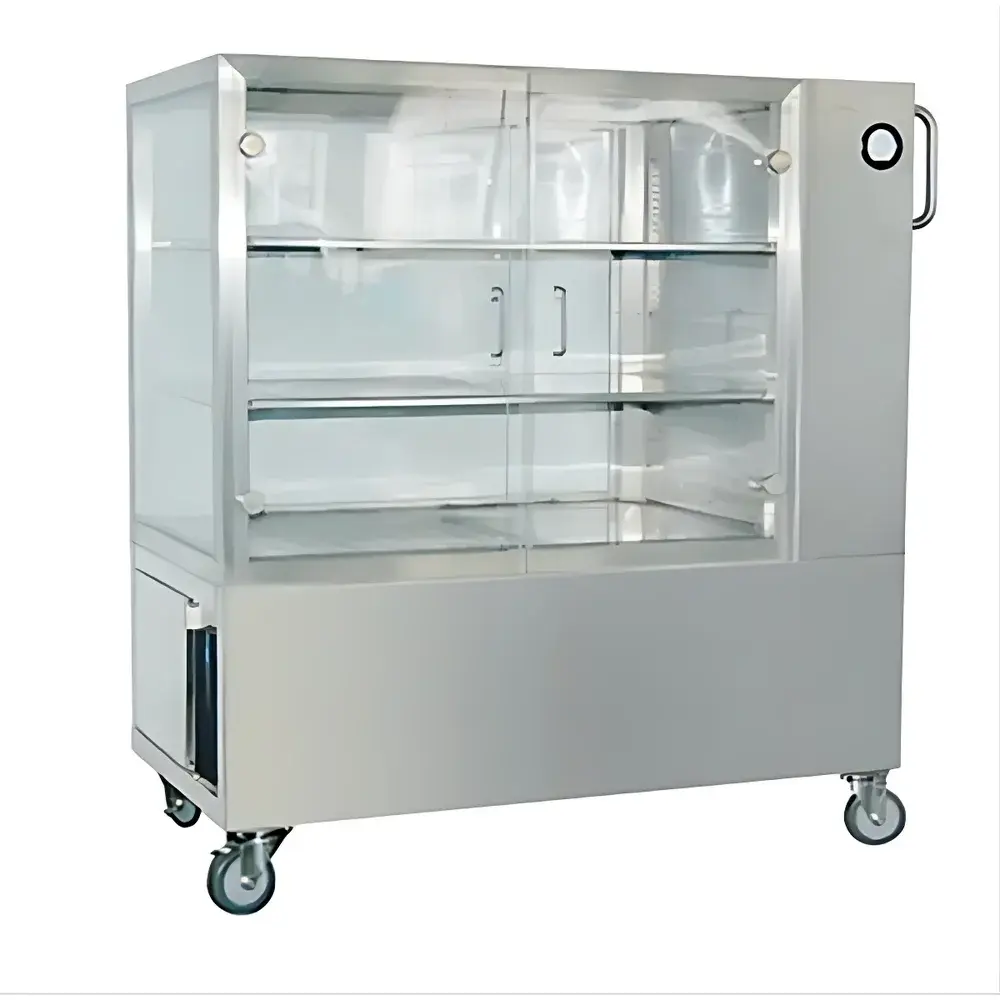
AIRTECH ACDW-1000 Mobile Clean Bench
| Brand | AIRTECH |
|---|---|
| Origin | Jiangsu, China |
| Manufacturer Type | Authorized Distributor |
| Product Origin | Domestic (China) |
| Model | ACDW-1000 |
| Quotation | Available Upon Request |
| Cleanliness Class | ISO 5 (Class 100) |
| Filter Efficiency | ≥99.99% @ 0.3 µm |
| Average Air Velocity | ≥0.3 m/s |
| Noise Level | ≤60 dB(A) |
| Power Supply | AC 220 V, 1φ, 50 Hz |
| Rated Power | 300 W |
| Battery Configuration | 38 Ah × 2 (rechargeable DC system) |
| Working Area Dimensions (W×D×H) | 840 × 600 × 670 mm |
| Overall Dimensions (W×D×H) | 1175 × 633 × 1230 mm |
Overview
The AIRTECH ACDW-1000 Mobile Clean Bench is an ISO 5 (Class 100) certified portable laminar flow workstation engineered for localized particle control in non-fixed laboratory, pharmaceutical, and quality control environments. It operates on the principle of horizontal unidirectional airflow—generated by a low-turbulence, high-efficiency fan system—passing through a HEPA filter (≥99.99% efficiency at 0.3 µm) to deliver continuous, uniform laminar flow across the work surface. This airflow architecture minimizes turbulence-induced cross-contamination and ensures consistent protection of sensitive samples, sterile preparations, or critical components during handling. Unlike fixed clean benches, the ACDW-1000 integrates mobility with self-contained power management, enabling deployment in dynamic settings such as GMP-compliant manufacturing support zones, QC sampling stations, or temporary cleanroom extensions where permanent infrastructure is unavailable or impractical.
Key Features
- Stainless steel structural frame with seamless integration of optically clear tempered glass panels—providing full visual access while maintaining mechanical integrity and chemical resistance.
- Integrated dual 38 Ah rechargeable DC battery system supporting 2–3 hours of uninterrupted operation after 8–12 hours of charging; eliminates dependency on proximity to AC outlets during short-duration interventions.
- Two-speed adjustable centrifugal blower with variable air volume control—enabling optimization of face velocity (≥0.3 m/s) for varying procedural requirements while maintaining energy efficiency and acoustic performance (≤60 dB(A)).
- Dual-power architecture: automatic switchover between mains supply (AC 220 V, 50 Hz) and inverter-driven battery mode ensures operational continuity during transient power disruptions.
- Optional differential pressure gauge for real-time monitoring of HEPA filter loading status—critical for preventive maintenance scheduling and compliance documentation.
- Standard PAO (Polyalphaolefin) test port integrated into the filter housing—facilitating quantitative leak testing per ISO 14644-3 and EU GMP Annex 1 protocols.
Sample Compatibility & Compliance
The ACDW-1000 is designed for use with non-hazardous, non-volatile materials requiring particulate-free handling—including but not limited to pharmaceutical intermediates, cell culture reagents, precision optics, microelectronics assemblies, and analytical reference standards. Its ISO 5 classification conforms to ISO 14644-1:2015 and aligns with USP , EU GMP Annex 1 (2022), and FDA guidance on aseptic processing. The unit’s construction materials meet ISO 14644-2 requirements for non-shedding surfaces, and its airflow validation methodology supports qualification under IQ/OQ protocols. While not intended for containment of biohazards or volatile solvents, it serves as a compliant auxiliary workstation within broader cleanroom ecosystems subject to periodic environmental monitoring per ISO 14644-2.
Software & Data Management
The ACDW-1000 is a hardware-centric, analog-controlled system with no embedded firmware or digital interface. All operational parameters—including fan speed selection, battery status indication, and optional pressure differential readout—are managed via physical controls and analog instrumentation. This design prioritizes reliability, electromagnetic compatibility (EMC), and auditability in regulated environments where software validation complexity must be minimized. For facilities operating under 21 CFR Part 11 or Annex 11 requirements, manual log entries—supported by timestamped calibration records for optional sensors and scheduled filter integrity tests—constitute the primary data trail. Integration with facility-wide environmental monitoring systems (EMS) is achievable via external analog signal outputs (e.g., 4–20 mA pressure transducer interface) when specified at order.
Applications
- On-demand sterile compounding support in hospital pharmacies and central fill units.
- Portable aseptic transfer of microbial cultures or biologics in R&D laboratories lacking dedicated cleanrooms.
- Field-based calibration and handling of high-precision metrology tools requiring particulate isolation.
- GMP-aligned raw material sampling and release testing in warehouse staging areas.
- Temporary ISO 5 workstations during cleanroom renovation, validation shutdowns, or pandemic-response surge capacity expansion.
- Education and training environments where visual transparency and operational simplicity are pedagogically advantageous.
FAQ
Is the ACDW-1000 suitable for handling cytotoxic or hazardous compounds?
No. It provides personnel and product protection only—not operator protection. It lacks negative pressure containment, ducted exhaust, or vapor-phase filtration; therefore, it must not be used for toxic, volatile, or pathogenic agents.
Can the unit be validated per ISO 14644-3?
Yes. Its laminar flow profile, particle count performance (ISO 5), and filter integrity test port support full certification per ISO 14644-3, including airflow visualization, uniformity mapping, and scan testing.
What maintenance intervals are recommended for the HEPA filter?
Filter replacement frequency depends on ambient particulate load and usage duration. Under typical GMP conditions, annual replacement is advised—with differential pressure trending used to determine early intervention thresholds.
Does the battery system support hot-swapping?
No. Batteries are internally mounted and require tool-assisted access; replacement must occur during scheduled downtime.
Is third-party calibration of the optional differential pressure gauge traceable to NIST?
Yes—when ordered with certified calibration documentation, the gauge is supplied with a certificate traceable to national standards, fulfilling ISO/IEC 17025 requirements for measurement uncertainty reporting.



