
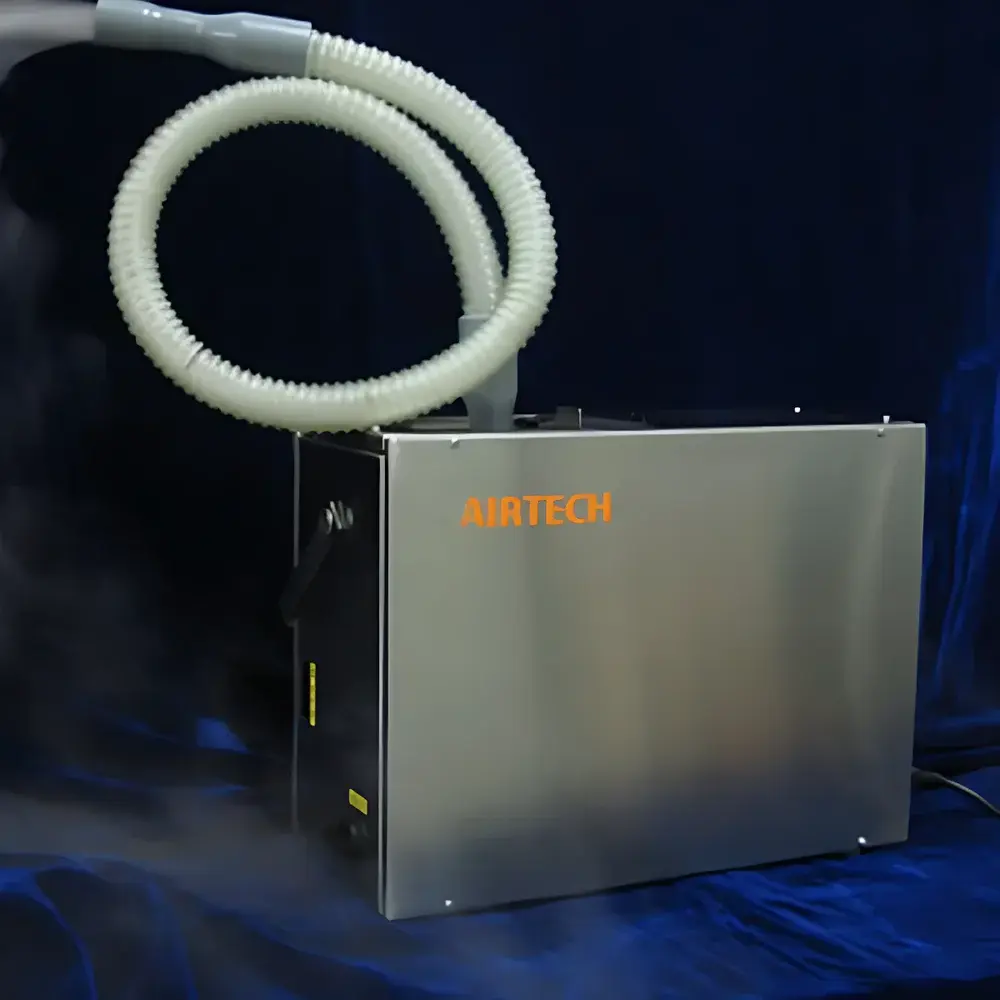
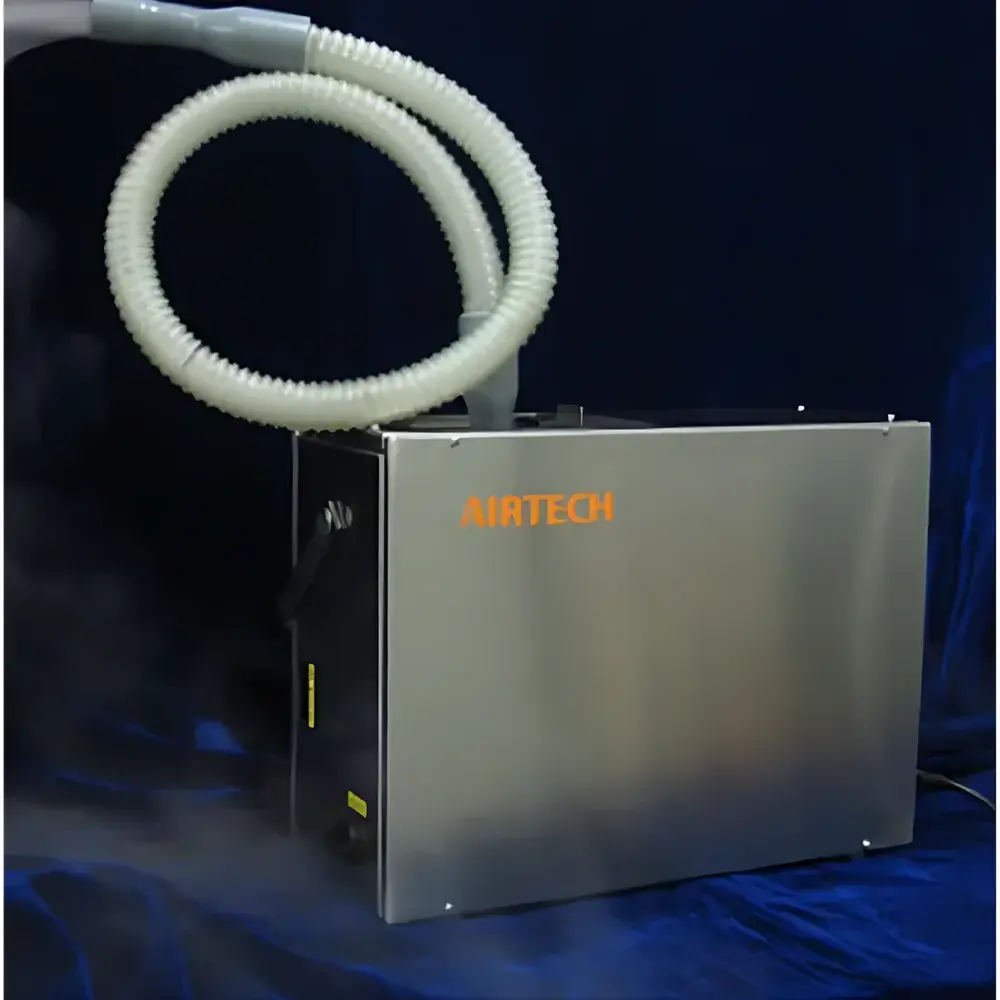
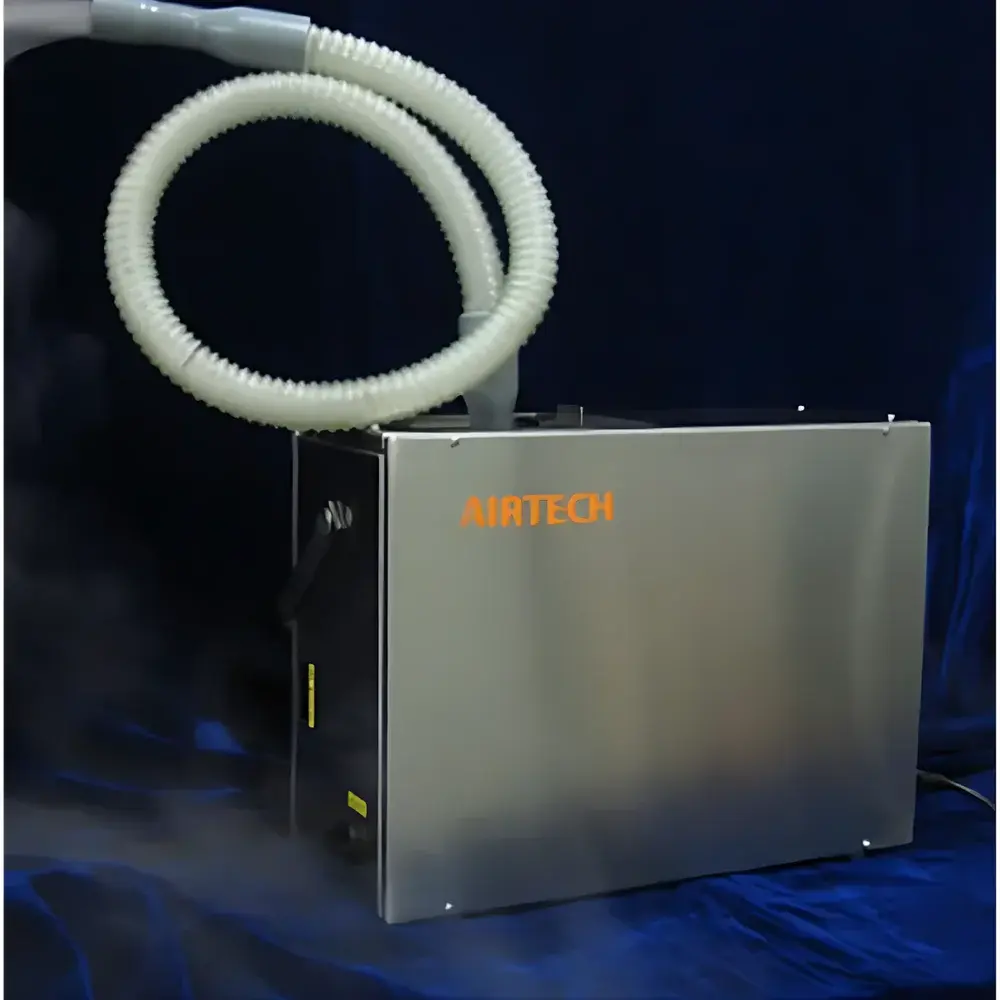
AIRTECH ACV-03 Cleanroom Airflow Visualization Generator
| Brand | AIRTECH |
|---|---|
| Origin | Jiangsu, China |
| Manufacturer Type | Authorized Distributor |
| Country of Origin | China |
| Model | ACV-03 |
| Price | Upon Request |
| Power Supply | AC 220 V, 1φ, 50 Hz |
| Rated Power | 200 W |
| Dimensions (L×W×H) | 410 × 210 × 290 mm |
| Max. Water Capacity | 1.2 L |
| Airflow Rate | 0–10 L/min |
| Smoke Output | up to 1.8 L/h |
| Filtration Efficiency | ≥99.97% @ ≥0.3 µm |
| Continuous Operation Time | 40 min |
| Weight | ~13 kg |
Overview
The AIRTECH ACV-03 Cleanroom Airflow Visualization Generator is an engineered tool designed for qualitative assessment of unidirectional and laminar airflow patterns in controlled environments—including ISO Class 5–8 cleanrooms, biosafety cabinets (BSCs), laminar flow hoods, pass-through chambers, and pharmaceutical isolators. It operates on the principle of controlled glycol-based aerosol generation, producing a non-toxic, low-concentration, optically visible smoke stream that traces air movement without perturbing local velocity profiles or introducing microbial or particulate contamination. Unlike thermal or dry-ice-based methods, the ACV-03 employs a precisely regulated ultrasonic nebulization system coupled with integrated HEPA filtration (≥99.97% @ 0.3 µm) to ensure that the generated aerosol remains sterile and particle-free—critical for applications under ISO 14644-3, EU GMP Annex 1, and FDA guidance for aseptic process validation.
Key Features
- Integrated dual-stage filtration: Pre-filter + certified H14 HEPA filter (EN 1822-compliant) ensures delivered airflow is free of ambient contaminants ≥0.3 µm, eliminating cross-contamination risk during visualization.
- Adjustable aerosol output: Two operational modes—Standard Fog (optimized for localized cabinet testing) and High-Volume Fog (for spatial mapping of room-scale airflow)—enable method-appropriate traceability per ISO 14644-3 Annex B.
- Robust safety architecture: Complies with IEC 61010-1 for laboratory equipment; includes automatic dry-run shutdown, anti-tip mechanical lock, IPX4-rated enclosure, and real-time water-level monitoring.
- Portable ergonomic design: Compact footprint (410 × 210 × 290 mm), integrated carry handle, and 13 kg mass support field deployment across multiple cleanroom suites without requiring fixed installation.
- Stable aerosol generation: Ultrasonic nebulizer delivers consistent droplet size distribution (mass median aerodynamic diameter ≈ 0.5–1.2 µm), ensuring high optical contrast under standard cleanroom lighting and compatible with digital particle image velocimetry (PIV) documentation workflows.
Sample Compatibility & Compliance
The ACV-03 is validated for use with standard cleanroom-grade glycerin-propylene glycol solutions (e.g., AeroSIL® or equivalent USP-grade formulations). Its filtered output meets the particulate cleanliness requirements for ISO Class 5 environments prior to aerosol generation. Device operation supports compliance with multiple regulatory frameworks: it facilitates execution of airflow pattern qualification per EU GMP Annex 1 (2022), aligns with ISO 14644-3:2019 Section 6.2.2 (Airflow Visualization), and supports data integrity expectations under FDA 21 CFR Part 11 when paired with timestamped video capture systems. No calibration certificate is supplied by default; users are advised to perform periodic verification of fog density and airflow consistency using calibrated photometric sensors or comparative visual grading protocols.
Software & Data Management
The ACV-03 is a standalone hardware instrument with no embedded firmware, touchscreen interface, or network connectivity. All operational parameters—including runtime, fog intensity, and airflow rate—are manually adjusted via front-panel dials. Documentation of airflow studies must be performed externally using high-resolution video recording (minimum 60 fps recommended), synchronized timecode, and annotated frame capture software. For audit readiness, laboratories should retain raw video files, operator logs (including date, location, test objective, and observer initials), and environmental conditions (temperature, RH, pressure differential) per GLP/GMP record retention policies. The device does not generate electronic records; therefore, it falls outside the scope of 21 CFR Part 11 electronic signature requirements—but its outputs feed directly into validated documentation systems used in aseptic process simulations.
Applications
- Qualitative airflow mapping of horizontal/vertical laminar flow workstations and biosafety cabinets (NSF/ANSI 49 compliance verification).
- Smoke tracing for detection of turbulence, eddies, or stagnant zones near critical processing areas (e.g., filling lines, weighing stations, gloveports).
- Validation support for ISO 14644-3 certification—specifically for Annex B “Airflow Visualization” and Clause 6.2.2 “Unidirectional Flow Assessment.”
- Educational demonstration of cleanroom behavior principles in pharmaceutical training programs and university cleanroom engineering labs.
- Troubleshooting HVAC rebalancing events or filter media degradation through comparative pre- and post-maintenance airflow imaging.
FAQ
Is the ACV-03 suitable for use inside ISO Class 5 laminar flow hoods without compromising sterility?
Yes—the integrated H14 HEPA filter ensures that all air drawn into and expelled by the unit is sterilized to ≥99.97% efficiency at 0.3 µm, preventing introduction of viable particles or microorganisms.
What type of fog fluid is recommended for use with the ACV-03?
Only USP-grade glycerin-propylene glycol mixtures (e.g., 50:50 v/v) meeting ISO 8573-1 Class 1 purity standards for compressed air contaminants. Avoid mineral oil–based or dye-containing fluids.
Can the device be operated continuously for longer than 40 minutes?
No—40 minutes is the maximum continuous runtime at full fog output due to thermal management limits and 1.2 L reservoir capacity. Intermittent use (e.g., 5-min bursts with 2-min cooldown) extends total daily usage.
Does the ACV-03 require annual calibration or certification?
It is not a measuring instrument and carries no metrological traceability. Users should verify fog output consistency and filter integrity quarterly using visual comparison charts and differential pressure monitoring across the HEPA stage.
Is the unit compliant with CE or UL safety markings?
The device complies with IEC 61010-1:2010 and GB 4793.1–2007 (Chinese national equivalent); however, it does not bear CE or UL marks as it is distributed in North America and EU markets via authorized partners who manage regional conformity assessments separately.



