
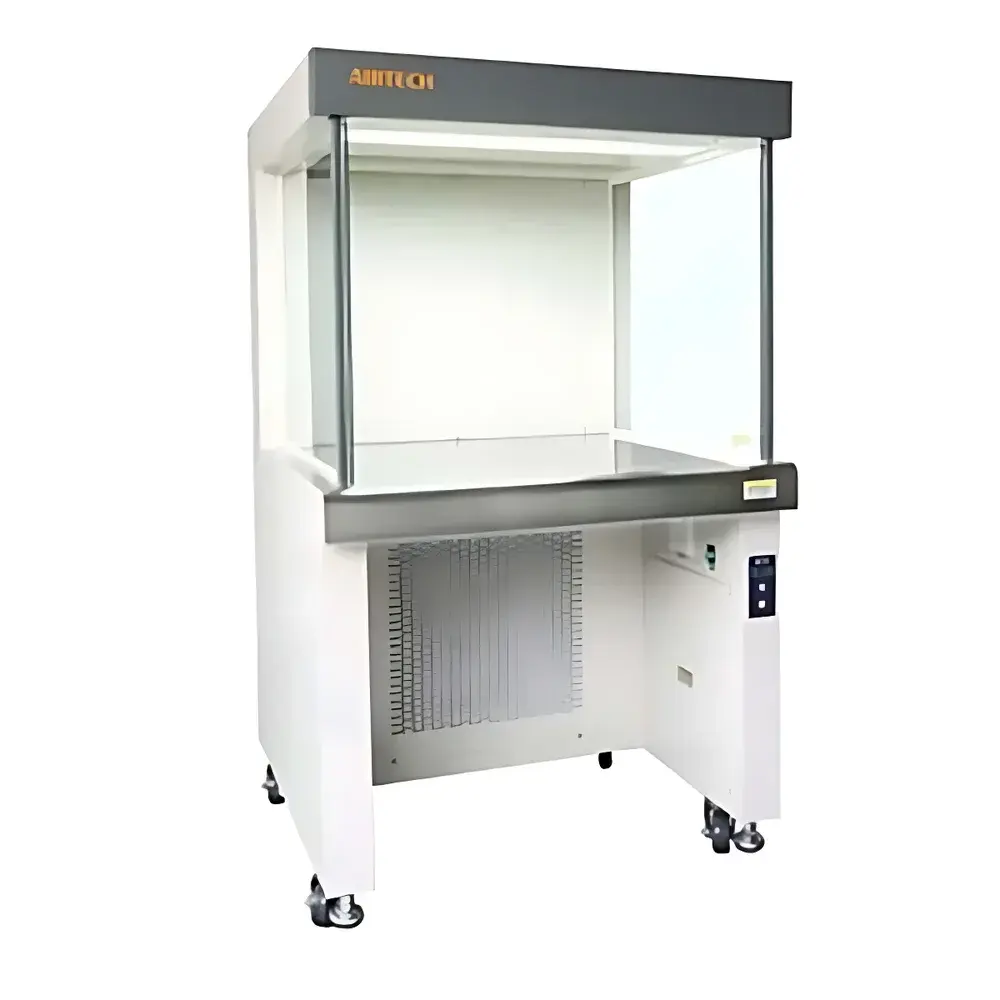
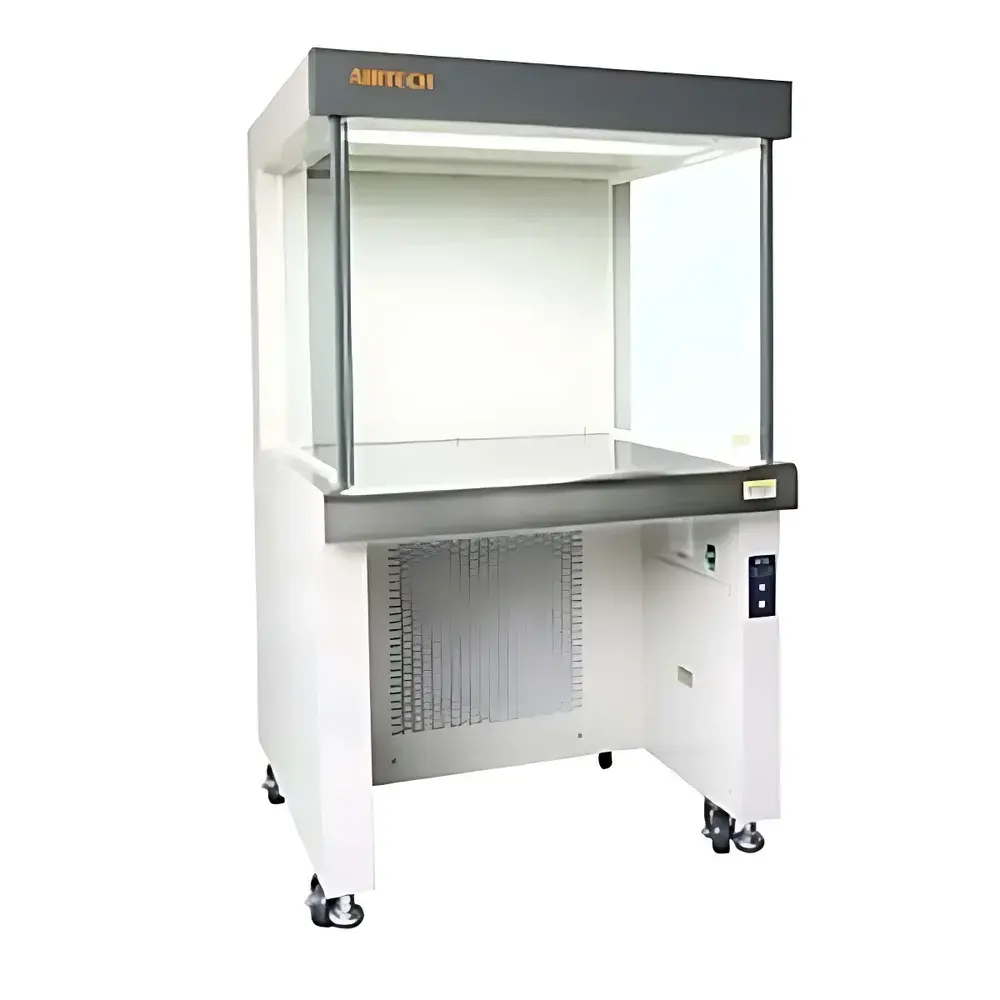
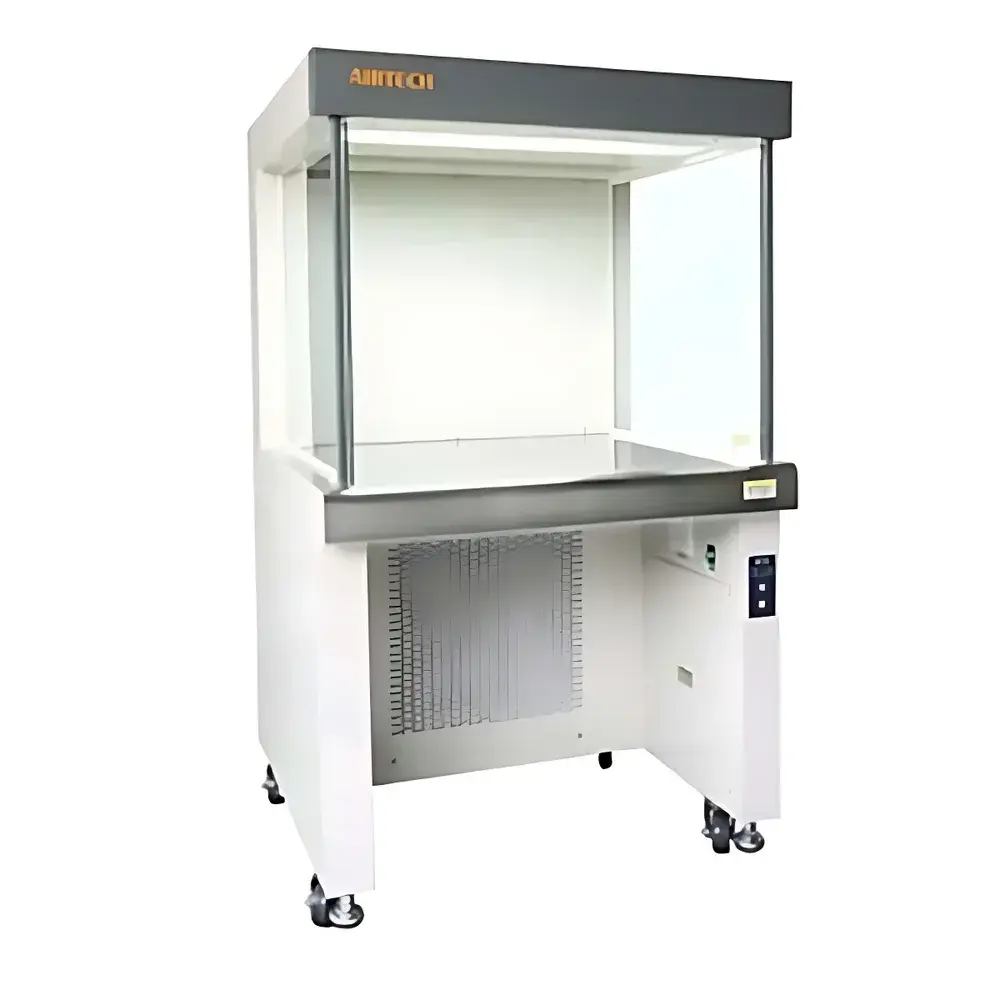
AIRTECH HS-840-II Horizontal Laminar Flow Clean Bench
| Brand | AIRTECH |
|---|---|
| Origin | Jiangsu, China |
| Manufacturer Type | Authorized Distributor |
| Product Category | Domestic |
| Model | HS-840-II |
| Instrument Type | Horizontal Laminar Flow Clean Bench |
| Cleanliness Class | ISO 5 (Class 100 per Fed. Std. 209E) |
| Noise Level | ≤62 dB(A) |
| User Capacity | Single-user, single-front configuration |
| Average Air Velocity | ≥0.3 m/s (adjustable) |
| Illumination | ≥300 lx |
| Power Supply | AC 220 V, 1φ, 50 Hz |
| Rated Power | 250 W |
| Net Weight | 125 kg |
| Work Area Dimensions (W×D×H) | 720 × 650 × 570 mm |
| Overall Dimensions (W×D×H) | 840 × 825 × 1430 mm |
| HEPA Filter Specification | 760 × 610 × 50 mm × 1 unit |
| Settling Microbial Count | ≤0.5 CFU/plate·0.5 h |
| Pre-filter | Quick-release, washable design |
| Safety Compliance | Meets GB/T 25225–2010 (Chinese National Standard for Laminar Flow Clean Benches), IEC 61010-1:2010 (Safety Requirements for Electrical Equipment for Measurement, Control, and Laboratory Use) |
Overview
The AIRTECH HS-840-II Horizontal Laminar Flow Clean Bench is an ISO 5–certified (Class 100 per Federal Standard 209E) containment workstation engineered for unidirectional, particle-free airflow across the work surface. It operates on the principle of horizontal laminar flow: air is drawn through a pre-filter, conditioned by a centrifugal fan, and then passed through a certified HEPA filter (efficiency ≥99.995% at 0.3 µm) before exiting uniformly across the work area at a minimum velocity of 0.3 m/s. This controlled airflow sweeps airborne contaminants—including viable microorganisms, dust, and aerosolized particles—away from the operator and out of the sterile field, making it suitable for non-hazardous applications requiring microbiological purity, such as cell culture preparation, media dispensing, pharmaceutical aseptic assembly, and precision instrumentation handling. Unlike vertical flow cabinets, the HS-840-II directs airflow horizontally toward the user-facing sash opening, eliminating turbulence caused by vertical recirculation or operator shadowing—critical for maintaining consistent sterility in single-operator workflows.
Key Features
- Digital control panel with tactile membrane switches enabling three-stage fan speed adjustment—optimized for balancing airflow stability, noise reduction, and energy efficiency.
- Programmable UV lamp scheduler: users can preset automatic ON/OFF cycles to minimize manual intervention and ensure consistent decontamination between operations.
- Real-time operational logging: integrated counters display cumulative runtime for the blower motor, UV germicidal lamp, and HEPA filter—supporting preventive maintenance planning and GLP-compliant recordkeeping.
- Double-sided tempered glass side panels (embedded flush-mount design) provide unobstructed lateral visibility without compromising structural integrity or airflow laminarity.
- Monolithic 304 stainless steel work surface with radiused front edge—resistant to corrosion from ethanol, isopropanol, sodium hypochlorite, and common laboratory reagents; seamless construction prevents microbial entrapment and simplifies cleaning validation.
- Exterior enclosure fabricated from cold-rolled steel with electrostatic white powder coating—enhancing resistance to abrasion, chemical exposure, and biofilm adhesion while meeting ISO 14644-1 surface cleanliness requirements for Class 5 environments.
- Aerodynamically refined chassis minimizes flow disruption at the work zone perimeter; CFD-validated profile ensures <5% velocity variation across the full work surface (per ISO 14644-3 Annex B).
- Four-point leveling system with dual-mode casters—locking swivel wheels for mobility during facility reconfiguration; adjustable leveling feet for permanent installation and vibration damping.
- Interlocked lighting and UV irradiation circuitry: illumination activates only when UV is off, preventing accidental exposure; redundant safety cutoff prevents simultaneous operation.
- Integrated 3A-rated auxiliary socket with uninterruptible power retention logic—maintains outlet functionality during brief mains interruptions, supporting continuity-critical peripheral devices.
Sample Compatibility & Compliance
The HS-840-II supports open-container manipulation of non-volatile, non-toxic, non-aerosol-generating samples—including Petri dishes, T-flasks, microcentrifuge tubes, pipette tip boxes, and glassware used in routine microbiology, molecular biology, and quality control testing. It is not designed for handling volatile organic solvents, radioactive isotopes, or pathogenic agents requiring biosafety level (BSL) containment. The unit complies with GB/T 25225–2010 (China’s national standard for laminar flow clean benches), IEC 61010-1:2010 (safety for laboratory electrical equipment), and ISO 14644-1:2015 (cleanroom classification). All units undergo factory performance verification per ISO 14644-3:2019 Annex D—including airflow uniformity mapping, filter integrity testing (via PAO scanning), microbial settling plate assays (≤0.5 CFU/plate·0.5 h), and sound pressure measurement (≤62 dB[A] at 1 m distance). Documentation includes traceable calibration certificates for airflow sensors and photometric lux meters.
Software & Data Management
While the HS-840-II operates via embedded firmware without external PC connectivity, its digital interface provides audit-ready operational data: fan runtime (hours), UV lamp lifetime (hours), and HEPA filter service interval (hours). These values are retained across power cycles and support integration into facility-wide maintenance management systems (CMMS) via manual log export. The control logic adheres to principles aligned with FDA 21 CFR Part 11 for electronic records—time-stamped event logs, operator-accessible reset locks, and non-erasable counter memory ensure data integrity for GMP/GLP environments. Optional RS-485 Modbus RTU interface (available upon request) enables remote monitoring of status signals (fan ON/OFF, UV ON/OFF, fault alarms) for centralized building automation systems.
Applications
- Aseptic preparation of mammalian and insect cell cultures in academic and biopharmaceutical laboratories.
- Media filling and sterility testing under ISO 13408-1 and USP <71> guidelines.
- Assembly and inspection of medical device components prior to final packaging (ISO 13485-compliant environments).
- QC/QA sampling and dilution series preparation for environmental monitoring programs (e.g., ISO 14698-1).
- Handling of sensitive optical components and microelectromechanical systems (MEMS) where particulate contamination must be minimized.
- Supporting ISO/IEC 17025-accredited testing laboratories requiring documented cleanroom-grade workspaces for reference material handling.
FAQ
What cleanroom class does the HS-840-II meet?
It achieves ISO Class 5 (equivalent to Federal Standard 209E Class 100) in operational mode, verified per ISO 14644-3:2019.
Can this unit be used for handling hazardous biological agents?
No—it provides personnel and product protection only; it is not a biosafety cabinet and offers no protection against inhalation hazards.
Is HEPA filter replacement supported on-site by the user?
Yes—the top-mounted HEPA module is accessible via tool-free latch mechanism; full replacement procedure requires <15 minutes and no specialized tools.
Does the unit include validation documentation?
Each shipment includes a Factory Acceptance Test (FAT) report detailing airflow velocity profiles, filter integrity scan results, noise measurements, and microbial settling test outcomes.
What is the expected service life of the UV lamp under typical usage?
Rated for 8,000 hours of operation; actual lifetime depends on daily cycle duration and ambient temperature—counter display enables proactive replacement scheduling.



