
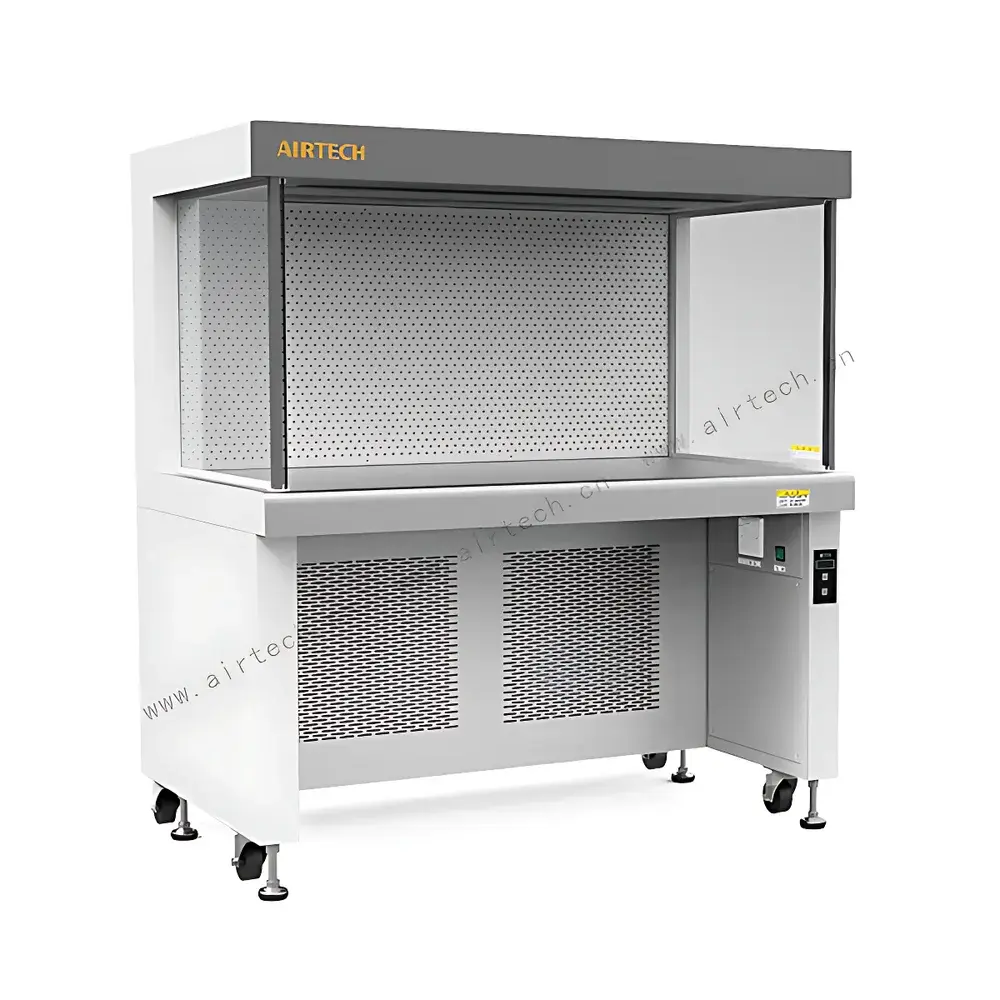
AIRTECH HS-II Series Horizontal Laminar Flow Clean Bench
| Brand | AIRTECH |
|---|---|
| Origin | Jiangsu, China |
| Manufacturer Type | Authorized Distributor |
| Country of Origin | China |
| Model Variants | HS-840-II, HS-1300-II, HS-840-U-II, HS-1300-U-II |
| Instrument Category | Horizontal Flow Clean Bench |
| Cleanliness Class | ISO Class 5 (equivalent to Federal Standard 209E Class 100 @ ≥0.5 µm) |
| Sound Pressure Level | ≤62 dBA |
| User Configuration | Single-user single-face or dual-user single-face |
| Airflow Pattern | Horizontal unidirectional laminar flow |
| Control Interface | Digital display with touch-sensitive keypad |
| Fan Speed | 3-step adjustable |
| UV Lamp Control | Programmable on/off scheduling |
| Runtime Monitoring | Real-time cumulative operating time for fan, UV lamp, and filter |
| Viewing Panels | Embedded tempered glass on both side walls |
| Work Surface | Seamless 304 stainless steel with front-radius edge design |
| Cabinet Material | Cold-rolled steel with ivory-white electrostatic powder coating |
| Structural Design | Aerodynamically optimized chassis minimizing airflow turbulence |
| Mobility System | Dual-mode casters (swivel + locking brake) with leveling feet |
| Pre-filter Access | Tool-free rapid replacement and washable design |
| Safety Interlock | UV lamp and lighting circuits mutually interlocked |
| Power Features | Integrated backup socket with power-fail protection |
| Factory Certification | Performed per ISO 14644-1, IEST-RP-CC002.3, and GB/T 25227–2010 performance validation protocols |
Overview
The AIRTECH HS-II Series Horizontal Laminar Flow Clean Bench is an engineered solution for non-sterile but particle-controlled laboratory environments requiring consistent ISO Class 5 (Federal Standard 209E Class 100) air quality at the work surface. Unlike vertical laminar flow hoods—where air descends vertically over the operator—the HS-II directs HEPA-filtered air horizontally across the work area, exiting toward the front of the unit. This horizontal airflow configuration minimizes turbulence-induced particle resuspension and provides optimal protection for sensitive samples during non-invasive procedures such as media preparation, electronics assembly, optical alignment, and routine microbiological handling where operator protection is not the primary objective. The bench complies with core cleanroom engineering standards including ISO 14644-1 for airborne particulate cleanliness classification and IEST-RP-CC002.3 for cleanbench performance testing. Its structural integrity, airflow uniformity, and material compatibility are validated through factory-based particle challenge tests, velocity mapping, and filter integrity verification prior to shipment.
Key Features
- Digital microprocessor-based control panel with intuitive touch-sensitive interface enabling precise three-stage fan speed adjustment—optimized for balancing airflow stability, noise reduction, and energy efficiency.
- Programmable ultraviolet germicidal irradiation (UVGI) system with user-defined schedule for automatic activation/deactivation; integrated runtime counter ensures traceable maintenance intervals per FDA-recommended UV lamp service life guidelines.
- Tempered glass side panels recessed into the cabinet frame provide unobstructed lateral visibility while maintaining structural rigidity and minimizing edge turbulence in the laminar zone.
- Monolithic 304 stainless steel work surface with radius-edged frontal contour—resistant to corrosion from common lab reagents, autoclavable, and compatible with ISO 14644-1 compliant cleaning protocols.
- Cold-rolled steel enclosure finished with antimicrobial electrostatic powder coating (ivory white RAL 1015), tested per ASTM D3359 for adhesion and ISO 20567-1 for resistance to microbial colonization.
- Aerodynamic chassis geometry reduces boundary-layer separation and maintains laminar uniformity across the full working plane (≥0.45 m/s ±20% across 85% of cross-section per IEST-RP-CC002.3).
- Modular pre-filter assembly designed for tool-free removal, rinsing, and reinstallation—reducing downtime and extending main HEPA filter service life by up to 40% under typical ambient conditions.
- Interlocked lighting and UV circuits prevent simultaneous operation, eliminating inadvertent UV exposure risk; redundant power management includes a dedicated GFCI-protected outlet with brownout safeguard.
Sample Compatibility & Compliance
The HS-II Series supports open-container handling of non-hazardous biological, pharmaceutical, and materials science samples where environmental particulate control—not personnel containment—is the operational priority. It is routinely deployed in QC laboratories performing USP compounding support tasks, ISO/IEC 17025-accredited calibration sample staging, and semiconductor packaging pre-assembly. All units undergo full compliance verification against GB/T 25227–2010 (Chinese national standard for clean benches), ISO 14644-1:2015 Annex B for classification testing, and IEST-RP-CC002.3 for airflow characterization. Documentation includes certified test reports for filter integrity (DOP/PAO scan), face velocity distribution, and sound pressure level measurement—available upon request for audit readiness.
Software & Data Management
While the HS-II operates via embedded hardware controls without cloud connectivity, its digital interface logs cumulative operational metrics—including fan motor hours, UV lamp exposure duration, and pre-filter usage cycles—stored in non-volatile memory. These parameters are accessible via the front-panel display and support GLP-compliant recordkeeping when manually transcribed into laboratory notebooks or LIMS. Optional RS-485 serial output (available on U-series models) enables integration with building management systems (BMS) for centralized monitoring of uptime, filter status alerts, and predictive maintenance scheduling aligned with ISO/IEC 17025 clause 6.4.2 requirements.
Applications
- Preparation of culture media and buffer solutions in microbiology and cell biology labs.
- Assembly and inspection of precision optical components and MEMS devices.
- Handling of non-pathogenic recombinant DNA constructs during cloning workflows.
- Staging of reference standards and certified reference materials (CRMs) prior to analytical instrument use.
- Electronics prototyping and soldering of high-reliability PCBs in R&D environments.
- Non-sterile packaging operations for medical device components under ISO 13485 Annex C guidance.
FAQ
What ISO class does the HS-II achieve at the work surface?
It delivers sustained ISO Class 5 (≤3,520 particles/m³ ≥0.5 µm) across the entire work plane under standard operating conditions.
Is the unit suitable for handling BSL-2 organisms?
No—it provides product protection only, not personnel or environmental protection; vertical laminar flow hoods or biosafety cabinets are required for BSL-2 applications.
How often should the HEPA filter be replaced?
Typical service interval is 3–5 years depending on ambient particulate load and pre-filter maintenance frequency; annual DOP testing is recommended per ISO 14644-3.
Can the HS-II be installed in a room without HVAC supply?
Yes—it is self-contained and recirculates filtered room air; however, ambient temperature must remain between 15–30°C and relative humidity below 70% to prevent condensation on internal surfaces.
Does it meet FDA 21 CFR Part 11 requirements?
The base model does not include electronic signature or audit trail functionality; however, its logged operational data may be incorporated into Part 11–compliant workflows when paired with validated external documentation systems.



