
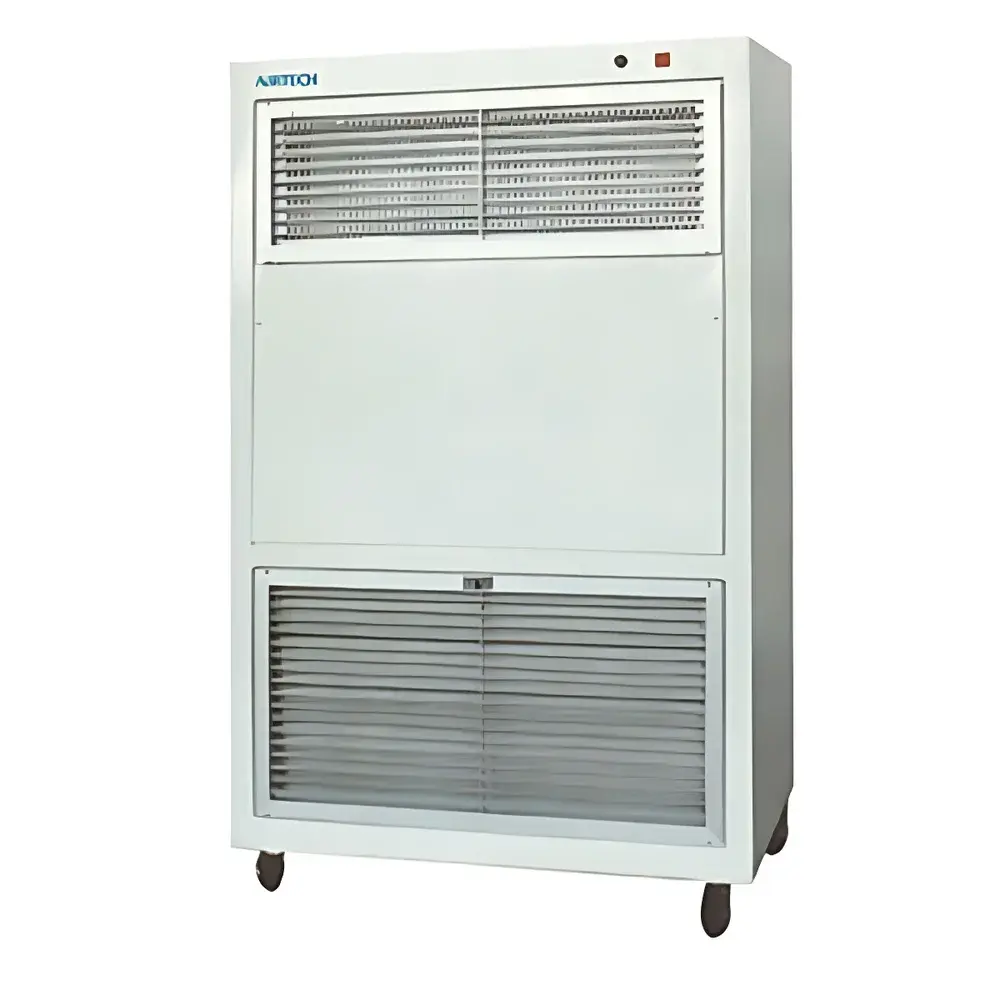
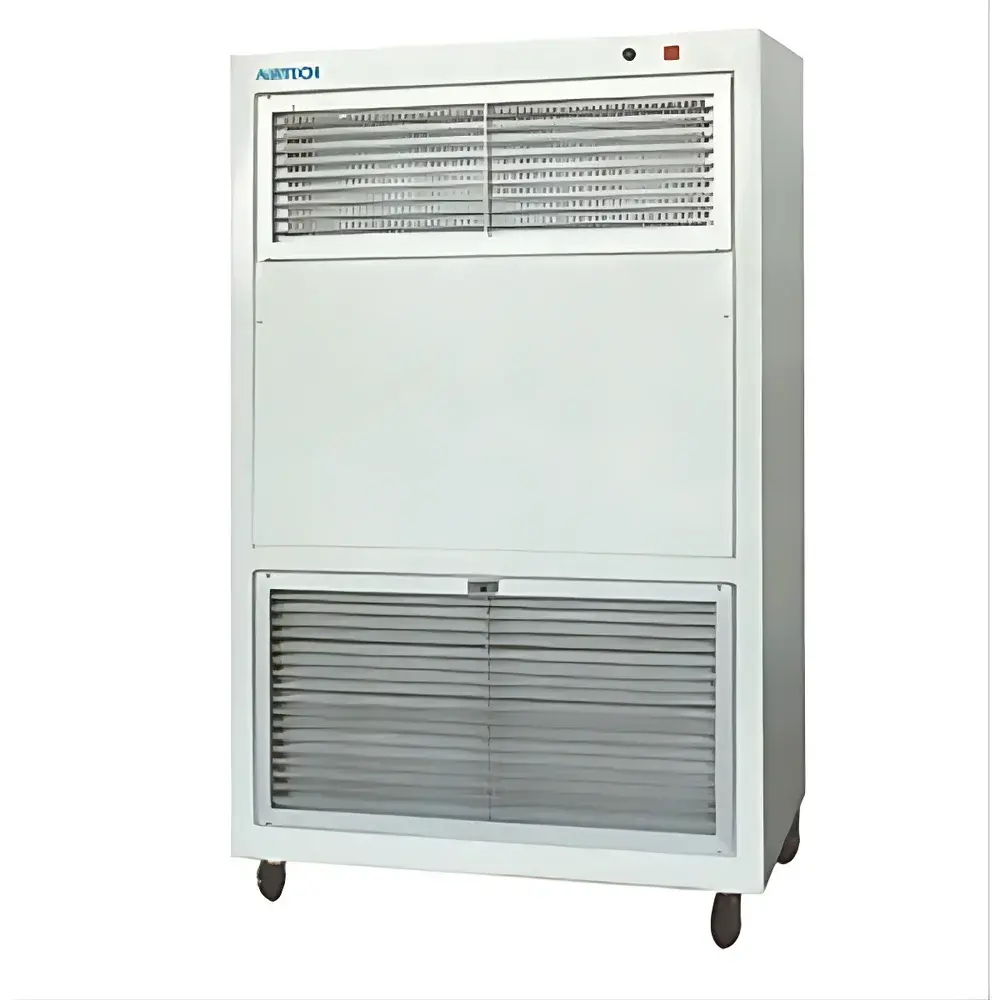
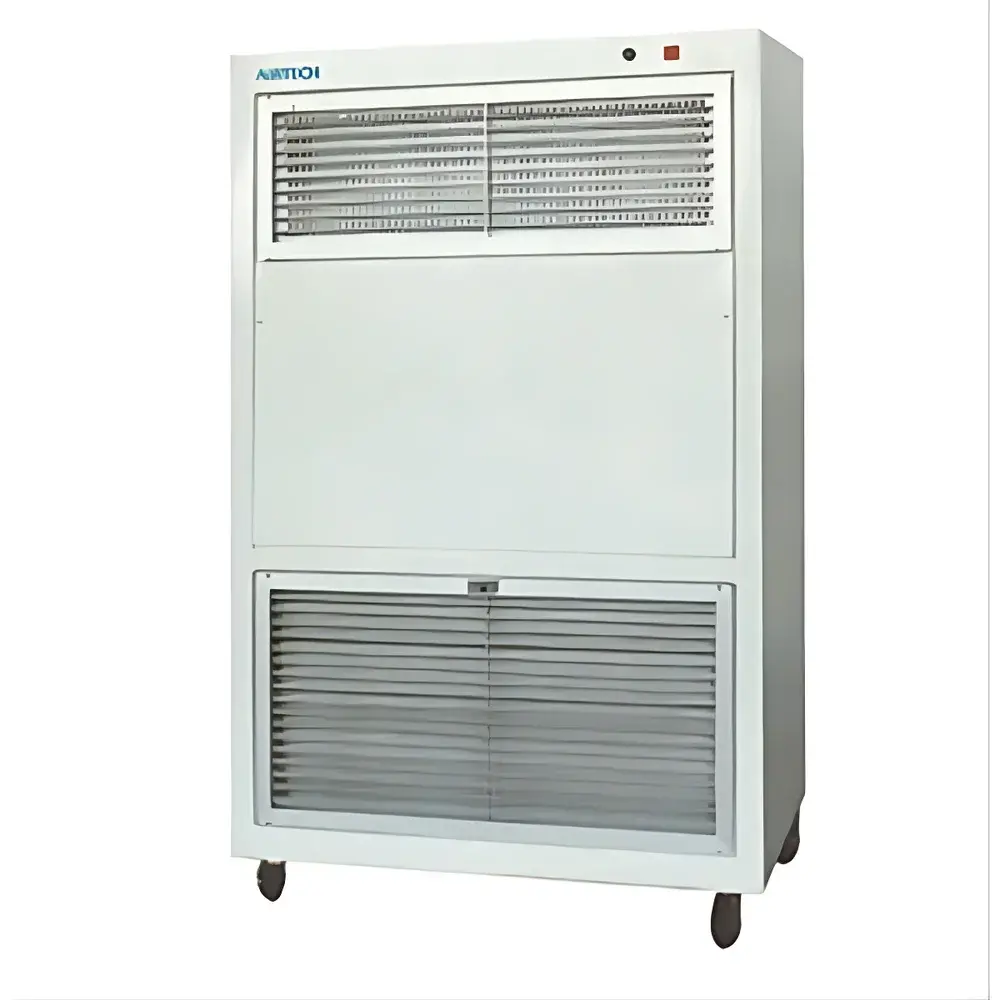
AIRTECH PAU-1000 Mobile Air Purification Unit
| Brand | AIRTECH (Sujing Antai) |
|---|---|
| Origin | Jiangsu, China |
| Manufacturer Type | Authorized Distributor |
| Country of Origin | China |
| Model | PAU-1000 |
| Quotation | Upon Request |
| Filtration Efficiency | ≥99.99% @ ≥0.3 µm |
| Airflow Rate | 1000 m³/h (adjustable) |
| Average Face Velocity | 1–2 m/s (adjustable) |
| Noise Level | ≤62 dB(A) |
| Dimensions (W×D×H) | 850 × 500 × 1340 mm |
| Power Supply | AC 220 V / 50 Hz |
| Rated Power Consumption | 300 W |
| Net Weight | 85 kg |
| HEPA Filter Specification | 720 × 610 × 90 mm × 1 unit |
Overview
The AIRTECH PAU-1000 Mobile Air Purification Unit is an engineered solution for localized clean air delivery in dynamic laboratory, pharmaceutical, and precision manufacturing environments. Designed around a variable-air-volume (VAV) centrifugal fan system, the unit operates on the principle of laminar airflow generation—drawing ambient air through a pre-filter stage, then forcing it through a single certified HEPA filter (ISO Class 5 compliant per ISO 14644-1 when installed in appropriate surroundings), and discharging purified air at a controlled face velocity. Its compact footprint and integrated mobility enable rapid deployment to critical work zones without structural modification—making it particularly suitable for ISO Class 5–7 transitional areas, QC testing benches, sterile compounding support stations, and R&D prototyping labs where permanent HVAC integration is impractical or cost-prohibitive.
Key Features
- Variable-speed dual-mode fan system enables precise control of face velocity between 1.0 and 2.0 m/s, optimizing particle capture efficiency while minimizing filter loading rate and extending HEPA service life.
- Manually adjustable aluminum louver assemblies at both supply and return grilles allow fine-tuning of airflow direction and distribution—critical for avoiding turbulence near sensitive instrumentation or open containment systems.
- Four swivel casters with locking brakes provide stable, low-effort repositioning across standard laboratory flooring; no anchoring or fixed ductwork required.
- Single-stage filtration architecture integrates one 720 × 610 × 90 mm HEPA filter (EN 1822-1:2019 H14 grade, ≥99.995% @ 0.3 µm MPPS) housed in a gasketed, leak-tested frame—ensuring integrity during transport and operation.
- Low-power consumption (300 W nominal) and acoustic optimization (<62 dB[A] at 1 m) support continuous operation in staffed environments without thermal or noise interference.
Sample Compatibility & Compliance
The PAU-1000 is not intended for direct sample processing but serves as an environmental control enabler for particulate-sensitive operations—including weighing of reference standards, preparation of microbiological media, handling of sterile APIs, and calibration of analytical balances. It complies with foundational cleanroom engineering references including ISO 14644-1 (airborne particle concentration limits), ISO 14644-3 (testing methods), and EU GMP Annex 1 (2022) provisions for localized air purification in Grade A/B background environments. While not certified for FDA 21 CFR Part 11 compliance (as it lacks digital audit trail functionality), its mechanical design supports GLP/GMP-aligned maintenance logging via external record-keeping systems. Filter replacement intervals must be validated per site-specific risk assessment and particle monitoring data—not time-based alone.
Software & Data Management
The PAU-1000 is a standalone, non-networked mechanical device with no embedded firmware, touchscreen interface, or data output capability. All operational parameters—including fan speed selection, louver positioning, and maintenance scheduling—are managed manually. This analog architecture eliminates cybersecurity exposure, reduces validation burden in regulated settings, and ensures deterministic behavior under electromagnetic interference (EMI)-prone conditions common near centrifuges or RF-emitting instruments. Users are advised to document filter installation dates, pressure differential readings (via optional external manometer), and visual inspection records in accordance with internal SOPs aligned with ISO/IEC 17025 or PIC/S guidance.
Applications
- Supplemental clean air coverage for ISO Class 5 laminar flow hoods during filter changeover or maintenance downtime.
- Temporary clean zones adjacent to analytical instrumentation (e.g., ICP-MS sample introduction areas, FTIR desiccated sample chambers).
- Mobile barrier protection for aseptic manipulations in hospital pharmacies or clinical trial material preparation suites.
- Particle mitigation during failure analysis in semiconductor packaging labs or MEMS assembly stations.
- Controlled environment support for ASTM D2248 (polymer film clarity testing) and USP Category 1–2 compounding workflows.
FAQ
Does the PAU-1000 meet ISO 14644-1 Class 5 requirements?
Yes—when installed in a controlled background environment (e.g., ISO Class 7 room) and operated at nominal face velocity (≥0.45 m/s), it achieves ≤3,520 particles/m³ ≥0.3 µm, satisfying ISO Class 5 criteria.
Can the unit be used in explosive atmospheres?
No—it lacks ATEX or IECEx certification and contains non-intrinsically safe electrical components.
Is filter integrity testing supported out-of-the-box?
The unit does not include a built-in upstream/downstream aerosol challenge port; however, its filter housing design permits standard DOP/PAO leak testing using external photometers per EN 1822-4.
What is the recommended filter replacement interval?
Filter life depends on ambient particle load; users must monitor initial pressure drop (typically ~120 Pa) and replace when ΔP exceeds 2× baseline or per site-specific PQ validation protocol.
Does the PAU-1000 generate positive or negative pressure?
It operates as a unidirectional supply-only unit—creating localized positive pressure relative to surrounding space, provided return air pathways are unobstructed.



