
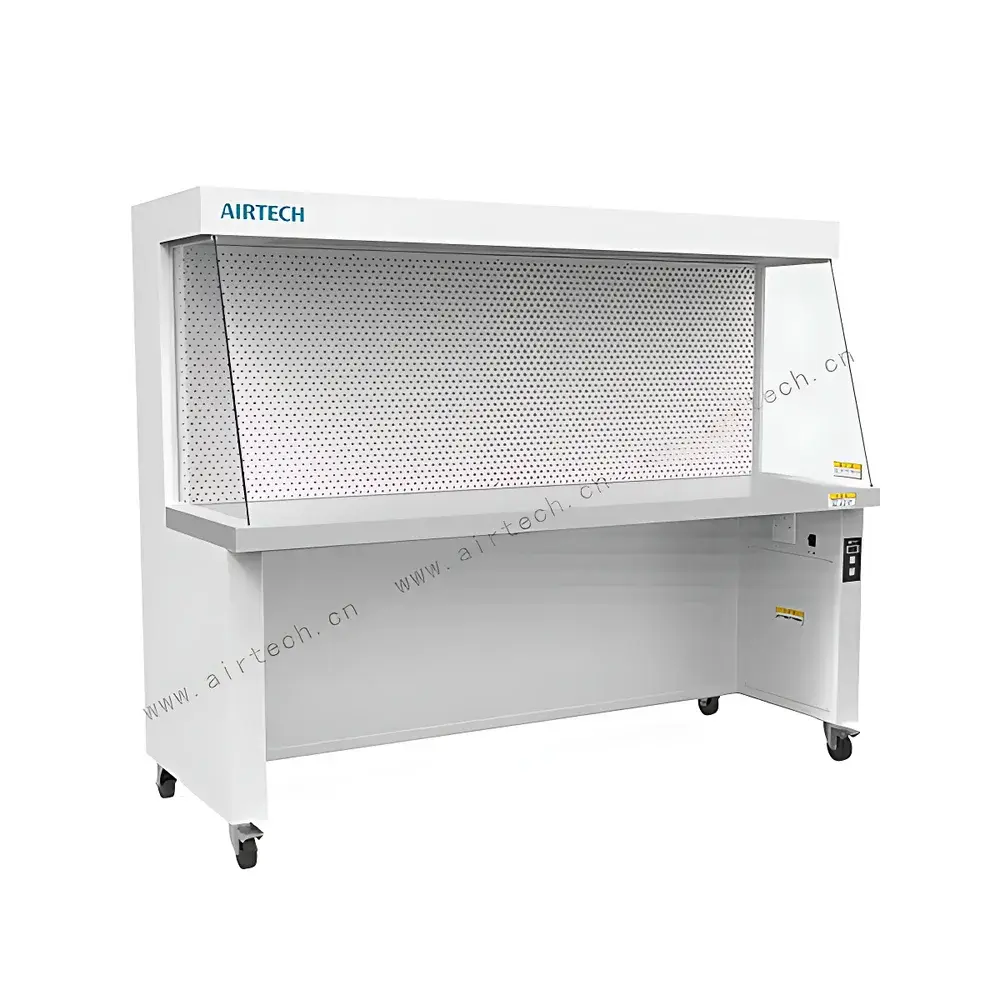
AIRTECH SW-CJ-II Series Horizontal Laminar Flow Clean Bench
| Brand | AIRTECH |
|---|---|
| Origin | Jiangsu, China |
| Manufacturer Type | Authorized Distributor |
| Product Category | Domestic |
| Models | SW-CJ-1B / SW-CJ-1BU / SW-CJ-1C / SW-CJ-1CU-II |
| Instrument Type | Horizontal Flow Clean Bench |
| Cleanliness Class | ISO Class 5 (100 @ ≥0.5 µm, per US Federal Standard 209E) |
| Noise Level | ≤62 dBA |
| User Configuration | Single- or Dual-Operator, Front-Access Only |
| Airflow Pattern | Horizontal Laminar Flow |
| Control Interface | Digital Display with Touch-Sensitive Keypad |
| UV Timer Function | Programmable On/Off Scheduling |
| Runtime Monitoring | Real-Time Accumulated Hours for Fan, UV Lamp, and Pre-Filter |
| Viewing Panels | Embedded Tempered Glass on Both Sides |
| Work Surface | Seamless Stainless Steel (AISI 304) |
| Enclosure Material | Cold-Rolled Steel with Ivory White Electrostatic Powder Coating |
| Structural Design | Aerodynamically Optimized Cabinet Profile |
| Mobility System | Locking Swivel Casters (360° Rotation) |
| Pre-Filter Access | Tool-Free Quick-Release Mechanism |
| Safety Interlock | UV Lamp Deactivation When Lighting Circuit Is Active |
| Power Protection | Built-in Backup Socket with Emergency Power-Off Capability |
| Compliance | Factory-Tested per GB/T 25227–2010 (Chinese National Standard for Clean Benches), Meets IEC 61010-1 Safety Requirements for Laboratory Equipment |
Overview
The AIRTECH SW-CJ-II Series Horizontal Laminar Flow Clean Bench is an ISO Class 5-certified containment system engineered for non-hazardous applications requiring unidirectional, particle-free airflow across the work surface. Unlike vertical flow hoods, this bench utilizes a horizontal laminar air pattern—air is drawn through a pre-filter, conditioned by a high-efficiency centrifugal fan, then passed through a HEPA filter (≥99.99% @ 0.3 µm) before exiting uniformly across the entire work area at a controlled velocity (typically 0.3–0.5 m/s). This configuration ensures minimal turbulence and optimal protection of sensitive samples—such as cell cultures, microbiological media, semiconductor wafers, and sterile pharmaceutical preparations—from airborne particulate contamination. Designed for installation in ISO Class 7 or cleaner ambient environments, the SW-CJ-II complies with core performance criteria outlined in GB/T 25227–2010 and aligns with international safety benchmarks defined in IEC 61010-1 for laboratory electrical equipment.
Key Features
- Digital control interface with touch-sensitive keypad enabling three-step fan speed adjustment—optimized for balancing airflow stability, noise reduction, and energy efficiency.
- Programmable UV lamp scheduler: users define start/end times for germicidal irradiation, minimizing manual intervention and ensuring consistent decontamination cycles.
- Real-time operational logging: integrated microcontroller records cumulative runtime for the main blower, UV lamp, and pre-filter—supporting preventive maintenance planning and GLP-compliant recordkeeping.
- Tempered glass side panels embedded into the cabinet frame provide full lateral visibility without compromising structural integrity or airflow uniformity.
- Monolithic AISI 304 stainless steel work surface—electropolished and radius-curved at edges—to resist corrosion, inhibit microbial adhesion, and facilitate rapid wipe-down between procedures.
- Aerodynamic enclosure geometry minimizes eddy formation at corners and transitions, preserving laminarity across the full 1.2–1.8 m working width (model-dependent).
- Four-point locking swivel casters enable precise repositioning within shared lab spaces and secure immobilization during operation.
- Tool-free pre-filter access panel allows rapid removal, cleaning, or replacement—reducing downtime and extending HEPA filter service life.
- Interlocked lighting and UV circuits prevent simultaneous activation, eliminating operator exposure risk; backup power socket supports auxiliary instrumentation with integrated emergency cutoff.
Sample Compatibility & Compliance
The SW-CJ-II is validated for use with non-volatile, non-toxic biological and material science specimens—including bacterial and mammalian cell lines, agar plates, optical components, and precision calibration standards. It is not rated for chemical fume containment or biohazardous aerosol generation (e.g., BSL-2+ agents). All units undergo factory certification per GB/T 25227–2010, verifying airflow uniformity (±15% across work plane), particle count compliance (≤3,520 particles/m³ @ ≥0.5 µm), and sound pressure level (<62 dBA at 1 m). Electrical safety conforms to IEC 61010-1:2010, including dielectric strength, leakage current, and protective earthing requirements. While not FDA 21 CFR Part 11–validated out-of-the-box, audit-ready runtime logs and configurable UV scheduling support integration into GMP/GLP workflows when paired with site-specific SOPs.
Software & Data Management
The SW-CJ-II operates via embedded firmware without external PC dependency. All operational data—including fan hours, UV exposure duration, and pre-filter usage—are stored in non-volatile memory and displayed on the front-panel LCD. No proprietary software is required; however, timestamped runtime logs can be manually transcribed for inclusion in electronic lab notebooks (ELN) or quality management systems (QMS). Optional RS-485 serial output (available on BU/CU variants) enables integration with building management systems (BMS) or centralized monitoring platforms for facility-wide environmental tracking.
Applications
- Aseptic transfer of primary cell isolates and stem cell lines in academic and contract research laboratories.
- Preparation of culture media, reagent aliquoting, and plate seeding under low-particulate conditions.
- Assembly and inspection of microfluidic devices and MEMS sensors where sub-micron debris must be excluded.
- Quality control testing of medical device packaging materials per ISO 11607.
- Calibration of particle counters and optical interferometers in metrology labs.
- Electronics prototyping involving solder paste application and fine-pitch component placement.
FAQ
Is the SW-CJ-II suitable for handling hazardous biological agents?
No. This unit provides personnel and product protection only—not cross-contamination or inhalation hazard protection. Use certified Class II biosafety cabinets for BSL-2 or higher work.
What HEPA filter specifications are supported?
Standard configuration includes a 610 × 610 × 90 mm H14-grade HEPA filter (EN 1822), replaceable every 12–24 months depending on ambient air quality and usage frequency.
Can runtime data be exported digitally?
Not natively. Data remain on-device but may be recorded manually or captured via optional RS-485 interface using third-party SCADA or LabVIEW drivers.
Does the unit meet ISO 14644-1 classification requirements?
Yes—verified ISO Class 5 (equivalent to FED-STD-209E Class 100) performance is documented in the factory test report supplied with each unit.
What maintenance intervals are recommended for the pre-filter?
Inspect weekly; clean with isopropyl alcohol biweekly; replace quarterly—or more frequently in high-dust environments—to maintain HEPA service life and airflow consistency.



