
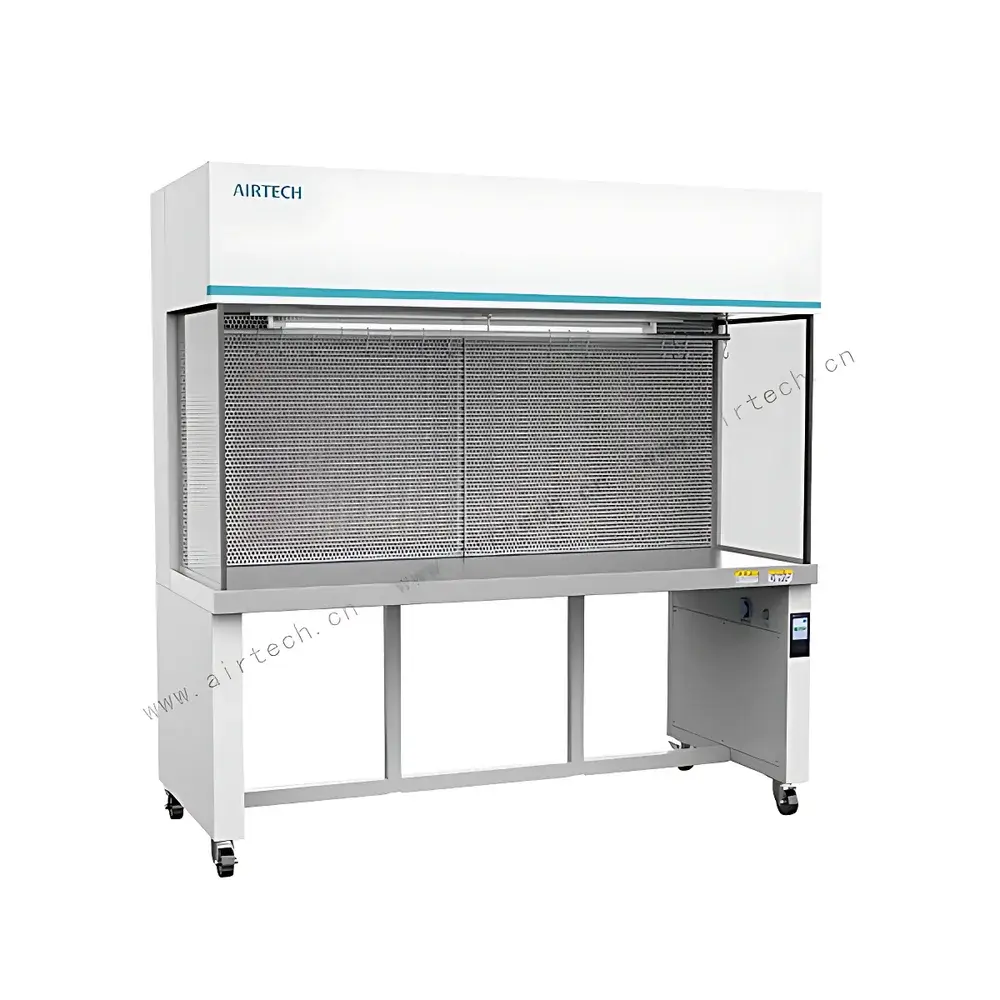
AIRTECH SW-CJ Series Horizontal Laminar Flow Clean Benches
| Brand | AIRTECH |
|---|---|
| Origin | Jiangsu, China |
| Manufacturer Type | Authorized Distributor |
| Country of Origin | China |
| Model Variants | SW-CJ-1B, SW-CJ-1BU, SW-CJ-1C, SW-CJ-1CU |
| Instrument Category | Horizontal Flow Clean Bench |
| Cleanliness Class | ISO Class 5 (100 @ ≥0.5 µm, per US Federal Standard 209E) |
| Noise Level | ≤62 dBA |
| User Configuration | Single-user single-face or dual-user single-face |
| Airflow Pattern | Horizontal laminar flow |
| Regulatory Compliance | YY/T 1539–2017 (CFDA Medical Device Standard), Class II Medical Device Registration Certificate |
Overview
The AIRTECH SW-CJ Series Horizontal Laminar Flow Clean Benches are engineered for precision-controlled, particle-free work environments in pharmaceutical compounding, aseptic preparation, cell culture support, and diagnostic reagent handling. Operating on the principle of unidirectional horizontal laminar airflow—generated by a low-turbulence, high-efficiency centrifugal blower and conditioned through a pre-filter and a certified HEPA filter (≥99.995% @ 0.3 µm)—these clean benches deliver ISO Class 5 (formerly Federal Standard 209E Class 100) air quality across the entire work surface. Unlike vertical flow units, the horizontal configuration directs filtered air parallel to the work surface, minimizing turbulence-induced cross-contamination and offering optimal protection for non-hazardous samples and personnel-facing operations. Designed and validated in accordance with YY/T 1539–2017, each unit carries a CFDA-registered Class II medical device certification, affirming its suitability for clinical-grade sterile preparations—including intravenous admixture services.
Key Features
- Horizontal laminar airflow architecture optimized for sample integrity and operator ergonomics in non-hazardous aseptic tasks.
- Integrated high-resolution color LCD touchscreen interface with real-time monitoring of inflow velocity, HEPA filter differential pressure, operational status, and system fault diagnostics.
- Intelligent variable-air-volume (VAV) control system delivering stable face velocity (typically 0.3–0.5 m/s) while maintaining energy efficiency and acoustic performance (≤62 dBA).
- Interlocked LED illumination and UV germicidal lamp circuitry: UV activation is automatically disabled when the sash is open or lighting is engaged, complying with IEC 61000-6-4 electromagnetic compatibility and IEC 62471 photobiological safety standards.
- Dedicated IV bag suspension rod integrated into the rear panel—designed specifically for gravity-fed or pump-assisted parenteral admixture workflows in hospital pharmacy settings.
- Rigorous factory acceptance testing per YY/T 1539–2017 Annex B: Each unit undergoes individual verification of airflow uniformity, filter integrity (via PAO/HEPA scan test), noise emission, electrical safety (IEC 61010-1), and cabinet structural integrity prior to shipment.
Sample Compatibility & Compliance
The SW-CJ series is intended for applications involving non-toxic, non-volatile, and non-pathogenic materials where personnel protection is not required—but product sterility must be preserved. It supports routine handling of Petri dishes, tissue culture flasks, vials, syringes, and infusion bags. Units are compliant with YY/T 1539–2017 (China’s national standard for medical clean benches), and their design principles align with ISO 14644-1 (cleanroom classification), ISO 14644-3 (testing methods), and EU GMP Annex 1 (2022) recommendations for aseptic processing zones. While not rated for containment of biohazards or volatile chemicals, the bench’s horizontal flow profile ensures minimal recirculation and consistent particle removal—critical for GLP-compliant analytical sample preparation and QC release testing in regulated pharmaceutical environments.
Software & Data Management
The embedded control firmware supports audit-ready operational logging: timestamps, filter runtime hours, UV exposure duration, alarm events (e.g., low airflow, filter clogging, door interlock breach), and manual mode overrides are recorded internally with non-volatile memory retention. Data export is available via USB port in CSV format for integration into laboratory information management systems (LIMS) or quality documentation archives. The system architecture adheres to ALCOA+ principles (Attributable, Legible, Contemporaneous, Original, Accurate, Complete, Consistent, Enduring, Available) and supports 21 CFR Part 11–compliant user access controls when deployed within validated IT infrastructures.
Applications
- Aseptic preparation of intravenous admixtures and total parenteral nutrition (TPN) formulations in hospital pharmacies.
- Microbiological media pouring, colony isolation, and non-pathogenic strain maintenance.
- Electronics assembly requiring particulate-free soldering or optical component handling.
- Quality control sampling and stability testing under controlled environmental conditions.
- Preparation of calibration standards and reference materials for analytical instrumentation (e.g., HPLC, GC-MS).
FAQ
Is the SW-CJ series suitable for handling hazardous biological agents or volatile solvents?
No. This is a clean bench—not a biosafety cabinet. It provides product protection only and does not protect the operator from aerosols or vapors.
What filter certification standard is applied to the HEPA units?
All HEPA filters are tested and certified to EN 1822-1:2019 (H14 class) or equivalent, with full-scan integrity verification performed at the factory using polyalphaolefin (PAO) challenge aerosol.
Can the unit be integrated into a facility-wide building management system (BMS)?
While native BACnet or Modbus RTU interfaces are not included, analog 0–10 VDC outputs for airflow and alarm status are available upon request for third-party BMS integration.
Does the unit meet FDA or EU regulatory expectations for GMP environments?
Yes—when operated and maintained per YY/T 1539–2017 and aligned with ISO 14644-1/3, it satisfies foundational requirements for Grade A local environments referenced in EU GMP Annex 1 and USP /. Full qualification (IQ/OQ/PQ) must be conducted on-site per facility SOPs.
What is the recommended maintenance schedule for the pre-filter and HEPA filter?
Pre-filters should be inspected monthly and replaced every 3–6 months depending on ambient particulate load; HEPA filters require annual integrity testing and typically last 5–7 years under normal use conditions.



