
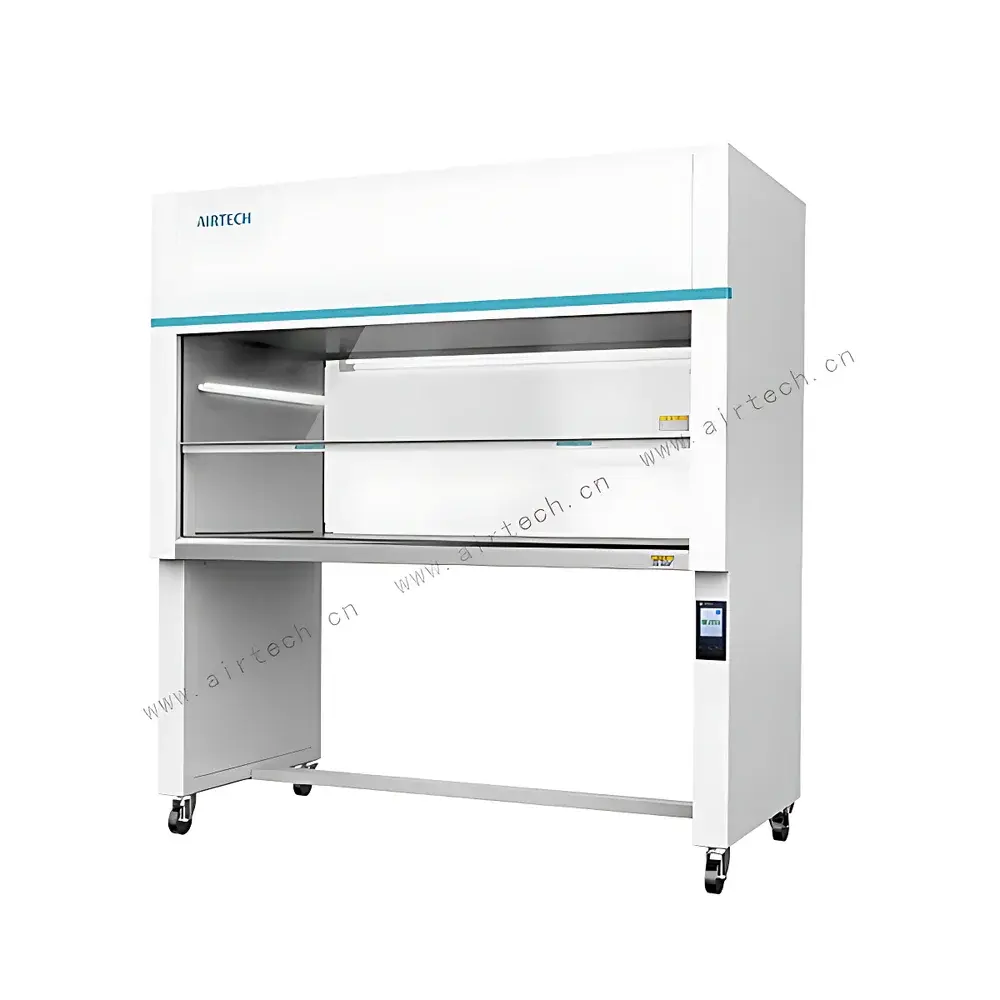
AIRTECH SW-CJ Series Vertical Laminar Flow Clean Benches
| Brand | AIRTECH |
|---|---|
| Origin | Jiangsu, China |
| Manufacturer Type | Authorized Distributor |
| Product Category | Domestic |
| Models | SW-CJ-1F, SW-CJ-1FD, SW-CJ-2F, SW-CJ-2FD |
| Instrument Type | Vertical Flow Clean Bench |
| Cleanliness Class | ISO Class 5 (100 @ ≥0.5 µm, per US Federal Standard 209E) |
| Noise Level | ≤62 dBA |
| User Configuration | Single-Operator Single-Face, Single-Operator Dual-Face, Dual-Operator Single-Face, Dual-Operator Dual-Face |
| Airflow Pattern | Vertical Downflow |
| Regulatory Compliance | YY/T 1539–2017 (China CFDA Medical Clean Bench Standard), Class II Medical Device Registration Certificate Issued |
Overview
The AIRTECH SW-CJ Series Vertical Laminar Flow Clean Benches are engineered for precision-controlled, particle-free work environments in pharmaceutical laboratories, clinical microbiology units, cell culture facilities, and medical device manufacturing cleanrooms. These units operate on the principle of unidirectional vertical laminar airflow—generated by a low-turbulence, high-efficiency centrifugal blower—directed downward through a certified HEPA filter (≥99.995% efficiency at 0.3 µm). The resulting ISO Class 5 (formerly Fed Std 209E Class 100) environment ensures that airborne particulates ≥0.5 µm are continuously removed from the working area at a uniform face velocity, minimizing cross-contamination during aseptic manipulations. Designed and validated in accordance with YY/T 1539–2017—the Chinese national standard for medical-grade clean benches—the SW-CJ series is registered as a Class II medical device under China’s CFDA (now NMPA) regulatory framework, affirming its suitability for clinical specimen handling, sterile compounding, and diagnostic reagent preparation.
Key Features
- Vertically oriented laminar airflow architecture with adjustable, motorized sash window system enabling precise ergonomic positioning across operational height ranges—eliminating manual force requirements and enhancing operator safety.
- Monolithic, front-curved stainless steel work surface (304 grade) fabricated via seamless deep-drawing process; non-porous, corrosion-resistant, and compliant with ISO 14644-1 surface cleanliness verification protocols.
- Integrated 7-inch full-color LCD HMI with capacitive touch interface: real-time display of supply air velocity (m/s), HEPA filter differential pressure status, UV lamp operational hours, and multi-level fault diagnostics (e.g., airflow deviation >±15%, filter saturation, sash interlock breach).
- Energy-optimized variable-frequency drive (VFD) blower control—maintains stable face velocity (0.3–0.5 m/s typical) across filter life while reducing power consumption by up to 30% versus fixed-speed systems.
- Interlocked safety architecture: UV germicidal irradiation (254 nm) and sash position sensors are hardwired to prevent simultaneous operation; LED task lighting (≥600 lux at work plane) meets IEC 60598 photometric standards.
- Factory-certified performance validation: each unit undergoes full-scope testing—including airflow visualization (smoke wire method), particle count verification (ISO 14644-1 Annex B), sound pressure measurement (IEC 61672-1), and electrical safety compliance (GB 4793.1/IEC 61010-1).
Sample Compatibility & Compliance
The SW-CJ series accommodates standard laboratory workflows involving Petri dishes, T-flasks, microcentrifuge tubes, pipette tip boxes, and sterile instrument trays. Its vertical downflow design minimizes turbulence-induced dispersion when handling open biological samples or low-volatility solvents. All models meet YY/T 1539–2017 mechanical, electrical, and microbiological performance criteria—including microbial challenge testing using Bacillus subtilis spores and formaldehyde vapor decontamination cycle validation. While not classified as biosafety cabinets (BSCs), these clean benches are intended for non-hazardous, non-toxic applications where personnel and environmental protection are not primary concerns—making them appropriate for ISO Class 5 supporting areas under GMP Annex 1 and WHO TRS 961 guidance.
Software & Data Management
The embedded firmware supports audit-ready data logging: timestamps, sash position history, UV exposure duration, filter pressure drop trends, and alarm event logs (with priority tagging). Data export is available via USB 2.0 port in CSV format for integration into LIMS or electronic lab notebooks (ELN). The system complies with ALCOA+ principles for data integrity and supports basic 21 CFR Part 11 readiness through user-level access control (three-tier privilege model: Operator, Supervisor, Administrator) and immutable event logging—though full electronic signature functionality requires external validation per site-specific SOPs.
Applications
- Aseptic transfer of mammalian and insect cell lines in academic and industrial bioprocessing labs
- Preparation of sterile parenteral formulations and ophthalmic solutions under pharmaceutical GMP conditions
- Microbiological isolation and subculturing of clinical specimens in hospital diagnostic laboratories
- Assembly and inspection of Class III medical devices requiring ISO Class 5 ambient control
- QC testing of raw materials and excipients where particulate contamination must be excluded per USP <788>
- Supporting cleanroom gowning rooms and pass-through airlocks as auxiliary buffer zones
FAQ
Is the SW-CJ series certified for use in regulated pharmaceutical manufacturing?
Yes—units comply with YY/T 1539–2017 and hold Class II medical device registration; they are suitable for ISO Class 5 support zones under EU GMP Annex 1 and PIC/S guidance, provided risk assessments confirm no exposure to hazardous agents.
Can the unit be integrated into a building management system (BMS)?
Standard models feature isolated dry-contact relay outputs for alarm signaling; optional RS-485 Modbus RTU interface enables BMS integration for remote monitoring of critical status parameters.
What maintenance intervals are recommended for HEPA filters?
Filter replacement is determined by differential pressure monitoring—not calendar-based; typical service life ranges from 18–36 months depending on ambient air quality and daily operational hours.
Does the unit include validation documentation?
Each shipment includes a Factory Acceptance Test (FAT) report with signed calibration certificates for airflow, noise, and particle count—fully traceable to CNAS-accredited laboratories.
Are UV lamps compliant with IEC 62471 photobiological safety requirements?
Yes—UV-C emitters are fully shielded during normal operation; interlock design ensures zero UV exposure when sash is open above 50 mm, meeting Risk Group 1 classification per IEC 62471.



