
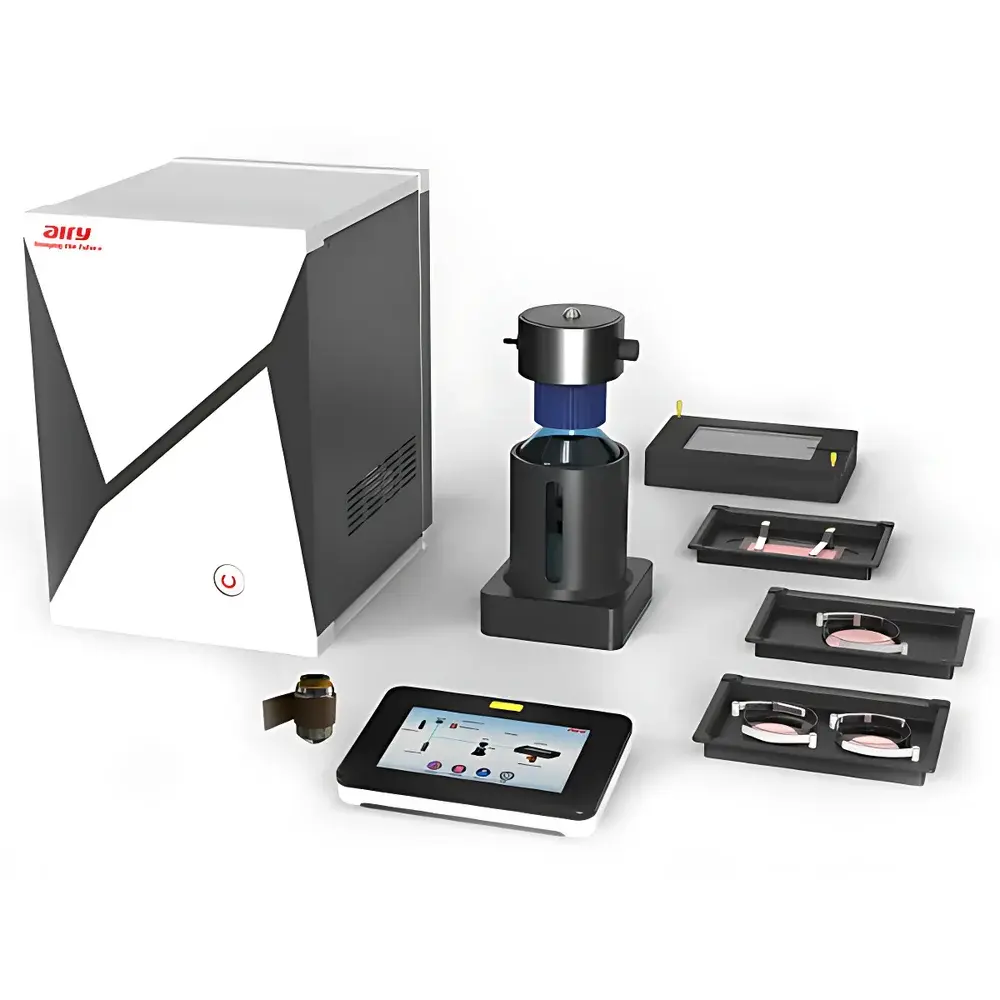
Airy MagiCube Stage-Top Live Cell Culture System
| Brand | Airy |
|---|---|
| Origin | Beijing, China |
| Manufacturer Type | Authorized Distributor |
| Product Origin | Domestic (China) |
| Model | MagiCube |
| Heating Method | Air-Jacketed |
| Cooling Method | Thermoelectric (Peltier) |
| Humidification Reservoir | External Water Tank |
| Temperature Range (with Humidification) | Ambient + 3°C to +40°C |
| Temperature Range (without Humidification) | Ambient + 3°C to +40°C |
| Temperature Uniformity | ±0.1°C |
| Relative Humidity Range | 65%–96% RH |
| Dimensions | Central Control Unit: 270 mm × 232 mm × 338 mm |
| Cell Culture Chamber (Base Model) | 159.5 mm × 109.5 mm × 22 mm |
| Humidification Module | 100 mm × 100 mm × 212 mm |
Overview
The Airy MagiCube Stage-Top Live Cell Culture System is an engineered microenvironment control platform designed for integration with inverted microscopes to support long-term, high-fidelity live-cell imaging experiments. Unlike conventional incubators that isolate samples from the optical path, the MagiCube operates directly on the microscope stage—maintaining precise spatiotemporal control of temperature, humidity, and ambient gas composition (when coupled with optional CO₂ modules) without obstructing optical access or compromising mechanical stability. Its core architecture leverages air-jacketed heating and thermoelectric (Peltier) cooling to achieve rapid thermal equilibration (<5 min to stabilize at setpoint) and exceptional thermal uniformity (±0.1°C), critical for minimizing thermal drift during time-lapse acquisition. The external humidification reservoir ensures stable relative humidity (65–96% RH) across extended durations, mitigating evaporation-induced osmotic stress in thin-layer culture formats such as glass-bottom dishes and microfluidic chambers.
Key Features
- Stage-integrated design compatible with standard inverted microscopes (Nikon Ti, Olympus IX, Zeiss Axio Observer series) via modular mounting brackets;
- Air-jacketed heating combined with bidirectional Peltier cooling enables active temperature regulation from ambient +3°C to +40°C with sub-degree stability;
- External water reservoir minimizes condensation risk inside the chamber and allows uninterrupted operation for >72 hours without refilling;
- Compact cell culture chamber (159.5 × 109.5 × 22 mm) optimized for low-volume media usage (as little as 200 µL) while ensuring laminar airflow distribution;
- Digital PID control loop with real-time feedback from dual platinum RTD sensors (one in chamber air, one adjacent to sample surface);
- Front-panel OLED interface with intuitive navigation and USB-C data logging capability for traceable environmental records;
- Modular expansion support for optional O₂/CO₂ gas mixing modules, perfusion adapters, and electrical grounding ports for electrophysiology-compatible configurations.
Sample Compatibility & Compliance
The MagiCube accommodates a broad range of live-cell substrates including 35 mm glass-bottom dishes, µ-Slide I/IV chambers (ibidi), Lab-Tek chambered coverglasses, and custom microfabricated devices. Its open-top chamber geometry permits unobstructed access for micromanipulation, patch-clamp electrodes, or multi-point stimulation probes. All wetted components are fabricated from medical-grade stainless steel and autoclavable polymers compliant with ISO 10993-5 cytotoxicity standards. Environmental control parameters adhere to ASTM E2927-21 guidelines for performance verification of stage-top incubation systems. Data logging functionality supports audit trails required under GLP and GMP-aligned workflows, with timestamped CSV export suitable for FDA 21 CFR Part 11–compliant documentation when paired with validated third-party LIMS integration.
Software & Data Management
The MagiCube operates independently via its embedded controller but also supports bidirectional communication through USB-C using the Airy Control Suite (v3.2+), a Windows-based application offering synchronized environmental logging alongside microscope metadata (e.g., exposure time, objective ID, Z-stack position). Logged parameters include chamber temperature, relative humidity, coolant duty cycle, and reservoir water level—each sampled at 1 Hz and stored with UTC timestamps. Exported datasets conform to MIAME-compliant structure and can be ingested directly into ImageJ/Fiji macros or Python-based analysis pipelines (e.g., napari, scikit-image). Firmware updates are delivered via signed binary packages verified using SHA-256 checksums to ensure integrity and traceability.
Applications
- Long-duration timelapse imaging of mitosis, cytokinesis, and organelle dynamics in primary neurons, iPSC-derived cardiomyocytes, and epithelial monolayers;
- Real-time monitoring of calcium flux, membrane potential, and FRET-based biosensor activity under physiological thermal/hygrometric conditions;
- High-content screening assays requiring multi-day phenotypic tracking under controlled microenvironments;
- Correlative light-electron microscopy (CLEM) workflows where minimal chamber footprint preserves EM grid accessibility;
- Development and validation of organ-on-chip platforms requiring dynamic environmental modulation during functional assessment.
FAQ
Can the MagiCube be used with upright microscopes?
No—the system is mechanically and thermally optimized for inverted microscope configurations only. Upright use would compromise heat dissipation and introduce optical path interference.
Is CO₂ control integrated into the base model?
CO₂ regulation is available as an add-on gas-mixing module (MagiCube-GM1), supporting 0–20% CO₂ with ±0.2% accuracy and independent humidity compensation.
What is the maximum recommended duration for unattended operation?
With a full external reservoir and stable ambient conditions (20–25°C, 40–60% RH), continuous operation up to 96 hours is validated per IEC 61000-4-30 power quality testing protocols.
Does the system meet electromagnetic compatibility (EMC) requirements for laboratory environments?
Yes—certified to EN 61326-1:2013 Class A for industrial/scientific equipment, with conducted and radiated emissions below CISPR 11 limits.
How is calibration traceability maintained?
Each unit ships with NIST-traceable calibration certificates for both temperature (ITS-90) and humidity (DIN EN ISO/IEC 17025), valid for 12 months under normal operating conditions.




