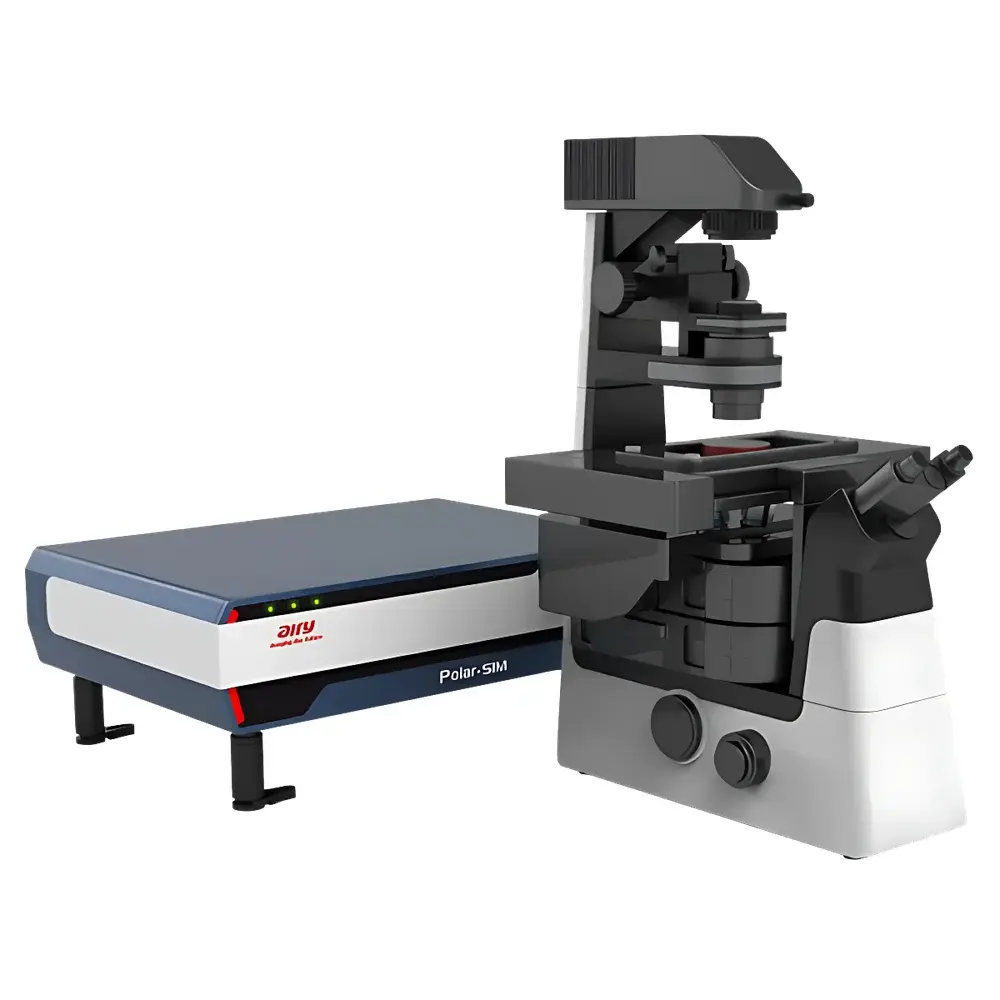
Airy Polar-SIM High-Fidelity Polarized Super-Resolution Microscopy System
| Brand | Airy |
|---|---|
| Origin | Beijing, China |
| Manufacturer Type | Authorized Distributor |
| Product Category | Domestic |
| Model | Polar-SIM |
| Pricing | Upon Request |
| Technology | Structured Illumination Microscopy (SIM) |
| Excitation Wavelength | Customizable |
| Resolution | XY: 85 nm (raw), <60 nm (algorithm-enhanced) |
| Z | 300 nm |
| Field of View | 130 × 104 µm (at 100× objective) |
| Imaging Speed | 565 fps @ 128 × 4096 |
| Eyepiece-Compatible Platforms | Nikon Ti2-E or Olympus IX83 (selectable) |
| Objectives | Apo 60×/NA=1.49, Apo 100×/NA=1.49, or NA=1.7 immersion objectives (optional) |
| Light Source | Customizable LED/Laser Engine |
Overview
The Airy Polar-SIM High-Fidelity Polarized Super-Resolution Microscopy System is an advanced optical platform engineered to extend structured illumination microscopy (SIM) beyond conventional spatial resolution limits—while simultaneously extracting molecular orientation information encoded in fluorescence polarization. Unlike standard widefield or even conventional SIM systems, Polar-SIM integrates a high-precision polarization modulation unit into the excitation path and a polarization-resolved detection architecture in the emission path. This dual-polarization capability enables quantitative measurement of dipole orientation, anisotropy, and rotational dynamics of fluorophores at sub-diffraction spatial scales. The system operates on the principle of polarization-modulated patterned illumination combined with phase-shifted image acquisition and vectorial reconstruction algorithms. It delivers isotropic lateral resolution down to <60 nm (post-processing enhanced) and axial resolution of 300 nm—fully compatible with live-cell imaging requirements including low phototoxicity, high temporal fidelity, and compatibility with common fluorescent proteins (e.g., mEGFP, mMaple, HaloTag ligands) and organic dyes (e.g., Alexa Fluor 488, ATTO 647N).
Key Features
- Integrated polarization-resolved SIM architecture: Simultaneous acquisition of intensity and orientation-resolved data across multiple illumination orientations.
- Algorithm-enhanced super-resolution reconstruction: Proprietary vector-SIM processing pipeline supports deconvolution-coupled polarization demodulation for artifact-suppressed, orientation-mapped images.
- Modular optical design: Compatible with industry-standard inverted microscope frames (Nikon Ti2-E and Olympus IX83), enabling seamless integration into existing core facility infrastructure.
- High-speed, low-noise imaging: Optimized synchronization between polarization modulator, pattern projector, and Hamamatsu ORCA-Flash4.0 V3 sCMOS camera enables frame rates up to 565 fps at reduced ROI dimensions—critical for tracking rapid intracellular events.
- Customizable excitation source: Supports interchangeable LED modules or laser combiners (405–730 nm range) with precise polarization purity control (>99.5% extinction ratio).
- Thermally stabilized optical train: Active drift compensation and vibration-isolated baseplate ensure long-term stability during time-lapse polarization mapping experiments.
Sample Compatibility & Compliance
Polar-SIM is validated for use with fixed and live biological specimens—including adherent mammalian cells (HEK293T, U2OS, primary neurons), tissue slices (≤100 µm thick), and cleared whole-mount samples (e.g., CLARITY-processed brain sections). Its non-destructive, low-dose illumination strategy meets widely adopted criteria for live-cell compatibility under ISO 20595:2019 (Microscopy — Requirements for super-resolution fluorescence microscopes). All hardware control firmware and acquisition software comply with IEC 62304 Class B medical device software standards where applicable. Data provenance, user access logs, and parameter audit trails are maintained in accordance with GLP/GMP-aligned workflows and support FDA 21 CFR Part 11 electronic record requirements when deployed in regulated research environments.
Software & Data Management
The Polar-SIM Control Suite (v3.2+) provides unified control of illumination polarization states, grating phase stepping, camera triggering, and real-time polarization vector calculation. Raw datasets are saved in standardized OME-TIFF format with embedded metadata per OME-XML schema (v2022-06). Polarization analysis modules include: (i) orientation angle mapping (0–180°), (ii) degree of linear polarization (DOLP) quantification, (iii) time-resolved anisotropy decay fitting, and (iv) co-localization-aware dipole correlation analysis. Export options include HDF5 for MATLAB/Python integration and CSV-compatible tables for statistical modeling. All processing pipelines are scriptable via Python API and support batch execution on HPC clusters.
Applications
- Subcellular cytoskeletal organization: Mapping actin filament alignment and myosin motor polarity in migrating cells with nanoscale angular precision.
- Mitochondrial cristae dynamics: Resolving membrane curvature-dependent fluorescence polarization shifts during fission/fusion cycles.
- Chromatin nanoarchitecture: Correlating histone modification-specific labeling orientation with local chromatin compaction states in interphase nuclei.
- Synaptic vesicle docking geometry: Quantifying SNARE protein dipole orientation changes pre- vs. post-stimulation in primary hippocampal cultures.
- Extracellular matrix fiber alignment: Combining Polar-SIM with second-harmonic generation (SHG) for multimodal structural–orientational phenotyping in tumor stroma models.
FAQ
Does Polar-SIM require specialized fluorophores?
No—standard dipole-emitting fluorophores (e.g., GFP derivatives, Cy dyes, ATTO dyes) are fully supported. Orientation sensitivity arises from intrinsic transition dipole moment alignment, not chemical modification.
Can Polar-SIM be upgraded from an existing SIM system?
Yes—Airy offers field-installable Polarization Integration Kits (PIK-100) for select commercial SIM platforms (Nikon N-SIM E, OMX v4), subject to optical train compatibility assessment.
Is real-time polarization rendering available during acquisition?
Yes—the Control Suite provides GPU-accelerated live orientation heatmap overlay at ≤15 fps for full-frame 2048×2048 acquisitions.
What level of training and application support is provided?
Airy delivers on-site installation commissioning, two-day hands-on operator training, and quarterly remote application workshops focused on polarization-aware experimental design and data interpretation.
How is calibration traceability maintained?
Each system ships with NIST-traceable polarization reference slides (SRM 2069a) and automated daily calibration routines that validate modulation depth, grating alignment, and detector polarization crosstalk (<0.8% residual coupling).
Related Products